Female Participation in IIT Admissions Hits Record High as Over 10000 Girls Qualify for JEE Advanced 2026 Counselling
Number of qualified female candidates more than doubles in a decade; girls account for 17.76% of successful candidates in 2026

Nitin Kukreja, CEO of ALLEN Career Institute, said the increasing participation of girls in engineering education was a positive development for the country's future and reflected broader social change.


Kota: Female participation in India’s premier engineering entrance examination has reached a new milestone, with a record 10,107 girls qualifying for JEE Advanced 2026 counselling, marking the highest-ever number of female candidates eligible for admission to the Indian Institutes of Technology (IITs).
According to data released following the JEE Advanced 2026 results, girls accounted for 17.76 per cent of all qualified candidates this year. The figure represents a significant increase from 4,570 girls who qualified in 2016, reflecting a more than twofold rise over the past decade.
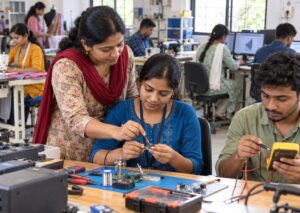
The trend also highlights the growing interest among female students in engineering and technology disciplines, particularly in emerging fields such as artificial intelligence, machine learning and computer science.
Among the top performers this year was Arohi Deshpande of ALLEN Career Institute, Kota, who emerged as the All India Girl Topper with an All India Rank of 77. The institute reported that 1,044 of its female students qualified for JEE Advanced counselling this year.
Nitin Kukreja, CEO of ALLEN Career Institute, said the increasing participation of girls in engineering education was a positive development for the country’s future and reflected broader social change. He attributed the trend to growing awareness, improved access to opportunities and increasing acceptance of technical careers among young women.
Experts point to several factors behind the steady rise in female participation. One of the most significant has been the introduction of the supernumerary quota for women in IIT admissions. Introduced in 2018, the scheme initially provided an additional 14 per cent female-only seat pool, which was subsequently increased to 17 per cent in 2019 and 20 per cent from 2020 onwards.
The expansion of technology-driven career opportunities has also played a key role. While engineering was traditionally associated with disciplines such as civil, mechanical and electrical engineering, the rapid growth of information technology, software development, artificial intelligence and data science has made engineering more attractive to female students seeking high-growth career options.
Growing awareness in smaller towns and rural areas has further contributed to the trend. The success of students from non-metropolitan backgrounds in securing IIT admissions and lucrative career opportunities has encouraged more girls to pursue engineering entrance examinations.
Kota, India’s largest coaching hub for engineering and medical entrance examinations, currently hosts more than 50,000 female students preparing for competitive examinations, reflecting the scale of women’s participation in the country’s higher education aspirations.
The number of girls registering for JEE Advanced has also continued to rise steadily, increasing from 27,778 in 2016 to 43,112 in 2026. The latest results suggest that female representation in India’s premier engineering institutions is likely to continue its upward trajectory in the coming years.