Scientists find a ‘single flip’ to delay or prevent quantum entanglement loss
Scientists from RRI, the University of Calgary and Louisiana State University have shown that a precisely timed single flip can delay or even prevent quantum entanglement sudden death.
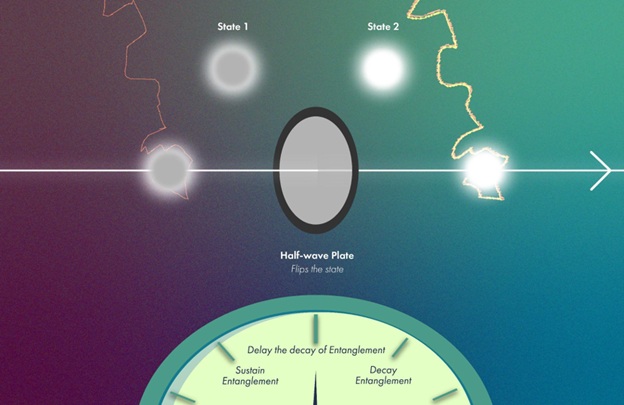
The placement of the operation can help control the decay of entanglement.

NEW DELHI: Scientists have demonstrated that a precisely timed flip operation can delay — and in some cases prevent — the sudden loss of quantum entanglement, offering a potential new way to extend the lifetime of fragile quantum information without changing quantum hardware.
The study was conducted by researchers from the Raman Research Institute (RRI), an autonomous institution of the Department of Science and Technology (DST), the University of Calgary and Louisiana State University. The work was partly funded through the National Quantum Mission.
Entanglement is a key resource in quantum systems, linking the states of particles even when they are physically separated. However, interactions with the environment can cause quantum systems to lose their coherence and entanglement.
A particularly striking phenomenon is known as “entanglement sudden death”, in which entanglement can disappear completely at a finite time, even before the underlying decay process itself has finished.
Timing becomes a control tool
The researchers used an optical experiment to mimic a two-level quantum system. They used the polarisation of light to represent two states: vertical polarisation as the excited state and horizontal polarisation as the ground state.
A waveplate, an optical device capable of changing the polarisation of light, was used to control the transition between these states.
Instead of allowing the excited-state population to undergo its natural decay, the researchers introduced a single, deliberately timed operation that swapped the populations of the ground and excited states.
The outcome depended critically on when the flip was applied during the decay process.
By selecting the appropriate timing, the researchers could delay the decay of the particles or, importantly, delay the loss of entanglement.
In certain conditions, the correctly timed flip could prevent entanglement sudden death altogether — a phenomenon the researchers describe as avoidance.
“Timing is not just an experimental detail; it can be a control resource,” said Urbasi Sinha, group leader of the Quantum Information and Computing (QuIC) lab at RRI and senior professor at the institute.
Saumya Ranjan Behera, quantum scientist at the QuIC lab and lead author of the study, said the timing of the single flip determines whether the operation can avoid, delay or hasten entanglement sudden death.
The study was published in Physical Review A in July.
One experiment bridges two noise models
The researchers also encountered an unexpected result while conducting the experiment.
The observed behaviour did not initially fit either of the two standard textbook models used to describe how quantum systems lose information to their environment.
The QuIC team spent almost a year examining different theoretical descriptions to understand the experimental observations.
The researchers eventually found that the experiment lay on the curve connecting the two theoretical frameworks. They identified a tuning parameter that allows the same experimental setup to move between the two frameworks and represent the different noise models and intermediate variants.
This means that rather than requiring separate experimental arrangements for the two models, a single setup can represent both depending on the value of the tuning parameter.
Potential significance for quantum computers
Quantum computers depend on preserving delicate quantum information for sufficiently long periods to perform useful computations. Environmental interactions can cause quantum information and entanglement to decay, creating one of the central challenges in quantum technology.
The experiment indicates that, under certain forms of environmental decay, the timing of an operation can itself become a resource for controlling the fate of entanglement.
The approach is particularly notable because it does not require a change to the underlying hardware. Instead, it relies on applying a carefully timed operation during the evolution of the quantum system.
The researchers say the finding could contribute to future strategies for managing fragile quantum links inside quantum computers and other quantum-information systems.