
India’s solar capacity crosses 162 GW as decade-long clean energy push enters a new phase
India has expanded its installed solar capacity more than 50-fold since 2014, with new policy initiatives, manufacturing growth and rooftop adoption positioning the country among the world's fastest-growing solar energy
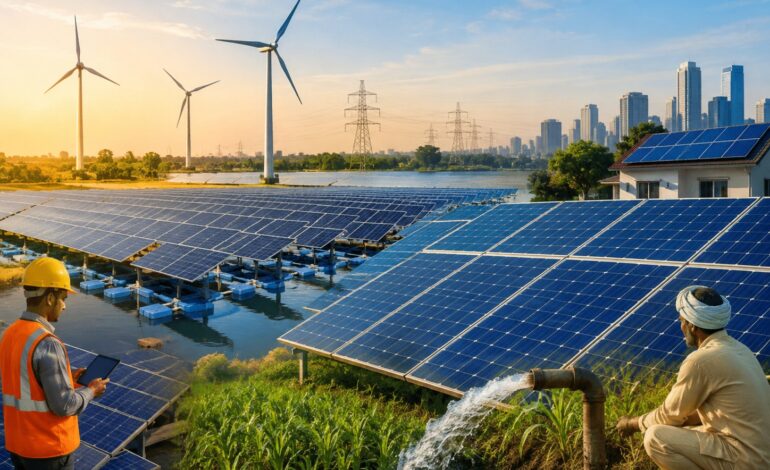
The Green Energy Corridor Programme has further strengthened transmission infrastructure, enabling the evacuation of more than 24,500 MW of renewable energy while improving grid integration for clean power.

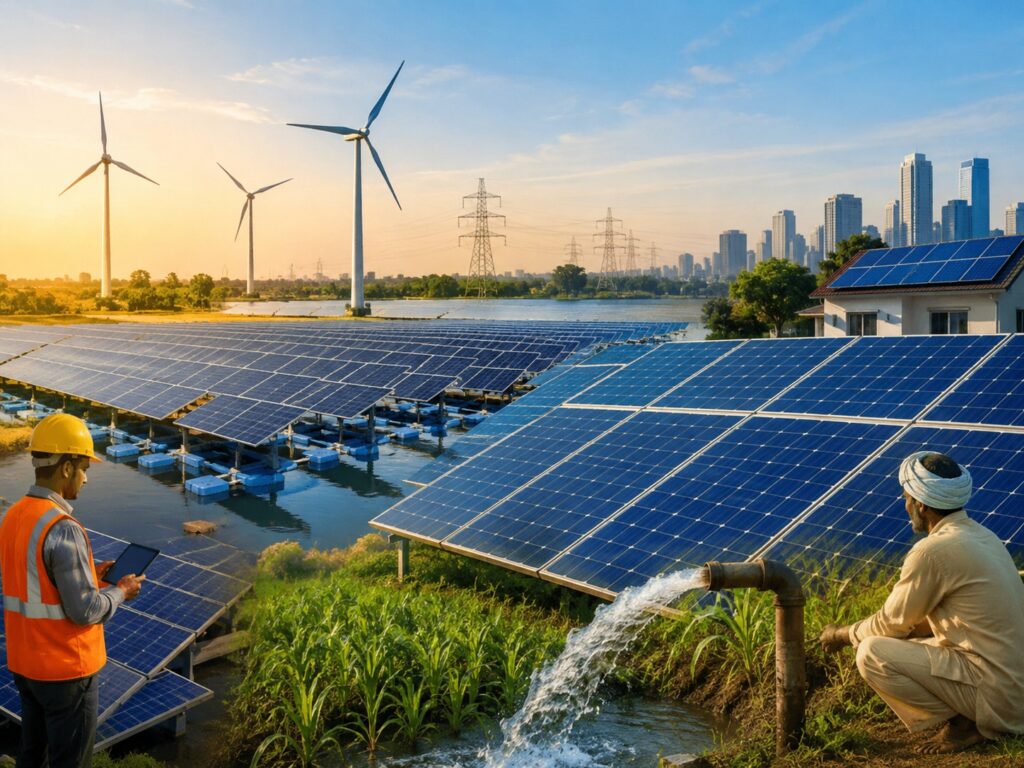
NEW DELHI: India’s solar energy sector has entered a new phase of growth, with installed solar capacity crossing 162 GW and a series of policy interventions accelerating the country’s transition towards clean energy, energy security and self-reliance.
A new background paper released by the government on Sunday highlights how India has transformed solar power from a niche energy source into the largest contributor to the country’s renewable energy capacity over the past decade. Installed solar capacity has grown from about 3 GW in 2014 to 162.15 GW as of June 30, 2026, representing an expansion of more than 50 times.
The latest milestone comes days after the Union Cabinet approved the Pradhan Mantri Surya Sarovar Yojana (PM-SSY), a flagship initiative that aims to develop 5,000 MW of floating solar capacity integrated with energy storage systems.
With an outlay of ₹5,070 crore, the scheme will be implemented between FY 2026-27 and FY 2030-31. It will support floating solar photovoltaic projects with co-located battery storage capable of supplying at least two hours of electricity, enabling states to better manage peak power demand while reducing pressure on scarce land resources.
The scheme is based on an assessment by the National Institute of Solar Energy, which estimates India’s floating solar potential at about 102 GW across reservoirs and inland water bodies. The government expects the initiative to reduce nearly 10 million tonnes of carbon dioxide emissions annually, create between 16,000 and 17,000 full-time equivalent jobs, and provide a major boost to domestic manufacturing of floating platforms, photovoltaic modules and energy storage systems.
According to the report, India added 37 GW of solar capacity during 2025, overtaking the United States in annual solar capacity additions and emerging as the world’s second-largest solar growth market.
During FY 2025-26 alone, the country added a record 44.61 GW of solar capacity, almost double the 23.83 GW added in the previous financial year. Total non-fossil fuel power capacity reached 283.46 GW, including 274.68 GW generated from renewable energy sources.
The rapid expansion has been supported by a comprehensive policy framework that includes the National Solar Mission, Solar Parks Scheme, Green Energy Corridor Programme, competitive tariff-based bidding, rooftop solar initiatives and solarisation programmes for agriculture.
Manufacturing capacity expands sharply
India has also witnessed remarkable growth in domestic manufacturing. Solar module manufacturing capacity has increased from just 2.3 GW in 2014 to nearly 172 GW by March 2026, supported by the Production Linked Incentive (PLI) Scheme and the Approved List of Models and Manufacturers (ALMM), aimed at reducing import dependence and strengthening domestic supply chains.
The PLI programme has attracted investments of around ₹35,000 crore while generating direct employment for about 10,000 people, further reinforcing India’s ambition to become a global manufacturing hub for clean energy technologies.
Solar reaches households and farms
The report highlights the growing contribution of distributed solar energy through flagship schemes such as PM Surya Ghar: Muft Bijli Yojana and PM-KUSUM.
Since its launch in February 2024, PM Surya Ghar has enabled more than 43 lakh households to install rooftop solar systems. The government has disbursed over ₹14,771 crore in central financial assistance, while more than 7.7 lakh households had achieved zero electricity bills by December 2025.
PM-KUSUM, which promotes solar energy in agriculture, has benefited more than 21.77 lakh farmers through solar-powered irrigation systems and feeder solarisation. Nearly 11.49 lakh standalone solar pumps have been installed, while over 15.89 lakh agricultural pumps have been covered under feeder-level solarisation.
Together, rooftop solar systems and agricultural solar initiatives contributed 16.3 GW—more than one-third of the country’s total solar capacity addition during FY 2025-26.
Affordable solar power and stronger infrastructure
Competitive bidding has significantly reduced solar tariffs in India over the past decade. Solar power prices have fallen from around ₹18 per unit in 2010 to a record low of ₹2.44 per unit, achieved during the Bhadla Solar Park auction in Rajasthan in 2017. According to the report, India’s utility-scale solar power now ranks among the cheapest in the world.
Infrastructure development has also accelerated through the Solar Parks Scheme, under which 54 solar parks with a combined sanctioned capacity of 39,188 MW have been approved across the country. Rajasthan and Gujarat account for the largest share of these projects, while states including Andhra Pradesh, Madhya Pradesh, Karnataka and Uttar Pradesh have also emerged as major solar power hubs.
The Green Energy Corridor Programme has further strengthened transmission infrastructure, enabling the evacuation of more than 24,500 MW of renewable energy while improving grid integration for clean power.
Global leadership in clean energy
Beyond domestic achievements, India continues to expand its international role through initiatives such as the International Solar Alliance (ISA) and the One Sun One World One Grid (OSOWOG) programme, promoting cross-border renewable energy cooperation and supporting the global clean energy transition.
The report concludes that sustained policy support, manufacturing expansion, improved infrastructure and growing public participation have positioned solar energy as a central pillar of India’s journey towards achieving its Panchamrit commitments and net-zero emissions target by 2070.