India’s first telecom manufacturing zone to come up in Gwalior with ₹493 crore Central support
A 350-acre integrated manufacturing hub in Madhya Pradesh aims to attract investments of up to ₹15,000 crore, create nearly 14,000 direct jobs, and strengthen India's ambitions to become a global
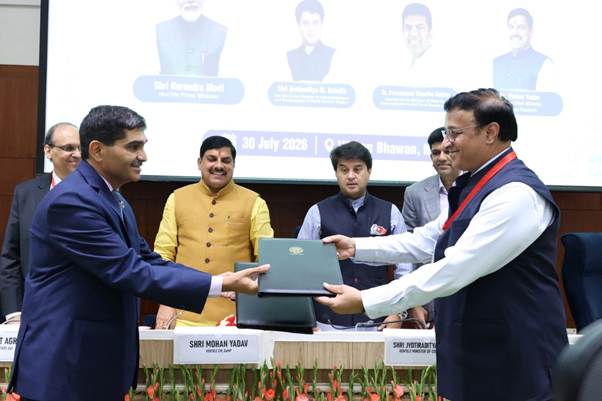
Union Minister for Communications Jyotiraditya M. Scindia, MoS Dr Chandra Sekhar Pemmasani and Madhya Pradesh Chief Minister Dr Mohan Yadav witness the exchange of the MoU for India's first telecom manufacturing zone in Gwalior on Thursday.

NEW DELHI: India has taken a significant step towards building a self-reliant telecom manufacturing ecosystem with the Department of Telecommunications (DoT) and the Government of Madhya Pradesh signing a Memorandum of Understanding (MoU) to establish the country’s first Telecom Manufacturing Zone (TMZ) in Gwalior. The announcement was made on Thursday, July 30.
The proposed Telecom Manufacturing Zone will be developed as a 350-acre integrated plug-and-play industrial cluster that will bring together telecom and electronics manufacturing, research and development, testing, certification and innovation under one ecosystem. The initiative is expected to position Gwalior as a major telecom manufacturing hub while strengthening India’s capabilities in producing critical telecom equipment domestically.
The project will be implemented through a Special Purpose Vehicle (SPV), with the Government of Madhya Pradesh holding a 51 per cent stake and the Department of Telecommunications owning the remaining 49 per cent.
To kick-start the project, the central government has committed ₹493 crore for Phase-I infrastructure development, while the Madhya Pradesh Government has allocated nearly 170 acres of land free of cost, valued at around ₹596 crore. The state has also announced an extensive package of fiscal incentives, including capital subsidies, employment incentives, power tariff rebates, stamp duty reimbursements and support for research and development.
The Telecom Manufacturing Zone is expected to attract investments ranging between ₹12,000 crore and ₹15,000 crore over time. During the investor roundtable held after the MoU signing, industry participants announced investment commitments worth ₹3,500 crore. The project is projected to generate around 14,000 direct skilled jobs, including approximately 3,500 jobs during the first phase, besides creating substantial indirect employment across the supply chain.
Several leading telecom and electronics companies, including Dixon Technologies, HFCL, Tejas Networks, VVDN and Syrma SGS, are expected to anchor the manufacturing ecosystem within the zone.
Unlike conventional industrial parks, the Telecom Manufacturing Zone has been designed as an integrated ecosystem covering the entire telecom value chain. It will support manufacturing of mobile devices, optical fibre, routers, antennas and other telecom equipment while also providing dedicated facilities for advanced semiconductor technologies, common testing laboratories, certification centres and next-generation 5G and 6G research.
The project will complement national initiatives such as the India Semiconductor Mission, the Electronics Components Manufacturing Scheme and the Telecom Technology Development Fund. By encouraging domestic production of strategic telecom equipment, the government aims to reduce import dependence, strengthen supply chains, improve telecom security and expand India’s export potential.
Union Minister for Communications Jyotiraditya M. Scindia described the initiative as a landmark step in transforming India from primarily a telecom service provider into a global telecom manufacturing nation. He said the Gwalior Telecom Manufacturing Zone would accelerate the country’s journey towards Aatmanirbhar Bharat while strengthening India’s position in the global telecom value chain.
Madhya Pradesh Chief Minister Dr Mohan Yadav said the project would establish Gwalior as a national centre for electronics and telecom manufacturing, attracting large-scale investments, advanced technology and employment opportunities.
Minister of State for Communications Dr Chandra Sekhar Pemmasani said the integrated zone would bring together research, design, manufacturing, skilled manpower, testing and intellectual property creation within a single ecosystem, enabling Indian companies to develop globally competitive telecom products.
With manufacturing, innovation and policy support converging at one location, the Telecom Manufacturing Zone represents one of India’s most ambitious initiatives to create an end-to-end domestic telecom manufacturing ecosystem. If implemented as planned, the project could significantly strengthen India’s role in global telecom supply chains while supporting the country’s long-term vision of becoming a leading technology manufacturing destination.