Scindia reviews Bharat 6G Alliance progress, urges global benchmarking as India accelerates race to 6G leadership
Reviewing the Bharat 6G Alliance, Communications Minister Jyotiraditya Scindia called for stronger collaboration, global standardisation leadership and faster indigenous innovation as India targets a front-line role in 6G by 2030.
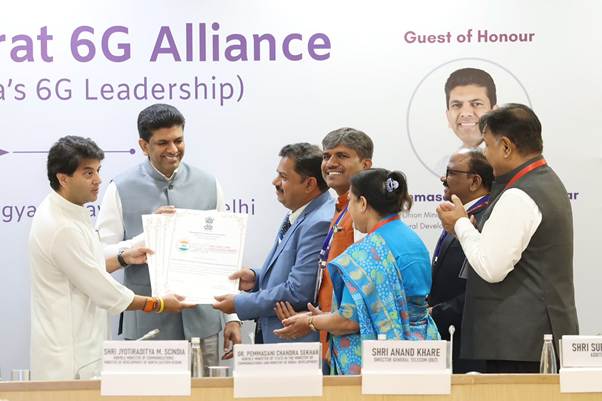
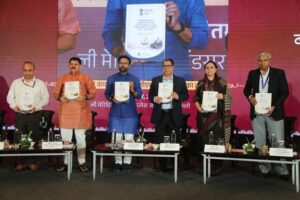
Union Minister for Communications Jyotiraditya M. Scindia reviews the progress of the Bharat 6G Alliance at Vigyan Bhawan in New Delhi and presents the 5G Lab Excellence Awards, reaffirming the government's commitment to positioning India as a global leader in 6G technologies in New Delhi on Tuesday.

NEW DELHI: Union Minister for Communications Jyotiraditya M. Scindia on Tuesday reviewed the progress of the Bharat 6G Alliance (B6GA), calling on the multi-stakeholder platform to benchmark India’s advances against global leaders and deepen collaboration across its working groups to accelerate the country’s journey towards becoming a global 6G powerhouse.
The review meeting, held at Vigyan Bhawan, was attended by Minister of State for Communications and Rural Development Dr Chandra Sekhar Pemmasani, Telecom Secretary Amit Agrawal, senior government officials, industry representatives, academia, startups and research institutions. During the event, the minister also presented the 5G Lab Excellence Awards to leading institutions for their outstanding contribution to India’s telecom innovation ecosystem.
The meeting comes as India advances its “Bharat 6G Vision”, unveiled by Prime Minister Narendra Modi in March 2023, which aims to position the country as a front-line contributor to the design, development and deployment of 6G technologies by 2030. The Bharat 6G Alliance has been established as a collaborative platform bringing together government, industry, academia and startups to drive research, innovation and standardisation in next-generation telecommunications.
During the review, officials presented the progress made by the Alliance’s seven specialised working groups covering spectrum, device technology and manufacturing ecosystem, technology, applications, green and sustainable communications, outreach, and 6G use cases and revenue streams. Discussions focused on accelerating indigenous research and development, strengthening manufacturing capabilities, promoting sustainable technologies, expanding industry-academia partnerships and creating globally competitive telecom products and services.
One of the highlights of the review was India’s growing footprint in global telecom research and standards development. According to the Ministry of Communications, organisations participating in the Bharat 6G Alliance collectively hold more than 7,700 patent filings related to 5G and 6G technologies, including over 4,400 international filings. India’s participation in the global 3GPP standards body has also increased significantly, with the number of Indian participants rising from 717 in 2020 to 1,787 in 2025, while technical contributions surged from 196 to 2,943 during the same period.
The meeting also reviewed India’s efforts in 6G technology standardisation led by the Telecom Standards Development Society, India (TSDSI). Participants emphasised the need for Indian innovations, technologies and use cases to play a meaningful role in shaping globally accepted 6G standards rather than merely adopting technologies developed elsewhere.
Addressing the gathering, Scindia congratulated the Alliance for the progress achieved since its previous review but stressed that the next phase should focus on benchmarking India’s achievements against leading international 6G initiatives. He urged the working groups to identify overlapping areas where greater collaboration could improve outcomes and accelerate technology development.
The Union minister said India must build a secure, resilient, sustainable and inclusive telecommunications ecosystem driven by indigenous research, strong participation in global standards, domestic manufacturing and international partnerships. He also highlighted the importance of world-class testing infrastructure and stronger coordination between government, industry, academia and startups to translate research into deployable technologies.
Delivering the keynote address, Dr. Chandra Sekhar Pemmasani said the Bharat 6G Alliance had made remarkable progress in bringing together diverse stakeholders to shape India’s 6G future. He stressed the need to accelerate indigenous technology development, nurture talent and create an enabling ecosystem for innovators and startups working on emerging communication technologies while strengthening coordination among the Alliance’s working groups.
The event also recognised outstanding performers under the Department of Telecommunications’ 5G Use Case Labs initiative. Based on cumulative performance during January-June 2026, IIITDM Kurnool emerged as the top performer across all four award categories—5G Lab Excellence, Utilisation Excellence, Engagement Excellence and Innovation Excellence—underscoring its leadership in India’s 5G research and experimentation ecosystem. Other awardees included DKTE Textile & Engineering Institute, IIT Roorkee, IIT Ropar, PEC Chandigarh, THDC Institute of Hydropower Engineering & Technology, and IIIT Delhi.
An open interaction with stakeholders explored emerging opportunities and challenges in the evolving 6G landscape, including technology development, spectrum policy, device manufacturing, sustainable communications and commercial applications. Participants agreed that stronger collaboration across the innovation ecosystem would be essential for India to emerge as a globally competitive hub for 6G innovation, technology, standards and deployment.
The review concluded with a reaffirmation of the government’s commitment to accelerating India’s 6G mission through coordinated action across research, standardisation, manufacturing, applications and sustainability, reinforcing the country’s ambition to play a leading role in defining the future of global telecommunications.