Tech-driven crop insurance system gains momentum with hyperlocal weather network: Govt
Over 16,800 weather monitoring sites have been approved under the WINDS programme as the Centre expands technology-driven crop insurance with remote sensing, digital claims and AI-enabled yield estimation.
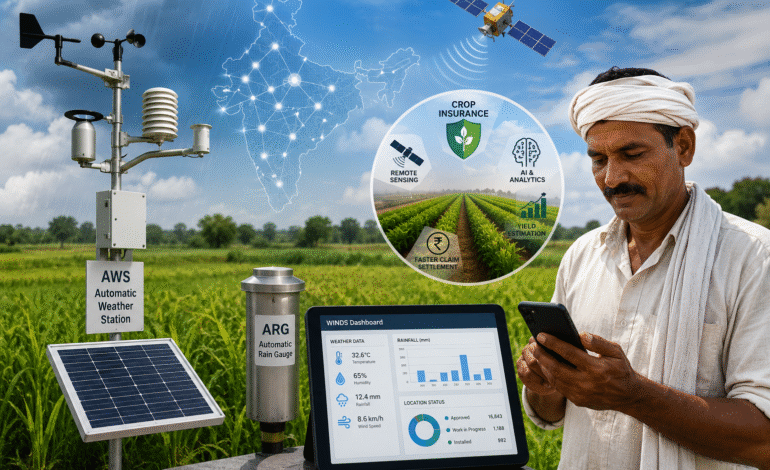
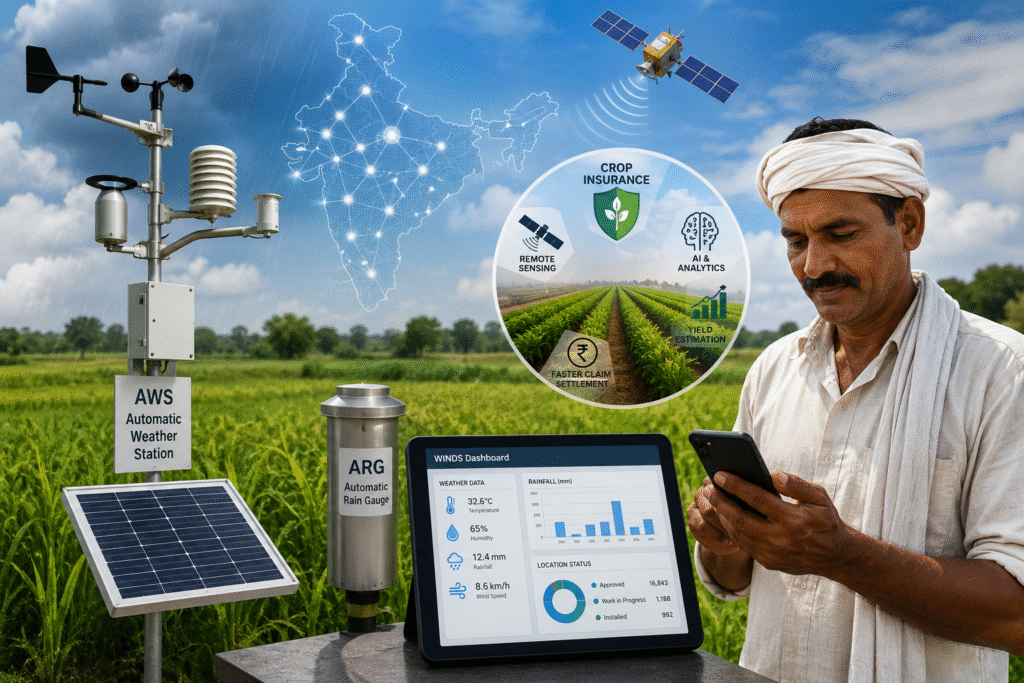
WINDS aims to establish a nationwide network of Automatic Weather Stations (AWS) and Automatic Rain Gauges (ARGs) to generate long-term hyperlocal weather data.

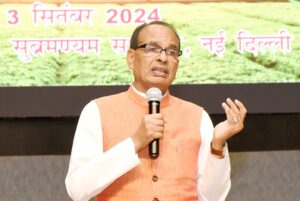
NEW DELHI: The Union government is accelerating the use of technology to improve crop insurance, agricultural advisories and disaster resilience through the rollout of the Weather Information Network and Data System (WINDS) and other digital initiatives under the Pradhan Mantri Fasal Bima Yojana (PMFBY), Union Minister of State for Agriculture and Farmers Welfare Ramnath Thakur said on Friday.
WINDS aims to establish a nationwide network of Automatic Weather Stations (AWS) and Automatic Rain Gauges (ARGs) to generate long-term hyperlocal weather data. The system is expected to support crop insurance, precision agriculture and disaster risk management, the minister said in a written reply in the Rajya Sabha.
The initiative has been adopted by seven States and Union Territories—Assam, Himachal Pradesh, Kerala, Odisha, Puducherry, Uttar Pradesh and Uttarakhand. So far, 16,843 sites have been approved for installation, civil works have been completed at 1,188 locations, and 892 Automatic Weather Stations and Rain Gauges have been installed.
The Government has also expanded the Yield Estimation System based on Technology (YES-TECH), which uses remote sensing for objective crop yield assessment. Introduced for paddy and wheat from the Kharif 2023 season and soybean from Kharif 2024, the system assigns a mandatory 30 per cent weightage to technology-based yield estimates.
During 2025-26, YES-TECH was implemented across 344 districts in 12 States. Madhya Pradesh adopted a fully technology-based yield estimation model with 100 per cent weightage, while Maharashtra and Uttar Pradesh assigned 50 per cent weightage. Odisha and Karnataka adopted a 40 per cent technology-based weightage for yield estimation.
The government said regular reviews are being conducted with stakeholders to ensure effective implementation of YES-TECH.
To improve the speed and transparency of insurance claim settlement under PMFBY, the Centre has developed the National Crop Insurance Portal (NCIP), which serves as a unified digital platform for farmer enrolment, subsidy processing, insurance data management and direct transfer of claim amounts to farmers’ bank accounts.
A dedicated DigiClaim module, operational since Kharif 2022, integrates the NCIP with the Public Finance Management System (PFMS) and insurance companies’ accounting systems to enable faster and more transparent claim processing.
The government has also introduced financial accountability measures. From Kharif 2024, insurance companies face an automatic 12 per cent penalty for delays in claim payments. From Kharif 2025, State Governments are also liable for a 12 per cent penalty if they delay releasing their share of the premium subsidy. In addition, States are now required to maintain escrow accounts for advance deposit of their premium contributions.
Other technology-driven measures include the use of the CCE-Agri App for digital Crop Cutting Experiment data collection, integration of State land records with the NCIP, remote sensing-based yield estimation through YES-TECH, and the mandatory use of the Crop Loss Assessment App (CLAP) for assessing losses caused by localised calamities and post-harvest damage at the individual farm level.