India’s Bioeconomy Surges from $10 Billion to $190 Billion in 12 Years, Says Jitendra Singh
Space startups cross 400, weather forecasting network expands sharply as India's science ecosystem emerges as a global innovation powerhouse
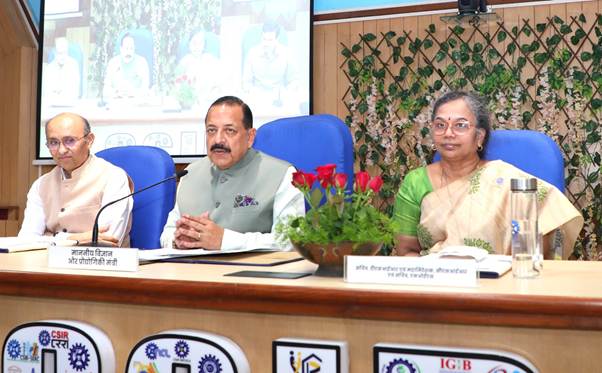
Jitendra Singh addresses a press conference on “12 Years of Transformative Growth in Science, Technology and Innovation” at the CSIR headquarters in New Delhi on Monday, June 15, 2026.

New Delhi: India’s science, technology and innovation ecosystem has undergone a dramatic transformation over the past 12 years, with the country’s bioeconomy expanding from nearly $10 billion in 2014 to more than $190 billion today, while the space sector has witnessed the emergence of over 400 startups and weather forecasting capabilities have expanded significantly, Union Minister Dr Jitendra Singh said on Monday.
Addressing a press conference on “12 Years of Transformative Growth in Science, Technology and Innovation” at the CSIR headquarters in New Delhi, the minister said science and technology have moved beyond laboratories to become a central pillar of India’s development journey under the leadership of Prime Minister Narendra Modi.
He said the rapid growth of India’s innovation ecosystem has helped transform scientific research into solutions that directly benefit citizens, industries, farmers and entrepreneurs.
Highlighting India’s biotechnology revolution, Singh said the country’s bioeconomy has grown nearly twenty-fold over the last decade and is now valued at more than $190 billion. The government has set a target of expanding the sector to $300 billion by 2030.
He attributed the growth to indigenous innovations in healthcare, genomics, diagnostics and biopharmaceuticals, supported by initiatives such as the BioE3 policy framework.
The minister said India has also made significant advances in healthcare technologies, including affordable CAR-T cell therapy, next-generation antibiotics, precision medicine and genomics, enabling the country to address both domestic and global health challenges.
Space Sector Emerges as Innovation Engine
Singh highlighted the remarkable transformation of India’s space ecosystem following policy reforms and increased private-sector participation.
He said the number of space startups has risen from single digits a decade ago to more than 400 today, reflecting growing entrepreneurial activity and investor interest in the sector.
India’s space economy, currently estimated at around $8 billion, is projected to grow to nearly $45 billion in the coming years, driven by satellite technologies, launch services, downstream applications and private innovation.
Referring to the success of Chandrayaan-3, Singh said India became the first country to successfully land near the Moon’s south pole, demonstrating its scientific and technological capabilities on the global stage.
The minister said India is now pursuing ambitious future goals, including the establishment of the Bharatiya Antariksh Station by 2035 and an Indian mission to the Moon by 2040.
Weather Forecasting Sees Major Leap
Singh described the transformation of weather and climate services as one of the most significant achievements of the past decade.
India had only 17 weather radars in 2014, compared with nearly 50 operational radars today, while another 50 are planned under Mission Mausam.
He said forecasting coverage has expanded from approximately 300 cities to nearly 1,700 locations across the country, enabling highly localised forecasts that support disaster management, agriculture and public safety.
The country has also strengthened lightning detection systems, rain-monitoring infrastructure and nowcasting capabilities, significantly improving disaster preparedness and climate resilience.
Science Driving Economic Growth
The minister said scientific institutions have become increasingly integrated with industry, startups, farmers and local communities.
He cited the success of the CSIR-led Aroma Mission, which has generated livelihood opportunities for farmers, particularly in Himalayan regions, by promoting high-value aromatic crops.
Another example is steel slag road technology, which converts industrial waste into durable road-building material. According to Singh, the technology has demonstrated superior durability, lower maintenance costs and improved cost-effectiveness, leading to wider adoption across infrastructure projects.
New Missions Strengthen Research Ecosystem
Senior officials highlighted several flagship initiatives launched in recent years, including the Anusandhan National Research Foundation (ANRF), National Quantum Mission, National Supercomputing Mission, National Geospatial Policy and the Research Development and Innovation Fund.
The Ministry of Earth Sciences also reported progress under Mission Mausam and the Deep Ocean Mission, including the development of indigenous deep-sea technologies such as Matsya 6000 and Varaha.
Officials from the Department of Biotechnology highlighted the expansion of startup ecosystems, genomics programmes and biotechnology innovation networks that have helped position India among the world’s fastest-growing innovation economies.
Singh said the achievements of the last twelve years demonstrate how science, technology and innovation have become critical enablers of India’s rise as a global knowledge-driven economy.
“India’s scientific progress is strengthening strategic capabilities, creating new opportunities for employment and entrepreneurship, and improving the quality of life of citizens as the country advances towards the vision of Viksit Bharat 2047,” he said.