India-Netherlands Elevate Ties to Strategic Partnership; Defence, Semiconductors, Green Hydrogen Drive New Agenda
Modi-Jetten talks produce sweeping roadmap spanning defence manufacturing, cyber security, semiconductors, clean energy, water management and Indo-Pacific cooperation
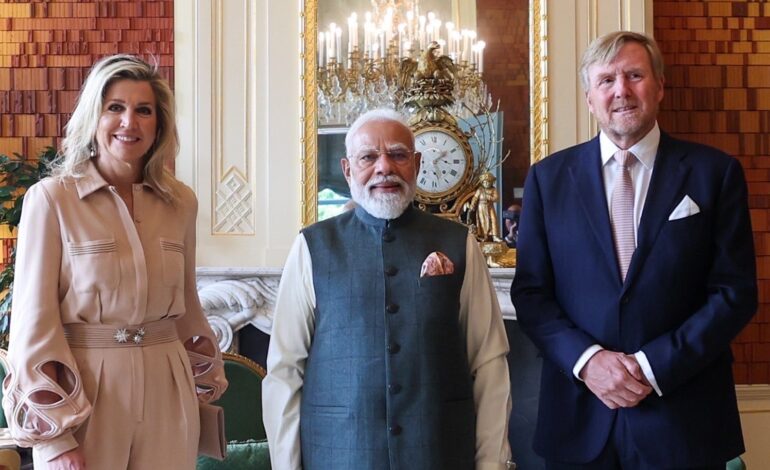
PM meeting with the King Willem-Alexander and Queen Máxima of Netherlands on May 16, 2026.

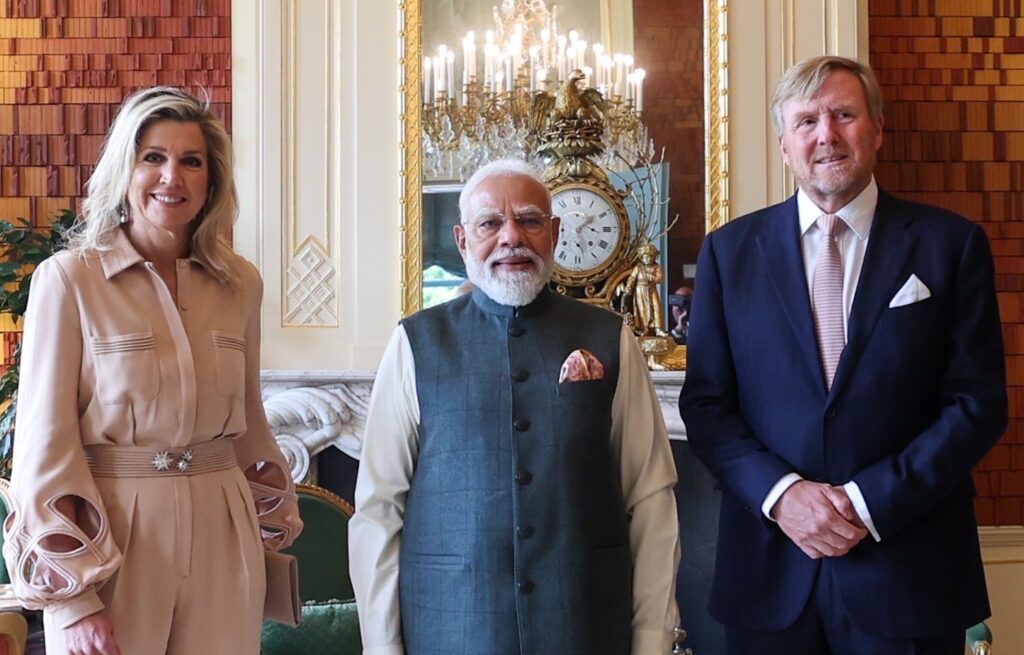
New Delhi: India and the Netherlands on Saturday elevated their bilateral relationship to a full-fledged “Strategic Partnership,” unveiling an expansive cooperation roadmap that significantly broadens engagement across defence, semiconductors, cyber security, AI, critical minerals, green hydrogen, maritime logistics and sustainable agriculture.
The announcement came during Prime Minister Narendra Modi’s official visit to the Netherlands, where he held bilateral talks with Dutch Prime Minister Rob Jetten and met King Willem-Alexander and Queen Máxima at the Royal Palace Huis ten Bosch in The Hague.
The strategic upgrade marks one of India’s most comprehensive bilateral frameworks with a European nation outside the traditional major powers axis and aligns closely with New Delhi’s ongoing push to deepen technology, trade and security partnerships across Europe.
The joint statement outlined structured cooperation across a wide spectrum of sectors including defence and security, semiconductors, AI, quantum technologies, maritime development, clean energy transition, cyber security, water management, sustainable transport, healthcare and higher education.
A major outcome of the visit was the deepening of defence and strategic cooperation. Both countries agreed to expand defence industrial collaboration through co-development, technology transfer and joint manufacturing initiatives. The two sides also discussed the possibility of establishing a Defence Industrial Roadmap focused on co-production of defence equipment and systems.
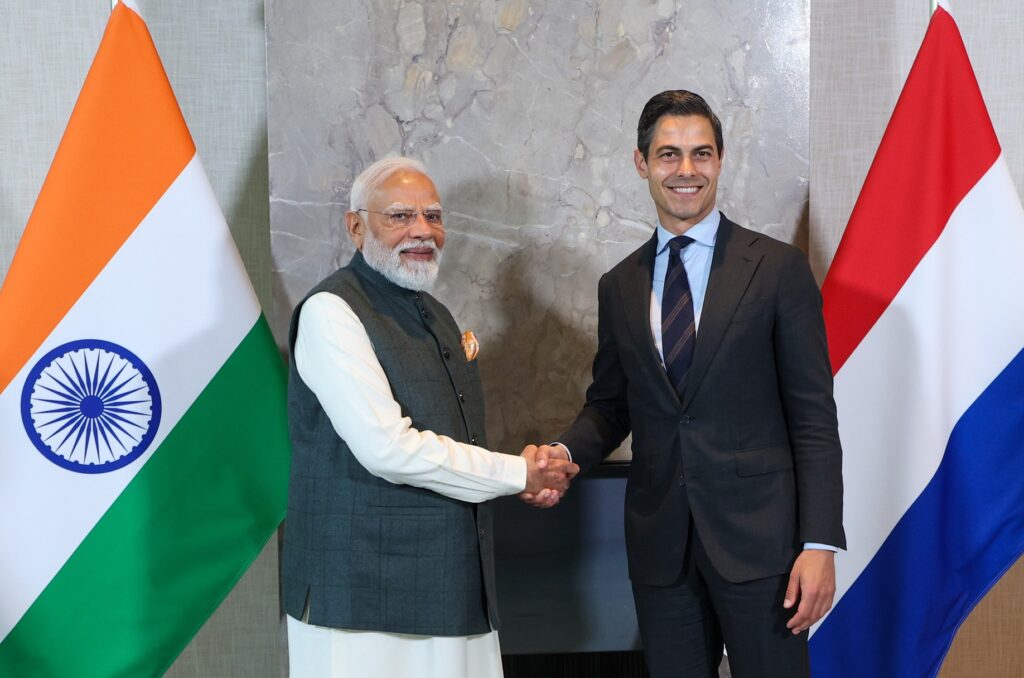
The Netherlands also strongly backed India on counter-terrorism issues. Prime Minister Jetten condemned the April 2025 terrorist attack in Pahalgam and reaffirmed Dutch support for India’s fight against terrorism, including cross-border terrorism. Both sides called for zero tolerance toward terrorism and stronger action against terror financing and safe havens.
Technology and semiconductor cooperation emerged as another central pillar of the new partnership. The two countries signed an MoU on semiconductors and related emerging technologies, aimed at expanding cooperation in investments, research and talent mobility.
The partnership also connects Dutch semiconductor capabilities with India’s Semiconductor Mission, while leading academic institutions from both countries will collaborate through a new “brain bridge” initiative involving IITs, Eindhoven University of Technology and the University of Twente, alongside industry participation from companies including ASML, NXP Semiconductors and Tata Group.
In the clean energy domain, the two countries launched an India-Netherlands Green Hydrogen Roadmap designed to accelerate investments, production and trade in green hydrogen technologies. The Netherlands also joined the Global Biofuel Alliance launched during India’s G20 Presidency.
The Netherlands’ role as a strategic European logistics gateway also figured prominently in the talks. Both sides highlighted the importance of the Port of Rotterdam in facilitating Indian exports into Europe while expressing optimism about expanded opportunities arising from the India-EU Free Trade Agreement concluded earlier this year.
The leaders additionally agreed to intensify cooperation in maritime logistics through plans for a “Green and Digital Sea Corridor” connecting India and the Netherlands, integrating sustainability, digital shipping systems and resilient supply chains.
Water management and climate resilience remained another major focus area. The Netherlands will deepen cooperation with India in river management, wastewater reuse, urban water resilience and delta management under the Strategic Partnership on Water. The two sides also agreed to strengthen collaboration on Gujarat’s Kalpasar Project.
The joint statement also reflected growing India-Europe geopolitical convergence. The Netherlands announced its decision to join the Indo-Pacific Oceans Initiative and co-lead its Capacity Building & Resource Sharing pillar alongside Germany and the European Union.
On multilateral reforms, the Netherlands reiterated support for India’s permanent membership in a reformed UN Security Council. Both sides also welcomed the conclusion of the India-EU Free Trade Agreement negotiations and the parallel India-EU Security and Defence Partnership.
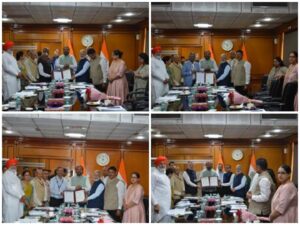
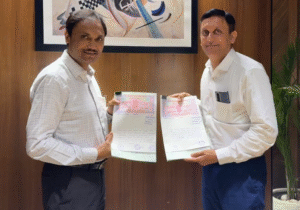
The two countries further signed agreements covering customs cooperation, mobility and migration, healthcare, critical minerals, higher education, dairy development, food safety and cultural cooperation.
The visit signals Europe’s increasing strategic interest in India not merely as a market, but as a long-term geopolitical, technological and supply-chain partner amid intensifying global competition over semiconductors, clean energy technologies and resilient trade corridors.
Key Takeaways
- India and the Netherlands elevated ties to a formal Strategic Partnership.
- Defence industrial collaboration, co-development and technology transfer emerged as a major pillar.
- Semiconductor cooperation gained strong momentum through industry-academia partnerships involving ASML, NXP and Indian IITs.
- A dedicated Green Hydrogen Roadmap was launched to deepen clean energy cooperation.
- The Netherlands joined the Indo-Pacific Oceans Initiative, signaling strategic alignment with India in the Indo-Pacific.
- Dutch support for India’s UNSC permanent membership was reaffirmed.
- Both sides backed stronger counter-terrorism cooperation and condemned cross-border terrorism.
- Maritime cooperation will expand through a proposed Green and Digital Sea Corridor.
- Water management and climate resilience remain core collaboration areas leveraging Dutch expertise.
- The India-EU FTA was projected as a major accelerator for bilateral trade and investment.
Policy Implications
Semiconductor Supply Chain Diversification
The partnership strengthens India’s ambitions to emerge as a trusted semiconductor manufacturing and R&D destination while reducing Europe’s dependence on concentrated East Asian supply chains.
Strategic European Alignment
The Netherlands joining India-led Indo-Pacific initiatives indicates expanding European strategic convergence with India beyond trade into security and maritime affairs.
Defence Manufacturing Push
The emphasis on co-development and defence industrial collaboration aligns with India’s Make in India and defence indigenisation agenda.
Green Hydrogen Diplomacy
The hydrogen roadmap positions India to leverage European demand and Dutch logistics capabilities for future green fuel exports.
Maritime and Logistics Integration
Rotterdam’s positioning as a gateway to Europe could significantly benefit Indian exporters once the India-EU FTA becomes operational.
Technology Diplomacy Model
The partnership reflects India’s evolving diplomacy model — combining geopolitics, emerging technologies, energy transition and resilient supply chains into integrated bilateral frameworks.