ISRO steps up measures to tackle space debris threat from satellite constellations
ISRO is strengthening measures to tackle the growing space debris threat from large LEO satellite constellations, with Active Debris Removal and Space Situational Awareness at the core of its strategy.
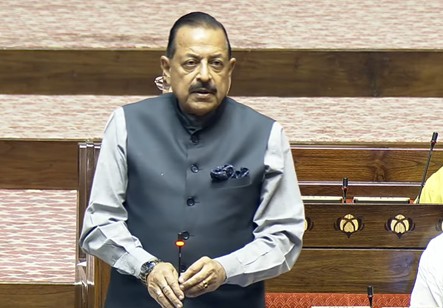
Union Minister of State (Independent Charge) for Science & Technology, Earth Sciences, Atomic Energy and Space, Dr. Jitendra Singh

NEW DELHI: The Indian Space Research Organisation is closely monitoring the risks arising from the rapid deployment of large Low Earth Orbit (LEO) satellite constellations and satellite internet networks, which can involve thousands of spacecraft operating in relatively congested orbital regions.
Minister of State for Personnel, Public Grievances & Pensions and Prime Minister’s Office Dr Jitendra Singh said in the Rajya Sabha on Thursday that ISRO is seized of the issue and is taking all possible steps for the mitigation and prevention of space debris.
The growing number of satellites in internet constellations increases the potential for collisions, particularly when spacecraft fail on orbit or lose their ability to manoeuvre. While many large constellations have autonomous collision avoidance systems, individual satellite failures can still create significant risks.
The threat is not limited to large objects. Small, untrackable debris can pose a particularly serious challenge because spacecraft cannot reliably avoid such objects or adequately shield themselves against their impact. A collision with even a relatively small piece of debris can cause mission-ending damage and generate additional debris, potentially triggering a cascading effect in heavily populated orbital regions.
Any fragmentation event, whether caused by a collision or an accidental satellite break-up, can further increase the risk to other spacecraft operating in the same orbital shell.
Against this backdrop, ISRO’s Debris Free Space Mission is expected to become a major component of India’s strategy to protect space assets and prevent further accumulation of debris. The initiative includes measures aimed at improving compliance with end-of-life disposal requirements and developing capabilities for Active Debris Removal (ADR).
India has also been engaged in international efforts to address the space debris problem for decades. ISRO has been a member of the Inter-Agency Space Debris Coordination Committee (IADC), established in 1993, since 1996. The IADC is among the leading international bodies dealing with space debris monitoring and mitigation.
India also participates in international mechanisms under the United Nations Committee on the Peaceful Uses of Outer Space, including the UN Scientific and Technical Subcommittee working group on Long-Term Sustainability and the Expert Group on Space Situational Awareness.
Other international platforms, including the IAA Space Debris Working Group and ISO Working Group 7, provide additional avenues for coordination between India and international agencies on space debris monitoring and mitigation.
India’s policy framework also places responsibility on satellite operators to address the end-of-life phase of spacecraft. The Indian Space Policy mandates adoption of internationally recognised space debris mitigation guidelines, including provisions relating to the disposal of satellites at the end of their operational lives.
The Debris Free Space Mission is being positioned as a proactive step towards implementing these principles, while the Norms, Guidelines and Procedures issued by IN-SPACe in 2024 encourage Indian space actors to adopt adequate post-mission disposal measures or ensure that their spacecraft have limited orbital life through natural decay.
Dr Jitendra Singh identified Space Situational Awareness as one of the most important enablers of long-term space sustainability. Effective monitoring of objects in orbit, he said, needs to be complemented by technical capabilities such as satellite manoeuvrability and trackability.
Operators are also expected to fulfil basic obligations such as registering space objects and sharing appropriate points of contact, supported by a robust regulatory framework.
The government sees Active Debris Removal as another important tool for containing the growth of orbital debris. Activities that could serve as precursors to ADR have already begun through on-orbit demonstrations, with such technologies expected to mature over time.
The challenge is becoming more pressing as commercial satellite constellations transform the orbital environment. The deployment of thousands of spacecraft for broadband and other services has expanded access to satellite connectivity but has also introduced a new dimension to space traffic management.
India’s response therefore combines international cooperation with efforts to build indigenous monitoring capabilities. Dr Jitendra Singh said international collaboration and data sharing would remain essential for comprehensive Space Situational Awareness, while India would simultaneously pursue self-reliance in monitoring space objects.
Research and development into innovative technologies will also be required as the space environment becomes increasingly congested.
The government has also emphasised the need to create greater awareness among space operators about the fragility of usable orbital regions. With more satellites competing for limited and increasingly crowded orbital pathways, preventing debris generation is becoming as important as removing debris that already exists.
For India, the objective is increasingly clear: as its own space programme expands and the global commercial space industry fills Low Earth Orbit with new constellations, preserving a safe and sustainable orbital environment will be essential to protect the infrastructure on which future space-based services depend.