BJP Sweeps Bengal, Retains Assam and Puducherry; Vijay’s TVK Storms Tamil Nadu, Congress Returns in Kerala
The 2026 assembly election results across five states and one Union Territory have redrawn India’s political map, delivering decisive mandates, historic breakthroughs and a strong anti-incumbency signal across regions.
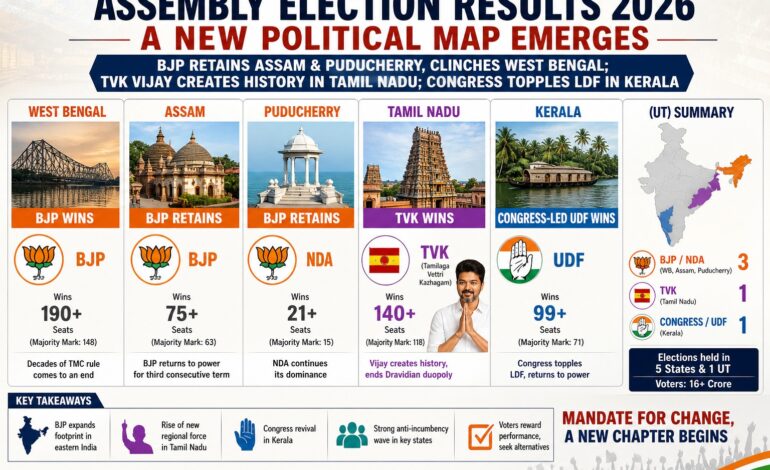

New Delhi: The 2026 assembly election results across five states and one Union Territory have redrawn India’s political map, delivering decisive mandates, historic breakthroughs and a strong anti-incumbency signal across regions.
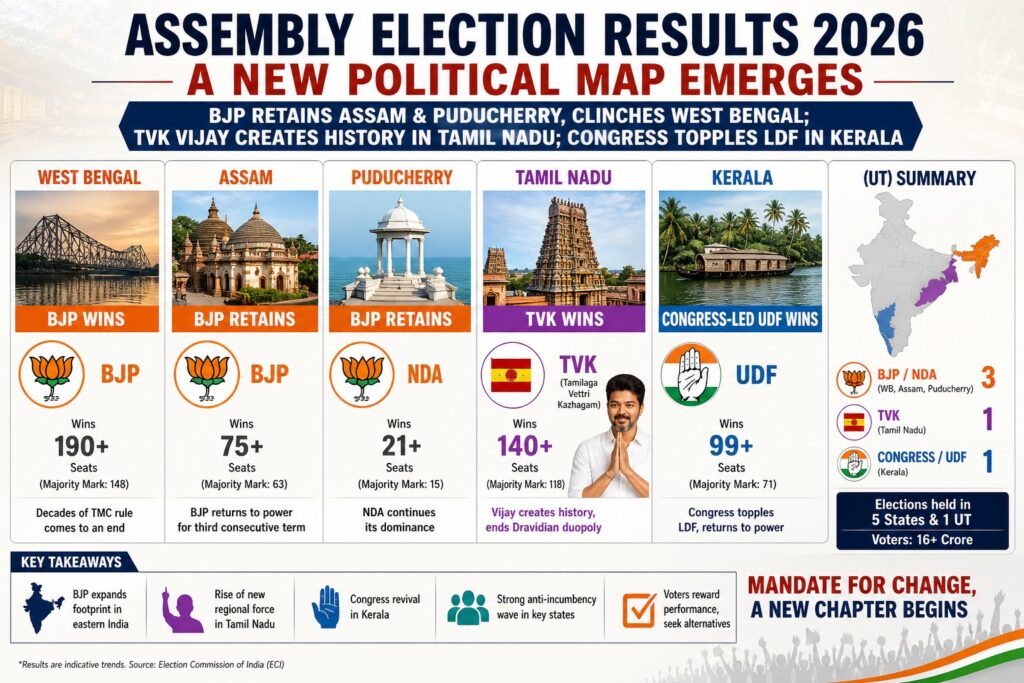
The Bharatiya Janata Party (BJP) emerged as the biggest gainer, scripting a landmark victory in West Bengal while retaining power in Assam for a third consecutive term and continuing its dominance in Puducherry as part of the NDA alliance.
In West Bengal, the BJP surged past the majority mark, ending decades of resistance in the state and dislodging the Trinamool Congress in a high-stakes contest. Early trends and results showed the party leading in well over 190 seats, marking its first government in the state.
Assam delivered continuity, with the BJP-led government returning to power amid a fragmented opposition, while Puducherry saw the NDA maintain its advantage, reinforcing the party’s footprint in smaller territories.
The most dramatic political shift, however, unfolded in Tamil Nadu, where actor-turned-politician Vijay’s Tamilaga Vettri Kazhagam (TVK) achieved a historic breakthrough. The party crossed the majority mark, dismantling the decades-old Dravidian duopoly of the DMK and AIADMK and positioning Vijay as the state’s next chief minister.
Analysts attribute TVK’s success to a combination of grassroots mobilisation and the consolidation of a new voter base, particularly younger demographics seeking an alternative to traditional political formations.
Kerala, meanwhile, witnessed a return to its cyclical political pattern, with the Congress-led United Democratic Front (UDF) toppling the Left Democratic Front (LDF) government. Strong anti-incumbency and governance concerns appear to have driven the shift, giving Congress a significant resurgence in the state.
Across states, the results reflect a broader national trend of voters favouring change over continuity in key battlegrounds, while rewarding incumbents in regions where governance delivery aligned with expectations.
The elections, involving over 160 million voters, are expected to have wider political implications, particularly as national parties recalibrate strategies ahead of the 2029 general elections.
Political observers note that the BJP’s expansion into eastern India, the emergence of new regional forces like TVK, and Congress’s revival in Kerala together signal a more fragmented yet competitive political landscape.
As the dust settles, the 2026 verdict underscores a clear message from the electorate: performance, adaptability and credible alternatives are now decisive factors shaping India’s evolving democratic mandate.