India’s space economy projected to reach $40–45 billion in 7–8 years
Predictable demand, faster approvals and stronger supply chains will be critical to helping private space companies scale, as India seeks to turn technological capabilities into commercially viable businesses.
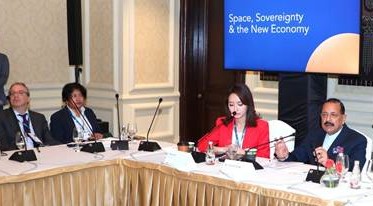
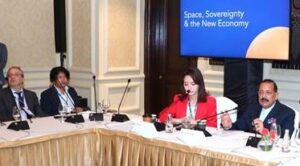
Union minister Dr Jitendra Singh speaks at a roundtable organised by Bloomberg New Economy Forum in New Delhi on Saturday.

NEW DELHI: India’s space economy, currently valued at around $9 billion, is expected to expand to $40–45 billion over the next seven to eight years, Union Minister of State for Space Dr Jitendra Singh said on Saturday.
Speaking at a Bloomberg New Economy Forum media roundtable on “Space, Sovereignty and New Economy” in New Delhi, Singh said the next phase of growth would require globally competitive commercial companies, backed by investment, predictable demand and sustainable business models.
He said opening the sector to private participation had broadened opportunities for enterprises. The priority now was to translate technological capabilities into market-ready products and services that could compete internationally.
Government procurement and support for proof-of-concept projects could help businesses demonstrate their technologies and move towards commercial deployment, he said. A predictable customer base would give companies greater confidence to invest in production and develop recurring revenue streams.
Singh called for regulatory approvals within defined timelines, lower business costs and stronger supply-chain integration. Measures relating to taxation and licensing needed to deliver practical benefits for companies seeking to manufacture, deploy or export space products.
Domestic and international investment could support technology development, manufacturing and access to overseas markets, he said, while indigenous capabilities remained important for national security and strategic autonomy.
The discussion also examined the expanding role of satellite communications, Earth observation and geospatial services in infrastructure monitoring, agriculture, disaster management and defence.
Singh cited applications including project clearances, tracking implementation timelines and geotagging development works. He also referred to India’s provision of space-based disaster management information and support to Myanmar, Bangladesh and Sri Lanka.
Beyond launch vehicles and satellites, downstream services and data-driven applications would be important sources of demand for Indian space companies, he said.
The roundtable included IN-SPACe Director (Promotion) Vinod Kumar and STEMBoard and LINGO founder Aisha Bowe, alongside representatives from industry, academia and the international space community.