Pralhad Joshi takes charge as Union Education Minister, reviews key reforms and flagship schemes
Assuming charge of the Education Ministry, Pralhad Joshi held his first review meeting with senior officials, signalling continuity in implementing the NEP 2020, digital learning initiatives and higher education reforms.
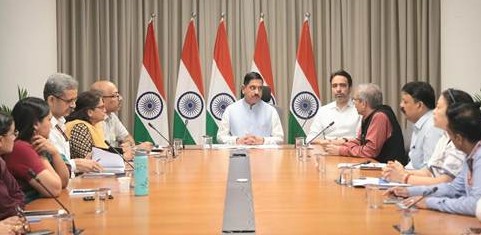
Union Education Minister Pralhad Joshi, accompanied by Minister of State for Education Jayant Chaudhary, chairs a review meeting with senior officials after officially assuming charge of the Ministry of Education at Kartavya Bhavan in New Delhi on Sunday.

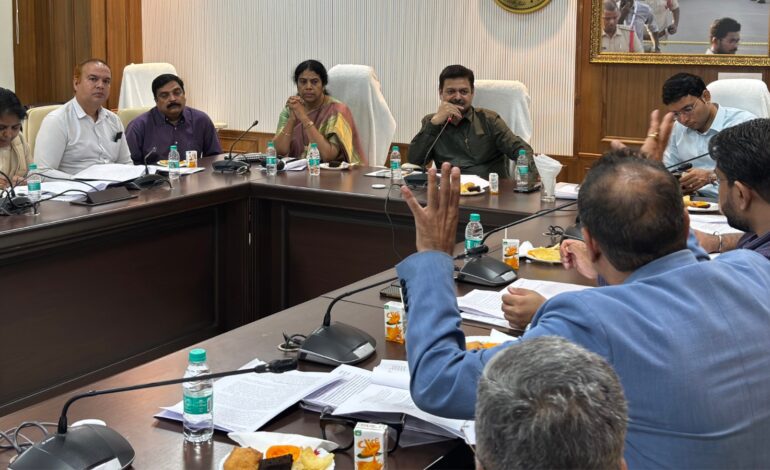
NEW DELHI: Union Minister Pralhad Joshi on Sunday officially assumed charge of the Ministry of Education at Kartavya Bhavan, adding another major responsibility to his existing portfolios of Consumer Affairs, Food and Public Distribution, and New and Renewable Energy. Soon after taking charge, he chaired a comprehensive review meeting with senior officials to assess the progress of the ministry’s flagship schemes, reforms and ongoing initiatives.
Minister of State for Education Jayant Chaudhary attended the meeting, along with Secretary, Department of Higher Education, Dr Vineet Joshi, Secretary, Department of School Education and Literacy, TK Anil Kumar, and other senior officials of the ministry.
The review focused on the implementation status of various programmes and policy initiatives across school and higher education. While the Ministry did not disclose specific decisions taken during the meeting, the exercise is expected to help the new minister familiarise himself with the progress of key reforms and identify priorities for the coming months.
Former Union Education Minister Dharmendra Pradhan’s tenure came to an abrupt end after months of mounting public anger over the alleged NEET-UG 2026 paper leak and examination irregularities. The controversy triggered nationwide student protests demanding accountability and systemic reforms in India’s examination system. With political pressure intensifying and protests spreading across the country, Pradhan resigned on July 25, saying the decision was aimed at safeguarding students’ interests and preventing further escalation of the crisis. His exit marked one of the most significant political consequences of the NEET paper leak controversy and paved the way for a leadership change in the Ministry of Education.
Pralhad Joshi’s appointment comes at a significant juncture for the education sector, which is undergoing one of its most ambitious transformations under the National Education Policy (NEP) 2020. The ministry is currently overseeing large-scale reforms aimed at improving learning outcomes, expanding access to quality education, strengthening research and innovation, enhancing skill development, and leveraging digital technologies to make education more inclusive and future-ready.
Among the major initiatives under implementation are the PM SHRI schools programme, the National Digital Education Architecture (NDEAR), the PM eVIDYA digital learning platform, SWAYAM online courses, the Academic Bank of Credits (ABC), the National Credit Framework, and the National Research Foundation (NRF). The Ministry is also working to strengthen multidisciplinary higher education institutions, expand vocational education and promote greater use of Indian languages in teaching and learning.
The Education Ministry has emerged as a key driver of the government’s Digital India vision, with technology playing an increasingly central role in school and higher education. Platforms such as DIKSHA, SWAYAM and the National Digital University initiative are designed to democratise access to quality educational resources, while digital public infrastructure for education continues to be expanded across the country.
Joshi’s stewardship of the Ministry is expected to focus on accelerating the implementation of ongoing reforms while ensuring greater coordination between school education, higher education, skill development and emerging technologies. His experience in handling multiple strategic ministries is likely to be viewed as an advantage in aligning education policy with India’s broader economic, technological and sustainability goals.
The review meeting marks the beginning of the new minister’s engagement with one of the country’s largest and most critical ministries, which serves millions of students, teachers and educational institutions across India. With the next phase of NEP implementation gathering pace, stakeholders will closely watch the policy direction and priorities set under Joshi’s leadership.