Modi-Trump Meeting, AI Roadmap and IMPACT Initiative Mark India’s Strong G7 Presence
India proposes global AI safeguards, unveils connectivity initiative for Global South, and reviews trade and strategic cooperation with US President Donald Trump
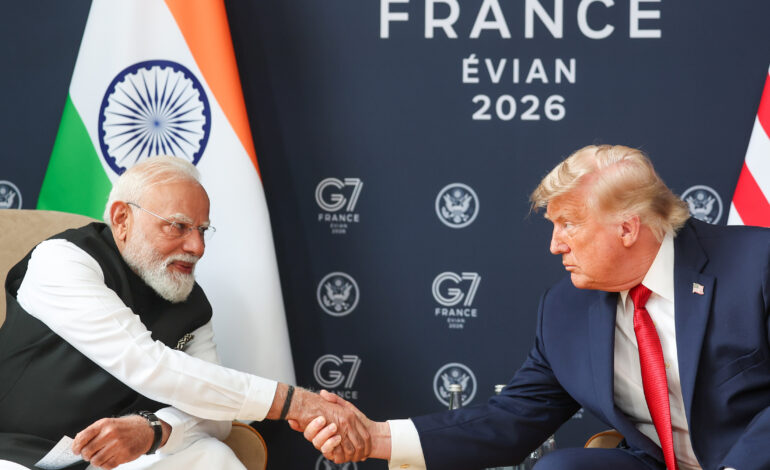
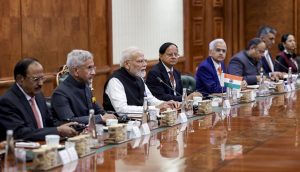
Prime Minister Narendra Modi meets US President Donald Trump on the sidelines of the G7 Summit 2026 in Evian, France, on June 17, 2026.

Evian, France: Prime Minister Narendra Modi projected India’s vision for a more inclusive, technologically empowered and economically resilient world during a series of high-level engagements at the G7 Summit in Evian, France on Thursday, where he advocated responsible Artificial Intelligence, sustainable economic growth, and deeper strategic cooperation with the United States.
Addressing the Outreach Session on “Ensuring a Safe, Rapid and Efficient Rollout of Artificial Intelligence,” Prime Minister Modi described AI as a transformative force capable of reshaping human civilization but stressed that technology must remain firmly rooted in human welfare.
Referring to India’s recently hosted AI Impact Summit, Modi outlined India’s MANAV (human-centric) vision for AI, emphasizing inclusivity, security and public good. He noted that democratic nations must have access to trusted AI systems capable of protecting critical information infrastructure and countering emerging cyber threats.
Calling for a balanced approach to AI governance, the Prime Minister proposed a four-point framework: AI systems should be safe-by-design; deployment should be supported by common standards and testing frameworks; global cooperation must be strengthened to tackle deepfakes, misinformation and cyber fraud; and AI benefits should be extended to the Global South to ensure equitable development.
“AI must expand human potential, empower human choice and protect human dignity,” Modi said, reaffirming India’s commitment to responsible and inclusive technological advancement.
Earlier, speaking at the Outreach Session on “Reviving a Balanced, Shared and Sustainable Economic Growth for All,” the Prime Minister highlighted the need for growth models that prioritize people’s well-being rather than merely focusing on GDP and trade figures.
At a time of global uncertainty, he said, sustainable growth must be inclusive and people-centric. Modi pointed to India’s development philosophy of “Sabka Sath, Sabka Vikas, Sabka Vishwas, Sabka Prayas” as a successful model of inclusive growth.
The Prime Minister noted that the same philosophy had guided India’s G20 Presidency under the theme “One Earth, One Family, One Future” and inspired the India-Middle East-Europe Economic Corridor (IMEC), envisioned to strengthen supply chains, generate employment, attract investments and foster innovation.
Highlighting the disproportionate impact of global crises and conflicts on developing nations, Modi called for greater international solidarity and urged global financial institutions to develop mechanisms that enhance economic resilience in the Global South.
In a significant proposal, he suggested the creation of an “International Mobilization Partnership for Accelerating Connectivity and Trade” (IMPACT), a collaborative framework that would combine G7 capital, India’s talent and the ownership of developing nations to accelerate connectivity and trade projects across Africa, Latin America and Pacific Island countries.
Modi also reaffirmed India’s commitment to a stable and prosperous global economy, underscoring the country’s efforts to expand trade and economic partnerships with G7 members and other nations.
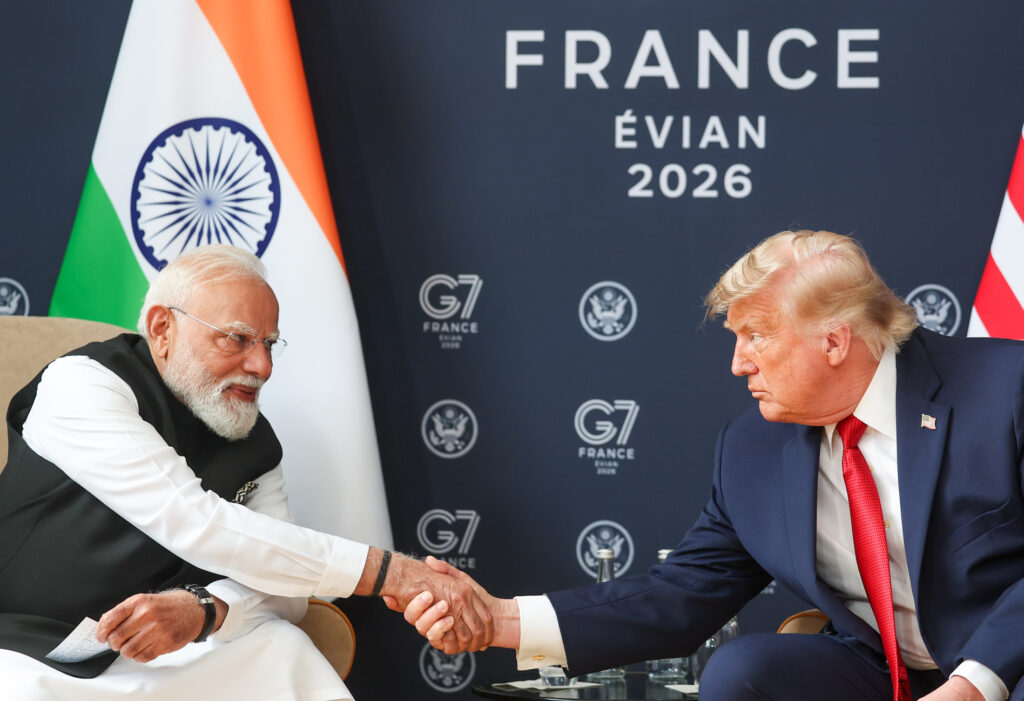
On the sidelines of the Summit, Prime Minister Modi met United States President Donald J. Trump to review the growing momentum in India-US relations and discuss key regional and global developments.
Modi commended President Trump for diplomatic efforts that contributed to an understanding aimed at ending the ongoing conflict in West Asia and restoring peace and stability in the region. He also emphasized the importance of safeguarding freedom of navigation and ensuring uninterrupted commerce through the Strait of Hormuz, a critical global energy and trade corridor.
The two leaders reviewed progress under the India-US COMPACT (Catalyzing Opportunities for Military Partnership, Accelerated Commerce and Technology), launched following their Washington meeting in February 2025.
They welcomed advancements in defence cooperation, strategic technologies, energy collaboration and bilateral trade. Both leaders expressed satisfaction over substantial progress in negotiations for an interim Bilateral Trade Agreement and directed officials to expedite efforts toward a balanced, mutually beneficial and commercially meaningful pact.
The leaders also noted that US Trade Representative Jamieson Greer is scheduled to visit India next week to advance discussions on the proposed agreement.
Reaffirming their commitment to the India-US Comprehensive Global Strategic Partnership, Modi and Trump pledged to deepen cooperation across strategic, economic and technological domains for the mutual benefit of both countries.
The Prime Minister’s engagements at the G7 Summit underscored India’s expanding role as a bridge between advanced economies and the Global South, while positioning the country as a leading voice on emerging technologies, inclusive development and global economic cooperation.