India’s Textile Recycling Reality: Circular Economy or Fast Fashion Waste Hub?
Government rebuts international criticism, but deeper questions emerge over labour, pollution, informal recycling networks and India’s role in the global textile waste economy
What remains uncertain is whether the country can formalise, modernise and environmentally upgrade this ecosystem quickly enough to avoid becoming trapped at the low-value and high-pollution end of the global textile waste chain.

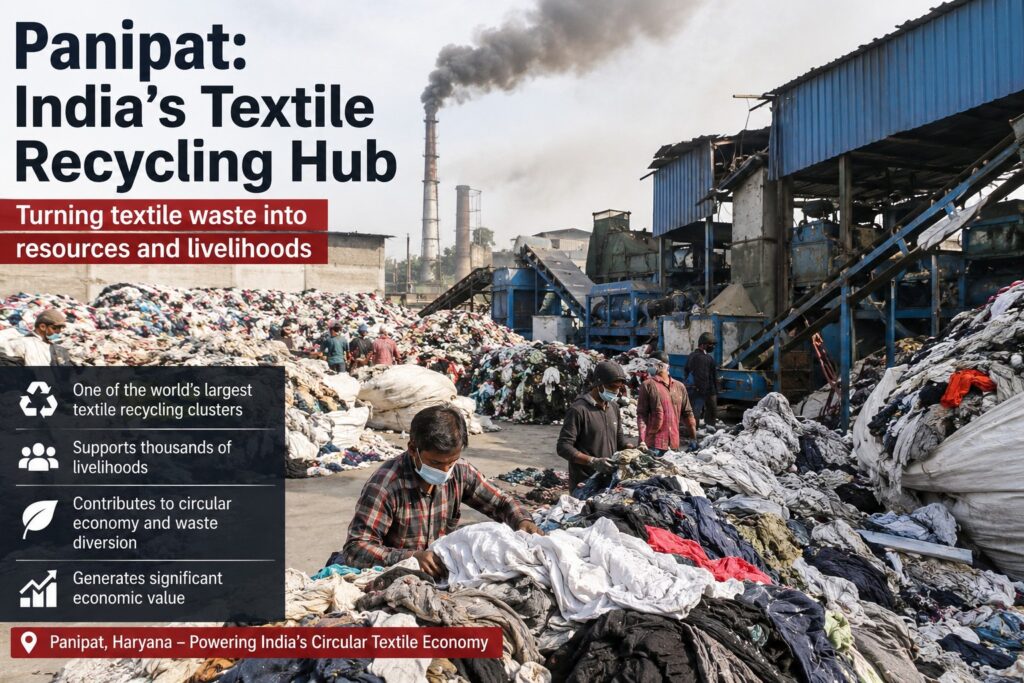
New Delhi: A sharply worded rebuttal issued today by the Ministry of Textiles against a recent international media report on textile recycling in India has reopened a much larger and more uncomfortable debate: Is India a global leader in circular textile recovery — or is it increasingly becoming the back-end processor of the world’s fast-fashion waste crisis?
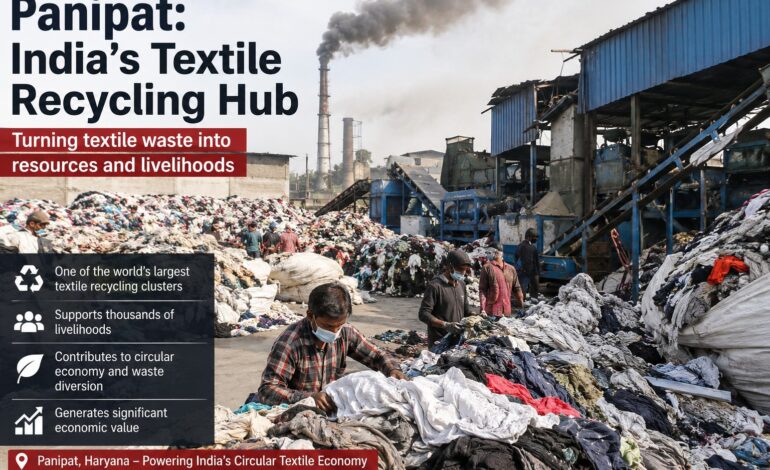
The ministry’s response strongly rejected what it called a “misleading” and “selective” portrayal of India’s textile recycling ecosystem, particularly in relation to the Panipat cluster in Haryana, one of the world’s largest textile recycling hubs.
According to the government, India possesses one of the world’s most extensive textile recovery and recycling networks, deeply embedded in traditional systems of reuse, repair, repurposing and fibre recovery. Officials argue that the sector represents not environmental exploitation, but a significant example of circular economy practices operating at scale.
Yet beneath the official defence lies a more layered reality involving:
- informal labour networks
- environmental compliance gaps
- imported textile waste streams
- worker safety concerns
- global fast-fashion supply chains
- regulatory weaknesses
- and the enormous economic value hidden within textile waste itself.
The Panipat Paradox
At the centre of the controversy lies Panipat, often described as the global capital of textile recycling.
For decades, the city has processed massive quantities of woollen and blended textile waste, converting discarded garments into:
- blankets
- yarn
- industrial materials
- insulation products
- low-cost recycled textiles
The ministry argues that media portrayals focusing solely on pollution or unsafe conditions ignore the cluster’s economic importance and environmental contribution.
Indeed, government-backed studies cited in the rebuttal indicate that India generates around 7,073 kilo tonnes of textile waste annually, with nearly 97 per cent of pre-consumer textile waste already being recycled within domestic manufacturing systems.
Officials also reject allegations that India is primarily a dumping ground for Western textile waste.
According to ministry data:
- over 90 per cent of textile waste processed in India originates domestically
- imported post-consumer textile waste accounts for only around 7 per cent
- imports are regulated under Hazardous and Other Wastes Rules, 2016
But critics argue the issue is not merely the volume of imported waste — it is the quality, traceability and downstream handling of increasingly complex synthetic and blended textile materials generated by the global fast-fashion industry.
The Fast Fashion Problem Nobody Wants to Own
Globally, the textile industry has become one of the largest contributors to environmental waste.
The explosion of ultra-fast fashion has dramatically shortened garment life cycles, flooding global markets with cheap synthetic clothing often designed for minimal reuse durability.
Developed countries increasingly struggle with textile waste disposal because:
- recycling blended fabrics is technologically difficult
- synthetic fibres release microplastics
- textile separation systems remain inadequate
- landfill pressures are rising
As a result, large volumes of second-hand clothing and textile scrap move into developing economies.
India, with its vast informal recycling ecosystem and low-cost labour structure, has naturally emerged as one of the major global processing destinations.
The ministry insists the imported component remains limited. Yet experts point out that even small percentages of imported textile waste can create disproportionately large environmental and occupational challenges because synthetic and blended waste streams are much harder to process safely.
The Informal Economy Behind Circularity
One of the most sensitive dimensions of India’s textile recycling system is the role of the informal sector.
India’s circular textile economy survives largely because of:
- waste pickers
- informal aggregators
- small sorting units
- micro-scale recyclers
- family-run workshops
- low-cost labour networks
This ecosystem creates enormous employment and economic value.
A FICCI report cited by the ministry estimates that India’s textile waste economy already generates nearly ₹22,000 crore annually.
But the same informal structure that enables high recycling rates also creates:
- fragmented regulatory oversight
- inconsistent environmental standards
- weak worker protections
- occupational exposure risks
- limited social security coverage
The ministry itself acknowledges continuing challenges in:
- environmental compliance among smaller informal units
- worker safety
- management of blended textile waste
- fragmented feedstock aggregation systems
This is where the government’s circular economy narrative becomes more complicated.
High recycling rates alone do not automatically guarantee sustainable or humane recycling systems.
Pollution, Dust and Invisible Occupational Risks
Textile recycling — particularly mechanical recycling of mixed fibres — generates substantial airborne particulate matter, fibre dust and chemical exposure risks.
Worker exposure to:
- synthetic fibre particles
- textile dyes
- chemical residues
- dust inhalation
- heat-intensive recycling operations
has increasingly drawn attention from environmental and labour researchers.
The ministry notes that recycling units are regulated under:
- Water Act, 1974
- Air Act, 1981
- Occupational Safety, Health and Working Conditions Code, 2020
It also highlights enforcement action by National Green Tribunal (NGT) and Pollution Control Boards against non-compliant units as evidence that regulatory systems are functioning.
However, enforcement in highly fragmented industrial ecosystems remains extremely difficult.
Environmental experts note that smaller recycling units often struggle with:
- wastewater treatment costs
- dust extraction infrastructure
- safe chemical handling
- energy efficiency investments
- formal labour compliance
particularly when operating under intense cost pressure from global low-margin textile markets.
India’s Circular Economy Argument
Despite these concerns, the government’s defence is not without merit.
India’s textile reuse culture is fundamentally different from Western consumption systems.
For generations, Indian households have traditionally practiced:
- garment reuse
- repair
- fabric repurposing
- resale
- secondary utilisation
This has historically resulted in lower per-capita textile waste generation compared to developed economies.
The ministry argues that India’s textile recovery ecosystem should therefore be viewed not merely as waste management but as an economically embedded circular system that:
- conserves materials
- reduces landfill burden
- supports livelihoods
- lowers resource extraction
- improves fibre utilisation efficiency
Research from IIT Delhi cited by the ministry strengthens this argument.
A Life Cycle Assessment study conducted using data from the Panipat cluster reportedly found that textile recycling reduces:
- greenhouse gas emissions
- fossil fuel depletion
- acid rain potential
by 30–40 per cent compared to virgin fibre production pathways.
The Technology Shift: From Mechanical Recycling to Molecular Recovery
Perhaps the most important transformation underway is technological.
Traditional textile recycling in India has largely depended on mechanical shredding and fibre recovery, which degrades fibre quality over repeated cycles.
But the ministry claims India’s recycling ecosystem is now moving toward:
- chemical recycling
- molecular-level fibre recovery
- textile-to-textile circularity
- advanced wastewater treatment
- renewable energy integration
- zero liquid discharge systems
Clusters such as Tiruppur have already gained global recognition for near-universal adoption of Zero Liquid Discharge (ZLD) systems in textile dyeing operations.
If scaled successfully, these technologies could significantly improve India’s environmental positioning in the global textile economy.
Defence Textiles, Aerospace Waste and Strategic Recycling
One of the least-discussed but strategically important aspects highlighted in the government rebuttal is India’s emerging focus on technical textile recycling.
The ministry revealed that IIT Delhi’s Atal Centre of Textile Recycling and Sustainability (ACTRS) in Panipat has developed technology for recycling high-performance aramid fibres used in:
- bulletproof jackets
- protective gear
- armoured systems
- defence applications
This signals a major shift.
India is no longer looking only at low-value textile waste recycling. It is attempting to move into high-value technical textile recovery involving:
- aerospace composites
- automotive materials
- industrial textiles
- defence-grade fibres
This could eventually position India not merely as a recycler of discarded garments but as a strategic materials recovery hub.
The Core Contradiction
The textile recycling debate ultimately exposes a deeper contradiction at the heart of the global sustainability economy.
Developed countries increasingly promote circularity and sustainability while simultaneously generating enormous volumes of disposable fashion waste.
Developing countries like India then absorb much of the downstream processing burden — often under weaker labour protections and environmental constraints.
India’s government is therefore correct in challenging simplistic portrayals of the country as merely a “dumping ground.”
But it is equally true that:
- environmental risks remain real
- informal labour vulnerabilities persist
- enforcement gaps exist
- and the transition toward genuinely clean textile circularity remains incomplete.
The Bigger Global Question
The real question may not be whether India’s textile recycling sector is perfect or problematic.
The bigger question is whether the global fashion industry itself is structurally sustainable.
As textile consumption accelerates worldwide, countries capable of building efficient circular recovery ecosystems may become increasingly important to the future of sustainable manufacturing.
India already possesses:
- scale
- labour networks
- industrial clusters
- recovery culture
- recycling expertise
What remains uncertain is whether the country can formalise, modernise and environmentally upgrade this ecosystem quickly enough to avoid becoming trapped at the low-value and high-pollution end of the global textile waste chain.
For now, the ministry’s rebuttal highlights a sector caught between two competing realities:
India is simultaneously a circular economy success story — and a frontline battleground in the global fast-fashion waste crisis.