Skyroot Sets July 12–August 4 Launch Window for India’s First Private Orbital Rocket Vikram-1
Mission Aagaman to mark India's first privately developed orbital-class rocket launch, paving the way for commercial space access
Authorities have already issued the necessary airspace and maritime notifications, formally designating restricted zones along the rocket's ascent and impact corridor ahead of the launch.

Hyderabad: Hyderabad-based Skyroot Aerospace has announced the launch window for the maiden flight of Vikram-1, India’s first privately developed orbital-class launch vehicle, marking a significant milestone in the country’s expanding private space sector.
The launch window for Mission Aagaman will open on July 12 and extend until August 4, subject to the successful completion of final assembly and testing at the Satish Dhawan Space Centre (SDSC-SHAR), Sriharikota, along with weather, safety and range clearance.
Named “Aagaman,” meaning “Arrival” in Sanskrit, the mission symbolizes the arrival of India’s private orbital launch capability. The primary objective is to capture critical in-flight performance data that will support the development of a high-cadence, on-demand commercial launch capability for the global space economy.
“The single most important objective of Mission Aagaman is to capture the real in-flight performance data from every system on Vikram-1. The moment Vikram-1 lifts off, India’s private space industry will cross a threshold it has never crossed before,” said Pawan Kumar Chandana, Co-founder and CEO of Skyroot Aerospace.
Mission Aagaman follows the successful launch of Vikram-S in November 2022, which became India’s first privately built rocket to reach space. While the upcoming mission will be partially commercial, Skyroot plans to commence full commercial orbital launch services after one or two successful demonstration missions. The flight will carry payloads from both domestic and international customers.
Co-founder and COO Naga Bharath Daka described Vikram-1 as the company’s biggest technological leap, saying the mission represents years of engineering effort supported by the Government of India, IN-SPACe, ISRO, investors and a team of more than 1,000 professionals.
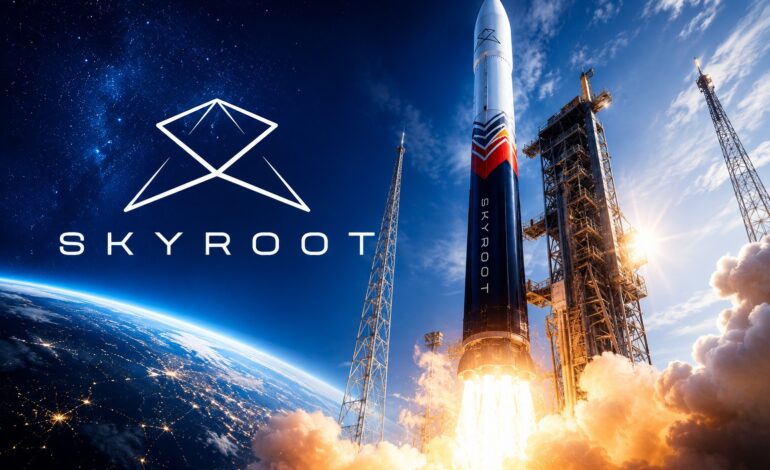
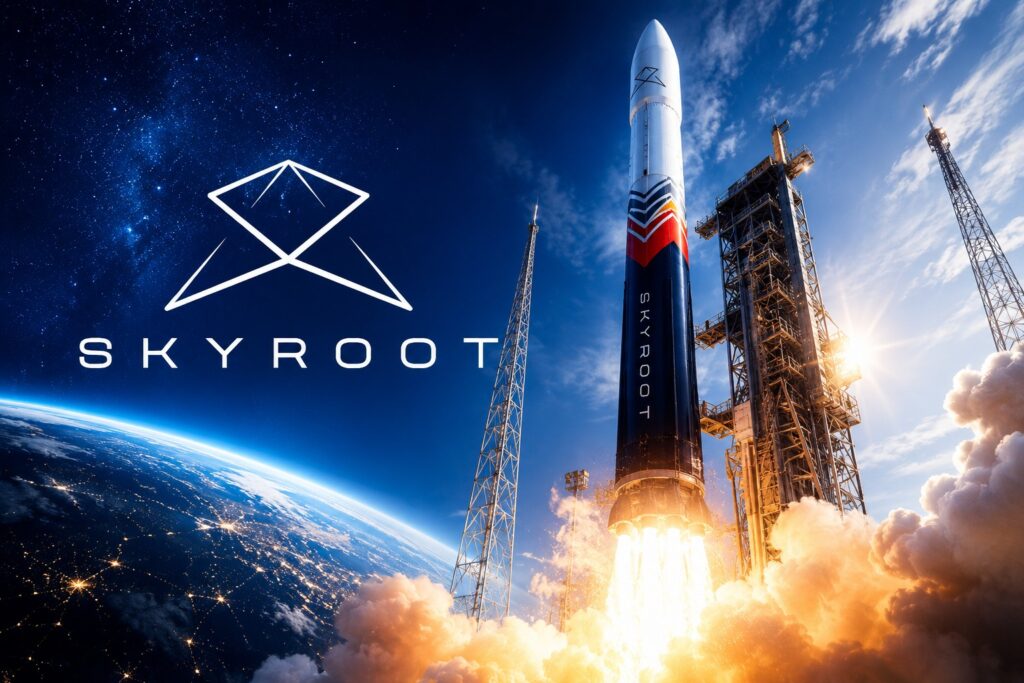
Skyroot said all stages of the launch vehicle have already been integrated and stacked at the launch pad. During the mission, engineers will collect performance data covering propulsion, stage separation, guidance, navigation, control systems and overall vehicle behaviour to validate the rocket’s design and support future commercial operations.
The seven-storey-tall Vikram-1 is an all-carbon composite, multi-stage launch vehicle powered by in-house developed propulsion technologies, including 3D-printed engines and high-thrust solid rocket motors. It is designed to place satellites weighing up to 350 kilograms into Low Earth Orbit (LEO) and will target an orbital altitude of 450 kilometres with a 60-degree inclination during its maiden mission.
Skyroot said the launch represents an important step in addressing the growing demand for dedicated and frequent satellite launches. The company believes indigenous launch capability will be crucial to supporting India’s rapidly expanding space economy, which is projected to grow from around USD 8.4 billion today to USD 44 billion by 2033.
Founded in Hyderabad, Skyroot became India’s first private company to launch a rocket into space in 2022 and has since emerged as the country’s first space-tech unicorn, with a valuation exceeding USD 1.1 billion. The company aims to make space launches as regular, reliable and affordable as air travel through its “Cab to Space” model.