India’s Trade Touches $1.84 Trillion, Pharma Sector Emerges as Growth Driver: NITI Aayog
While services exports continue to power India's trade resilience, NITI Aayog says the country's pharmaceutical industry must move beyond generics into biologics and advanced therapeutics to unlock global opportunities.
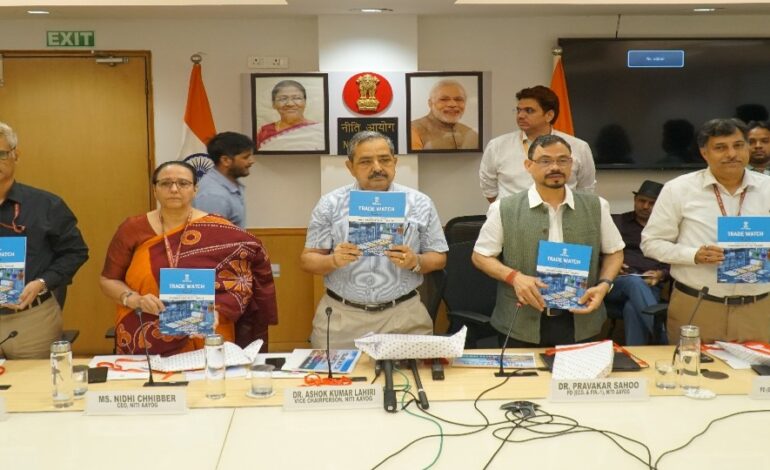
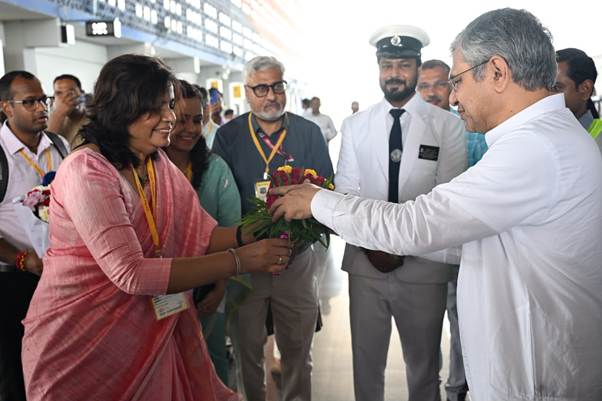
Ashok Kumar Lahiri, Vice Chairman of NITI Aayog, releases the eighth edition of the Trade Watch Quarterly covering January–March 2026 in New Delhi on Tuesday, in the presence of senior officials.

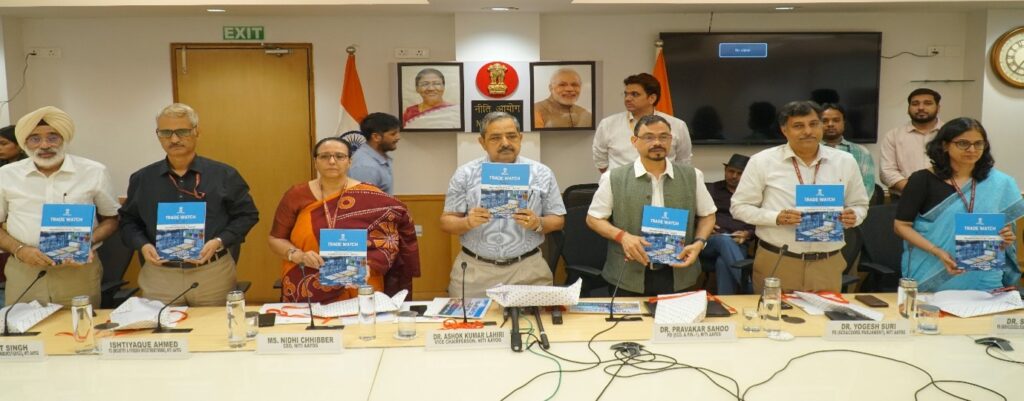
New Delhi: NITI Aayog has released the eighth edition of its Trade Watch Quarterly, highlighting India’s resilient trade performance in FY2025-26 and identifying the pharmaceutical sector as a strategic growth engine capable of significantly expanding the country’s footprint in global value chains.
The report, covering the January-March 2026 quarter, was released by NITI Aayog Vice Chairman Ashok Kumar Lahiri in New Delhi on Tuesday. The publication provides a detailed assessment of global and domestic trade trends at a time when international commerce continues to navigate geopolitical tensions, economic uncertainty and supply-chain realignments.
According to the report, India’s total merchandise and services trade expanded by 5.4 per cent year-on-year during FY2025-26, reaching $1.84 trillion, underlining the resilience of the country’s external sector despite global headwinds.
Services Sector Emerges as India’s Trade Powerhouse
One of the report’s key findings is the growing strength of India’s services sector, which continues to outperform merchandise trade.
Services exports recorded a robust 9 per cent growth during the fourth quarter of FY2025-26, helping sustain a strong trade surplus in services and offset pressures arising from slower merchandise export growth.
India retained its position as the world’s eighth-largest services exporter in 2025. Over the last decade, services exports have grown at a compound annual growth rate (CAGR) of 10.3 per cent, significantly higher than the global average, reflecting the country’s increasing competitiveness in technology, business and professional services.
Overall exports grew by 4.2 per cent, while imports increased by 6.5 per cent during FY2025-26, demonstrating continued integration with global markets.
Pharma Sector in Spotlight
The latest edition places special focus on India’s pharmaceutical industry, which has emerged as one of the country’s most globally competitive sectors.
India remains one of the world’s leading suppliers of generic medicines, vaccines and essential therapeutics, playing a crucial role in global healthcare systems and pharmaceutical supply chains.
The report estimates global pharmaceutical and Active Pharmaceutical Ingredient (API) demand at approximately $1.3 trillion in 2025, while India’s pharmaceutical and API exports stood at $35.8 billion.
Despite its strong reputation as the “pharmacy of the world,” India still accounts for a relatively modest share of global pharmaceutical trade, indicating substantial room for future expansion.
Moving Beyond Generic Medicines
The analysis notes that India’s export strength remains heavily concentrated in generic medicines and pharmaceutical formulations.
However, the global pharmaceutical industry is increasingly shifting toward high-value segments such as:
- Biologics
- Biosimilars
- Immunological products
- Advanced therapeutics
- Precision medicines
India’s presence in these high-growth categories remains limited, presenting both a challenge and a significant opportunity.
The report suggests that future growth will depend on the country’s ability to strengthen innovation, research and development capabilities while moving up the pharmaceutical value chain.
API Dependence Remains a Concern
The study also highlights India’s continuing dependence on imported raw materials and intermediates, particularly from China.
While India has improved its competitiveness in several specialized chemical intermediates and antibiotic ingredients, supply-chain vulnerabilities remain a concern.
Strengthening domestic API production and upstream manufacturing capabilities will be critical to improving resilience and reducing import dependence, according to the report.
Telangana Among India’s Pharma Powerhouses
The report identifies Telangana, Gujarat and Maharashtra as the three major pillars of India’s pharmaceutical ecosystem.
These states account for a significant share of the country’s pharmaceutical manufacturing, exports and global value-chain integration.
Their success has been driven by strong industrial clusters, globally competitive companies, research capabilities and supportive policy frameworks that have enabled rapid industry growth.
For Telangana, the recognition further reinforces Hyderabad’s position as one of the world’s leading pharmaceutical and life sciences hubs.
Roadmap for the Next Growth Phase
NITI Aayog’s analysis concludes that India is well-positioned to deepen its role in global pharmaceutical value chains.
The report recommends continued investments in:
- Research and development
- Innovation ecosystems
- Advanced manufacturing technologies
- Skilled workforce development
- Regulatory efficiency
- Export market access
Such measures could help India capture a larger share of the rapidly evolving global healthcare market while strengthening its position as both a manufacturing and innovation hub.
Trade Resilience Amid Global Uncertainty
Commenting on the findings, Ashok Kumar Lahiri noted that as global trade undergoes structural shifts, India must continue diversifying its export basket while building domestic capabilities in strategic sectors.
The pharmaceutical sector, he said, demonstrates both India’s existing strengths and its future potential. The next phase of growth will require moving beyond low-cost manufacturing toward innovation-led products and higher value-added exports.
With global healthcare demand rising and supply chains being reconfigured, the report suggests that India’s pharmaceutical industry could become one of the most important drivers of the country’s export growth story over the coming decade.
📈 Trade Watch Quarterly: Key Numbers
| Indicator | FY2025-26 Performance |
|---|---|
| Total Trade | $1.84 Trillion |
| Trade Growth | 5.4% YoY |
| Export Growth | 4.2% |
| Import Growth | 6.5% |
| Services Export Growth | 9.0% |
| Global Rank in Services Exports | 8th Largest Exporter |
| Global Pharma Market | $1.3 Trillion |
| India’s Pharma & API Exports | $35.8 Billion |
| Leading Pharma States | Telangana, Gujarat, Maharashtra |
| Key Opportunity Areas | Biologics, Biosimilars, Advanced Therapeutics |