AI Unlocks a Century of Solar History from Kodaikanal Observatory’s Hand-Drawn Sun Records
Researchers use machine learning to analyse 100 years of solar observations, offering new insights into the Sun's magnetic activity and long-term space weather patterns
Researchers have successfully used Artificial Intelligence (AI) to analyse nearly a century of hand-drawn solar observations from the historic Kodaikanal Solar Observatory (KoSO).

New Delhi: Researchers have successfully used Artificial Intelligence (AI) to analyse nearly a century of hand-drawn solar observations from the historic Kodaikanal Solar Observatory (KoSO), creating one of the longest continuous records of the Sun’s magnetic activity and opening new possibilities for understanding long-term solar cycles.
The study, led by Dibya Kirti Mishra of the Aryabhatta Research Institute of Observational Sciences (ARIES), demonstrates how modern machine learning techniques can transform historical astronomical records into high-quality scientific datasets. The findings have been published in The Astrophysical Journal.
The research team, which included scientists from the Indian Institute of Space Science and Technology (IIST), Thiruvananthapuram, the Southwest Research Institute, USA, and the Indian Institute of Astrophysics (IIA), Bengaluru, analysed hand-drawn Sun records spanning 1916 to 2007, covering nine solar cycles.
Scientists have long sought to understand the Sun’s magnetic cycles, which influence sunspots, solar flares and coronal eruptions. These solar events can affect satellites, GPS navigation, communication networks and power grids on Earth. However, incomplete and inconsistent historical observations have limited long-term studies.
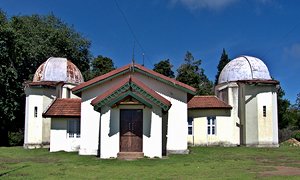
The Kodaikanal Solar Observatory, established in 1904, maintains one of the world’s most valuable archives of daily solar observations. Its collection includes meticulously hand-drawn “suncharts” documenting features such as sunspots, plages, filaments and prominences over more than a century.
To convert these historical drawings into usable scientific data, the researchers employed a supervised deep-learning model based on the U-Net architecture.
In the first stage, the AI model automatically identified the Sun’s disc in each scanned drawing, accurately determining its centre, size and orientation. In the second stage, it detected and mapped plages—bright, magnetically active regions on the Sun—across observations covering nine solar cycles.
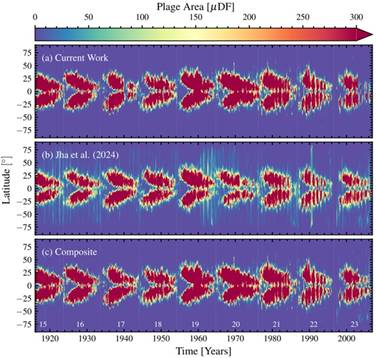
By extracting these features, the researchers generated a detailed “butterfly diagram,” a time-latitude map showing how solar magnetic activity migrates across the Sun during successive solar cycles.
The study found that the plage measurements derived from the hand-drawn suncharts closely matched observations obtained from KoSO’s Ca II K full-disk solar images, confirming the reliability of the AI-generated dataset. The combined records also help bridge gaps in historical observations, creating a more complete picture of solar activity over the past century.
According to the researchers, long-term records of the Sun’s magnetic behaviour are essential for comparing different solar cycles, reconstructing historical changes in solar energy output and improving scientific understanding of long-term space weather risks that can impact modern technological infrastructure.
The Department of Science and Technology (DST) said the study demonstrates how Artificial Intelligence can revive historical scientific archives, converting ageing hand-drawn observations into machine-readable datasets that will support future research in solar physics and space weather forecasting.
The research also highlights the growing role of AI in scientific discovery, enabling researchers to extract valuable insights from historical records that were previously difficult to analyse using conventional techniques.