Punjab completes e-Filing 3.0 rollout across all district courts as eCourts Phase III accelerates India’s digital justice transformation
Punjab has implemented e-Filing 3.0 across all district courts as the Centre intensifies eCourts Phase III, strengthening digital court infrastructure with modern equipment, virtual hearing facilities and technology-driven justice delivery.

The Ministry of Law and Justice said the eCourts Phase III project is being implemented through an institutional framework in which the e-Committee of the Supreme Court of India provides policy guidance while High Courts serve as the implementing agencies

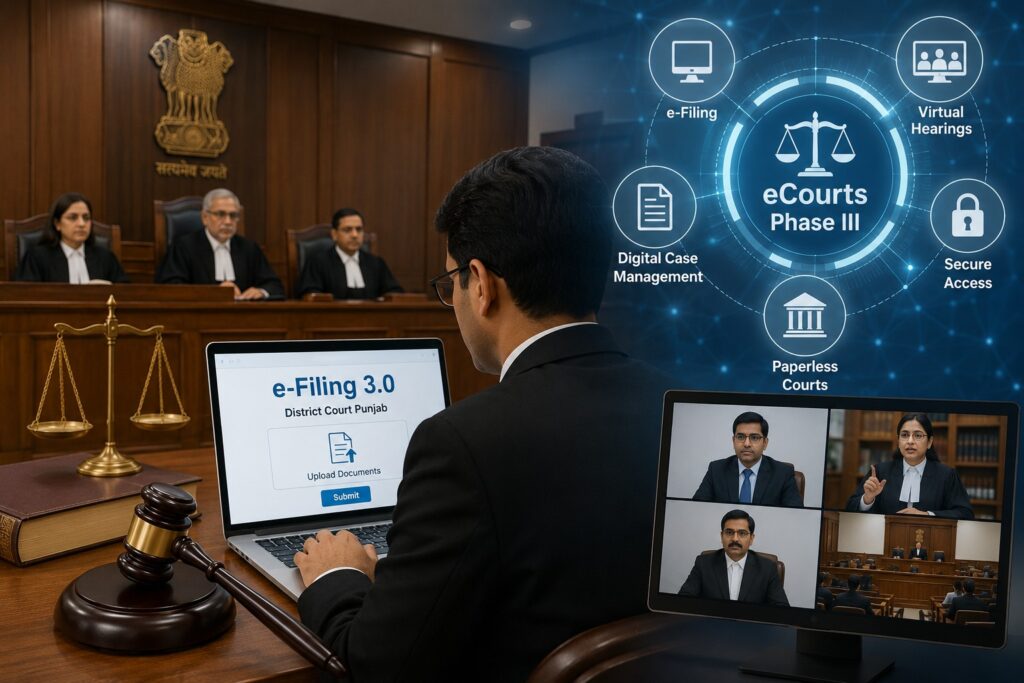
NEW DELHI: Punjab has completed the rollout of e-Filing 3.0 across all its district courts, marking another milestone in India’s ambitious digital justice transformation under the eCourts Mission Mode Project Phase III. The Union government has said that the project’s implementation is being monitored regularly to ensure timely execution of approved components and seamless modernization of the judicial system.
The Ministry of Law and Justice said the eCourts Phase III project is being implemented through an institutional framework in which the e-Committee of the Supreme Court of India provides policy guidance while High Courts serve as the implementing agencies. Progress is reviewed periodically through regular meetings, status reports and continuous coordination with the respective high courts to ensure effective execution of the programme.
According to the ministry, e-Filing 3.0 has now been implemented in all district courts across Punjab. The state’s district judiciary has also been equipped with adequate digital infrastructure to facilitate virtual hearings in line with the guidelines issued by the e-Committee of the Supreme Court of India. These measures are expected to make judicial processes more accessible, efficient and transparent for litigants, lawyers and courts.
The statement, presented in Parliament in response to a Lok Sabha question, provides a district-wise account of digital infrastructure supplied under the project. Courts across Punjab have been equipped with video conferencing cameras, desktop computers, scanners, document visualizers, public address systems, display boards, laptops, printers, servers, storage devices and other digital tools required for modern courtroom operations.
The largest deployments include hundreds of desktop computers, uninterrupted power supply systems, high-speed scanners, multifunction printers and video conferencing equipment distributed across districts such as Amritsar, Bathinda, Gurdaspur, Hoshiarpur, Jalandhar, Ludhiana, Patiala and several others. The equipment is intended to support paperless court proceedings, virtual hearings, electronic filing, digital record management and faster case processing.
The Ministry said the eCourts Mission Mode Project Phase III represents the next stage of judicial digitisation in India, building upon earlier phases that introduced case information systems, virtual courts, e-payment facilities, online case status services and video conferencing. The current phase focuses on creating a technology-enabled judicial ecosystem capable of delivering faster, citizen-centric and more transparent justice.
By enabling electronic filing across all district courts in Punjab and strengthening courtroom infrastructure with modern digital equipment, the Centre aims to reduce procedural delays, improve access to justice and enhance the overall efficiency of judicial administration. The initiative also aligns with the broader Digital India programme, under which technology is increasingly being integrated into public service delivery across sectors.
The information was provided by the Ministry of Law and Justice in a written reply to the Lok Sabha, reaffirming the government’s commitment to expanding digital infrastructure across India’s judicial system and ensuring that courts are equipped to meet the growing demands of a modern, technology-driven justice delivery framework.