AIM, STPI Bring Together Global Capability Centres to Deepen Startup and Innovation Collaboration
Bengaluru conclave explores stronger industry partnerships to connect school innovation, startup incubation and technology commercialisation
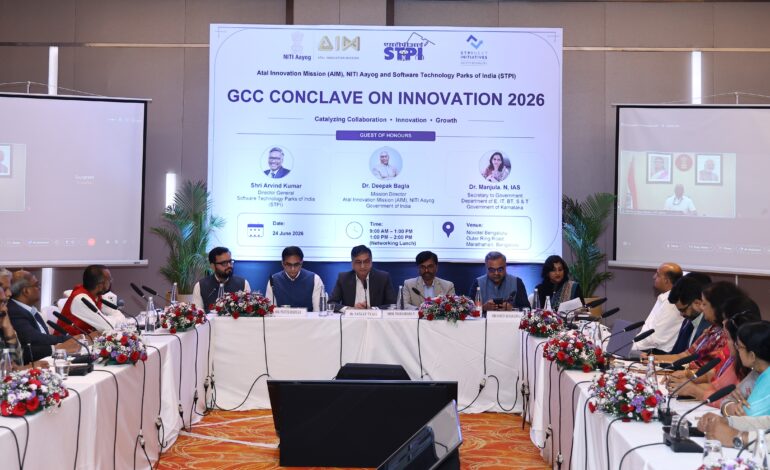
The conclave focused on creating structured partnerships between India's rapidly expanding Global Capability Centre (GCC) ecosystem and AIM's nationwide innovation network, spanning school-level innovation, startup incubation and enterprise acceleration.

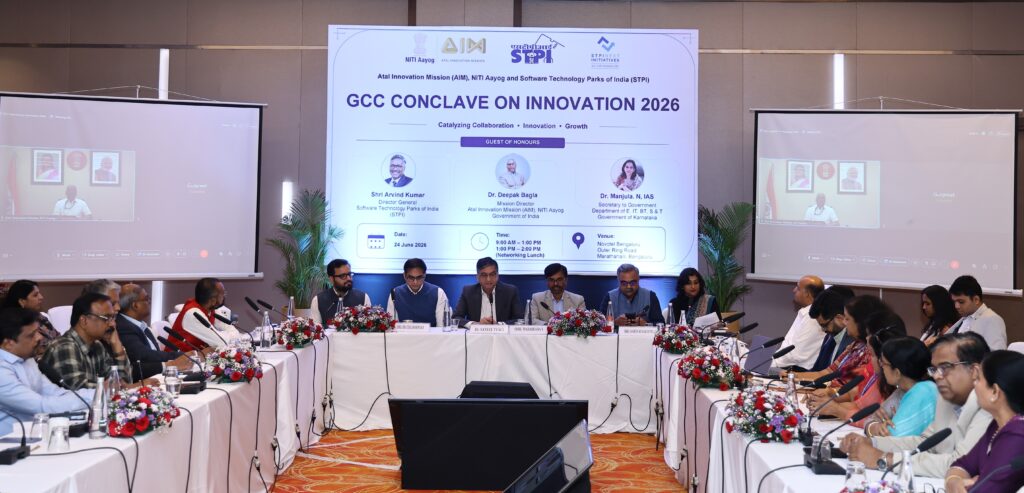
BENGALURU: The Atal Innovation Mission (AIM), NITI Aayog, in partnership with the Software Technology Parks of India (STPI), on Tuesday convened the GCC Conclave on Innovation 2026 in Bengaluru, bringing together Global Capability Centre (GCC) leaders, technology companies, startup incubators and policymakers to strengthen collaboration across India’s innovation ecosystem.
The conclave focused on creating structured partnerships between India’s rapidly expanding Global Capability Centre (GCC) ecosystem and AIM’s nationwide innovation network, spanning school-level innovation, startup incubation and enterprise acceleration.
Senior executives from leading multinational companies, including Intel, IBM, Bosch, Amazon, SAP, Shell, Mercedes-Benz, NVIDIA, Samsung, Philips, Morgan Stanley, Thermo Fisher Scientific, CGI, Yahoo, Wipro and SanDisk, participated in the event alongside representatives from Atal Tinkering Labs (ATLs), Atal Incubation Centres (AICs), Atal Community Innovation Centres (ACICs), STPI Centres of Entrepreneurship and the Karnataka Digital Economy Mission (KDEM).
Connecting innovation with industry
The conclave explored opportunities for GCCs to engage with innovators at every stage of AIM’s innovation pipeline—from nurturing school students through Atal Tinkering Labs, supporting startups through AICs and ACICs, to helping growth-stage startups scale through AIM’s upcoming Atal Acceleration Centres for Scale-up of Startups (AACESS) programme.
The objective is to create stronger industry-led innovation by enabling startups to access mentorship, technology validation, pilot projects, commercialisation opportunities and global market linkages through multinational companies operating GCCs in India.
GCCs emerging as innovation hubs
Addressing the conclave, Arvind Kumar, Director General, STPI, said India’s GCC ecosystem has evolved into a major global innovation engine.
He noted that India today hosts more than 2,100 Global Capability Centres, generating nearly USD 100 billion in annual revenue, reflecting the country’s growing importance in global technology, engineering and product development.
According to him, STPI’s nationwide network of technology parks and entrepreneurship centres, when combined with AIM’s innovation ecosystem, can provide GCCs with a structured platform to co-create technologies, mentor startups and accelerate India’s innovation-driven growth.
Industry participation crucial
Deepak Bagla, Mission Director, Atal Innovation Mission, highlighted the importance of industry participation in nurturing innovation from classrooms to globally competitive enterprises.
He said AIM has built one of the country’s largest innovation ecosystems through more than 10,000 Atal Tinkering Labs and over 100 incubators, creating a continuous pipeline of innovators, entrepreneurs and startups.
Bagla invited GCCs to actively contribute through mentorship, innovation challenges, pilot deployments, market access and startup partnerships, helping transform promising ideas into globally scalable businesses.
Focus on industrial acceleration
One of the major discussions centred around AIM’s proposed AACESS Industrial Accelerator Programme, which aims to strengthen collaboration between startups and industry by providing growth-stage startups access to industrial validation, pilot opportunities, industry mentorship and commercialisation support.
Participating GCCs were invited to help shape the programme by identifying sector priorities, engagement models and collaboration mechanisms that can accelerate technology adoption and startup scale-up.
Four key themes
The conclave featured discussions around four major themes:
- Reimagining school innovation through Atal Tinkering Labs (ATLs)
- Strengthening startup incubation through AICs and ACICs
- Scaling innovation through the AACESS Industrial Accelerator initiative
- Building joint accelerator platforms through collaboration between GCCs and STPI’s Centres of Entrepreneurship
Participants also explored opportunities for technology commercialisation, sector-specific accelerator programmes and stronger integration between startups and multinational enterprises.
Why this matters
India’s Global Capability Centres have evolved well beyond back-office operations to become global hubs for research, engineering, product development and innovation. As multinational companies increasingly undertake cutting-edge R&D from India, connecting GCCs with the country’s startup ecosystem has become a strategic priority.
The AIM-STPI initiative seeks to bridge this gap by creating structured engagement between global enterprises and Indian innovators. If successfully implemented, these partnerships could accelerate technology commercialisation, improve startup access to global markets and strengthen India’s position as one of the world’s leading innovation ecosystems in line with the vision of Viksit Bharat 2047.