India’s GCCs Emerge as Global Innovation Engines as AI Takes Centre Stage: NTT DATA–The Mainstream Report
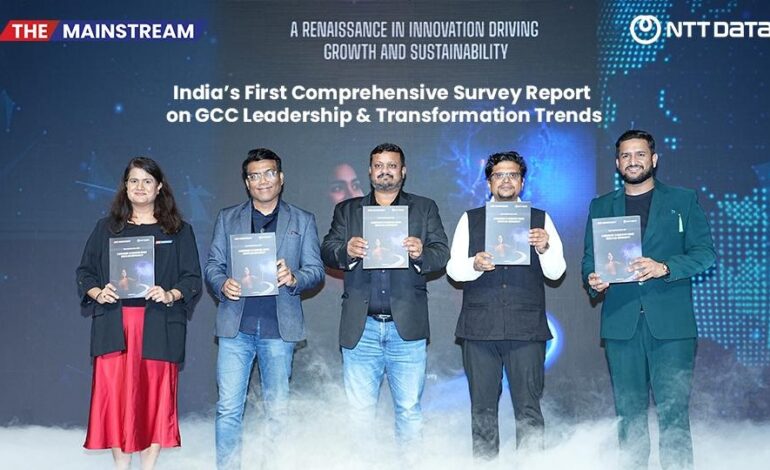
Khushbu Soni, Co-Founder & CEO, The Mainstream, Manish Kumar Sinha, Founder & CEO, Zamun, Ankur Dasgupta, Head of Marketing, NTT DATA India, Santosh Srikantaiah, Vice President Innovation Center India, NTT DATA India, Jigar Soni, Co-Founder, The Mainstream, during the release of the report in Bengaluru on Wednesday.

Bengaluru: India’s Global Capability Centres (GCCs) are undergoing a decisive transformation—from cost-focused offshore units to globally influential innovation hubs—driven by artificial intelligence, leadership evolution and outcome ownership, according to the India GCC Innovation Transformation Report 2025 released by NTT DATA in collaboration with The Mainstream.
Unveiled at the GCC Converge Summit – Bengaluru Edition, the report finds that nearly 40% of India’s GCC ecosystem has already transitioned into innovation-led centres, actively contributing to digital modernization, product co-creation and customer experience design for global enterprises. More than 45% of GCCs are deploying AI within core business processes, marking a pivotal shift in how value is created and measured across multinational organisations.
From Cost Efficiency to Value Ownership
India currently hosts close to 2,000 GCCs employing nearly two million professionals, spanning sectors such as technology, engineering, consulting, manufacturing and BFSI. Over the past decade, these centres have steadily evolved beyond transactional execution roles to become strategic partners shaping enterprise-wide transformation.
The report highlights a clear inflection point: while operational excellence remains table stakes, value creation, innovation ownership and monetisation are now defining GCC maturity. Leading GCCs are increasingly responsible for end-to-end product mandates, platform engineering and global customer experience outcomes.
However, the next phase of growth will require standardising how innovation value is measured and monetised—an area where many GCCs are still developing consistent frameworks.
AI as the Defining Differentiator
Artificial intelligence has emerged as the most powerful catalyst in this transformation. Nearly all surveyed GCCs are investing in AI-led initiatives, though maturity levels vary widely. The report identifies an almost even distribution across four stages of AI adoption—exploration, piloting, functional integration and enterprise-scale deployment—with 22–25% of GCCs in each category.
GCCs that have embedded AI deeply into core workflows are already gaining a competitive advantage, particularly in areas such as predictive analytics, intelligent automation, product engineering and decision intelligence.
Talent Depth and Leadership Gaps
Despite India’s vast talent pool, the report flags a persistent challenge: end-to-end outcome ownership. Around 42% of GCCs cite shortages in specialised deep-tech skills, limiting their ability to lead full product lifecycles and innovation agendas.
To address this, more than 70% of GCCs are investing in leadership capability building, with 42% implementing structured leadership development programmes and 31% adopting mentor–mentee models. The emphasis is shifting toward nurturing product visionaries, technology strategists and innovation leaders capable of translating ambition into global-scale impact.
Purpose-Driven Innovation and ESG Alignment
Beyond technology, GCCs are increasingly embedding ESG principles, green operations and responsible AI into their global mandates. The report notes that sustainability and ethics are no longer peripheral considerations but integral to innovation strategies, reflecting growing expectations from global headquarters, regulators and customers.
Policy Perspective
Reacting to the findings, Piyush Goyal, Union Minister of Commerce and Industry, said the report underscores the strategic importance of GCCs in India’s innovation ecosystem.
“The report clearly highlights how GCCs have evolved into strategic hubs driving digital transformation, advanced technologies and high-value talent development. Their growing contribution to global competitiveness reinforces India’s position as a preferred destination for innovation-led enterprises and future-ready global organisations,” he said.
Industry Voices
Khushbu Soni, Co-Founder and CEO of The Mainstream, said the research goes beyond surface-level metrics to capture the mindset shaping global innovation hubs.
“India’s capability centres are becoming the world’s innovation laboratories—where technology, talent and purpose converge. This report reflects deep leadership intent behind that shift,” she said.
Avinash Joshi, Executive Managing Director, India, NTT DATA, said the report marks a turning point in India’s GCC journey.
“As AI becomes a core enterprise differentiator, India’s GCCs are poised to lead global transformation agendas. With the right collaboration and vision, they will shape the future of enterprise and society,” he noted.
Research Methodology
The report is based on in-depth engagements with over 250 GCC leaders and practitioners across Bengaluru, Hyderabad, Pune and Delhi. Participants included technology leaders, GCC heads and senior executives from HR, finance and procurement functions.
The research adopted a hybrid methodology combining one-on-one interviews, national surveys, leadership roundtables held during the GCC Converge Summit, and secondary benchmarking against global industry studies—ensuring insights that are both data-driven and grounded in lived leadership experience.
A New Global Role for India’s GCCs
As multinational enterprises recalibrate their global operating models, the report concludes that India’s GCCs are no longer peripheral support centres but central drivers of innovation, resilience and strategic growth. With AI, leadership depth and purpose-led transformation at the core, India’s GCC ecosystem is rapidly positioning itself as a global benchmark for innovation-led enterprise delivery.