India–EU Free Trade Agreement Concluded, Unlocking Unprecedented Market Access
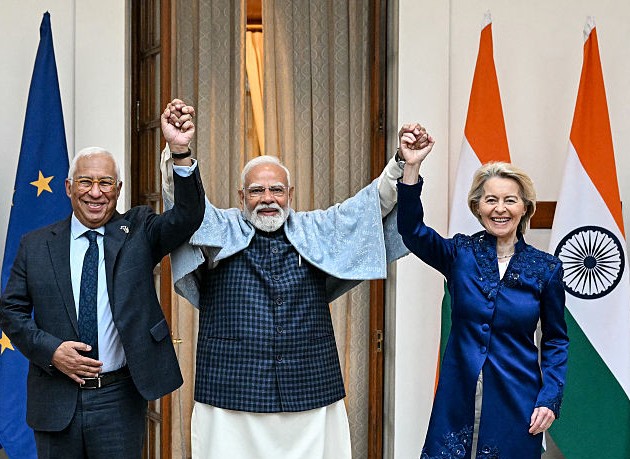
The agreement was unveiled at the 16th India–EU Summit by Prime Minister Narendra Modi and European Commission President Ursula von der Leyen in the presence of António Costa in New Delhi on Tuesday.

Deal announced at 16th India–EU Summit; over 99% of Indian exports to gain preferential entry into the European Union
New Delhi: India and the European Union Tuesday announced the conclusion of the India–EU Free Trade Agreement, marking a decisive milestone in India’s global trade engagement. The agreement was unveiled at the 16th India–EU Summit by Prime Minister Narendra Modi and European Commission president Ursula von der Leyen.
The FTA brings together the world’s fourth-largest and second-largest economies, accounting for nearly 25% of global GDP and one-third of global trade. It positions India and the EU as trusted partners committed to open markets, predictability, and inclusive growth.
Negotiations, relaunched in 2022, culminated after sustained engagement and political consensus on a balanced, modern, and rules-based trade framework.
Unprecedented access for Indian exports
A key highlight of the agreement is preferential market access for over 99% of Indian exports by value to the EU. Exports worth nearly ₹6.41 lakh crore (USD 75 billion) are expected to gain momentum, with USD 33 billion in labour-intensive sectors such as textiles, apparel, leather, marine products, gems and jewellery, handicrafts, engineering goods, and automobiles benefiting from tariff elimination of up to 10% upon entry into force.
The agreement is expected to create significant employment opportunities for women, artisans, youth, professionals, and MSMEs, while integrating Indian enterprises more deeply into global value chains.
Trade, services, and mobility
The FTA covers trade in goods and services, rules of origin, customs facilitation, trade remedies, and emerging areas such as digital trade and SMEs. Services—now the fastest-growing segment of India–EU economic engagement—receive commercially meaningful commitments across IT and IT-enabled services, professional services, education, financial services, tourism, construction, and other business sectors.
India secures predictable access to 144 EU services subsectors, while the EU gains access to 102 Indian subsectors, enabling reciprocal growth and technology inflows.
A future-ready mobility framework facilitates short-term business travel, intra-corporate transfers, contractual service suppliers, and independent professionals across multiple sectors. Provisions also cover dependent entry, student mobility, and post-study work opportunities.
Agriculture, automobiles, and safeguards
India’s agricultural and processed food exports—including tea, coffee, spices, fruits, vegetables, and processed foods—gain enhanced market access. Sensitive sectors such as dairy, cereals, poultry, soymeal, and select produce remain safeguarded, ensuring domestic stability.
In automobiles, a calibrated quota-based liberalisation allows EU manufacturers limited access to higher price segments, while opening future opportunities for Make in India manufacturing and exports to the EU.
Climate, technology, and IP
The agreement includes forward-looking provisions on the EU’s Carbon Border Adjustment Mechanism (CBAM), ensuring dialogue, flexibility, technical cooperation, and support for emissions reduction.
It reinforces TRIPS-compliant intellectual property protections, affirms the Doha Declaration, and recognises India’s Traditional Knowledge Digital Library. Cooperation is also envisaged in artificial intelligence, clean technologies, semiconductors, and digital payments.
Strategic impact
In 2024–25, India–EU trade in goods stood at ₹11.5 lakh crore (USD 136.5 billion), while services trade reached ₹7.2 lakh crore (USD 83.1 billion). The FTA is expected to significantly scale these figures, enhance export competitiveness, and deepen investment flows.
The India–EU agreement becomes India’s 22nd FTA, complementing recent trade pacts with the UK, EFTA, UAE, Australia, Oman, and New Zealand. Together, these agreements effectively open the entire European market to Indian exporters and entrepreneurs.
Aligned with India’s vision of Viksit Bharat 2047, the India–EU FTA lays the foundation for inclusive, resilient, and future-ready growth, strengthening India’s position as a trusted global trade partner.