Azul Launches Free JVM Risk Assessment as AI-Driven Cyber Threats Accelerate
Company warns autonomous AI tools can now discover and exploit Java vulnerabilities in days or hours, shrinking traditional security response windows

As more public services, financial transactions and critical infrastructure move onto digital platforms, the ability to detect threats early and coordinate responses across government and industry is becoming a critical component of India's digital infrastructure.


New Delhi: Enterprise Java solutions provider Azul has launched a free JVM Vulnerability Risk Assessment aimed at helping organizations identify and address hidden security risks across their Java environments as autonomous AI-powered cyberattacks become increasingly sophisticated.
The company said the initiative comes amid a dramatic shift in the cybersecurity landscape, where advances in artificial intelligence are significantly reducing the time required to discover and exploit software vulnerabilities.
According to Azul, the emergence of advanced AI systems capable of autonomously identifying previously unknown vulnerabilities and generating exploit paths has transformed the threat environment for enterprises running large Java estates. Vulnerabilities that once required months of specialized research can now potentially be exploited within days or even hours.
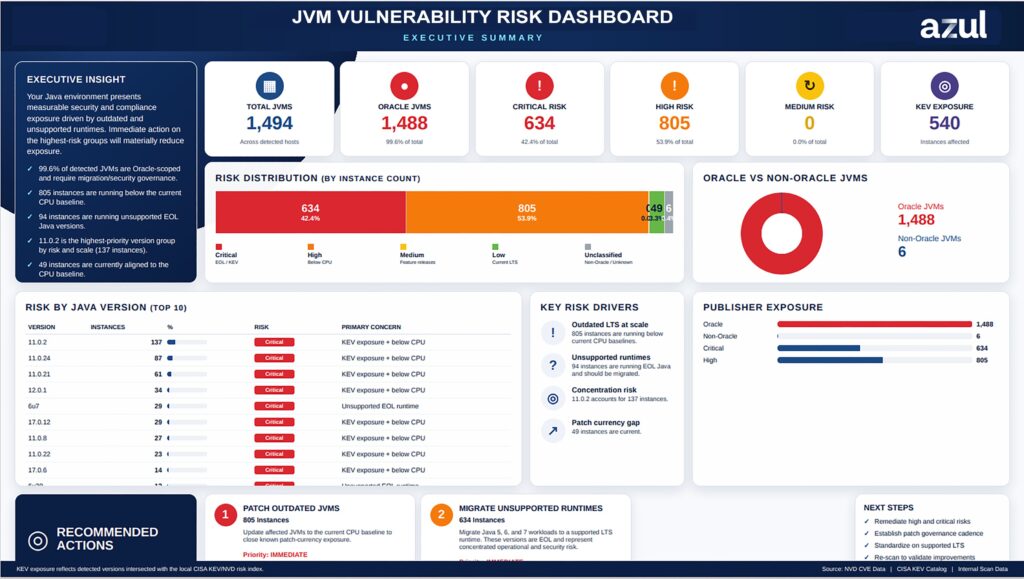
To help organizations respond to these evolving risks, Azul’s free assessment provides comprehensive visibility into Java runtime environments, enabling DevOps and SecOps teams to identify vulnerable Java versions, prioritize remediation efforts and strengthen security posture.
The assessment delivers an executive-level dashboard, risk-by-version analysis, identification of known exploited vulnerabilities, and a prioritized remediation roadmap. It is designed to help organizations uncover embedded or unmanaged Java runtimes that may otherwise escape conventional asset discovery processes.
“Through our strategic partnership with Azul, we significantly reduced our security risk level with our Java applications and Java-based infrastructure,” said Jenny Nelson, Head of ICT & Digital at Newcastle City Council, highlighting the operational benefits of standardizing Java environments.
Azul emphasized that security patch velocity has become a critical defense mechanism as AI-enabled attackers accelerate vulnerability discovery and exploitation. The company’s enterprise Java platform supports organizations through quarterly security-focused updates, emergency patches and full-stack runtime visibility.
The company noted that regulated sectors such as financial services, healthcare, utilities and government face heightened risks due to stringent compliance requirements and the complexity of their Java estates. Regulatory frameworks increasingly demand visibility into software versions, timely patching and documented vulnerability management processes.
Scott Sellers, Co-founder and CEO of Azul, said the rise of autonomous AI exploitation tools means organizations can no longer rely on traditional assumptions about security.
“AI can now discover and weaponize vulnerabilities on its own. The deep expertise that once stood between attackers and enterprise software environments is no longer a barrier,” Sellers said.
Azul stated that its JVM Vulnerability Risk Assessment can be deployed as a standalone analysis or integrated into broader security, licensing and compliance programmes delivered through its partner ecosystem.
The company serves a wide range of global enterprises and says its Java platform powers mission-critical systems for more than one-third of Fortune 100 companies and many of the world’s leading financial institutions and consumer brands.