
The Guardrails Gap: An Industry Expert’s Blueprint for Safe, Scalable Agentic AI
Gartner predicts that more than 40% of agentic AI projects will be canceled by 2027. Despite widespread investment, only 11% of organizations currently run AI agents in production. The gap
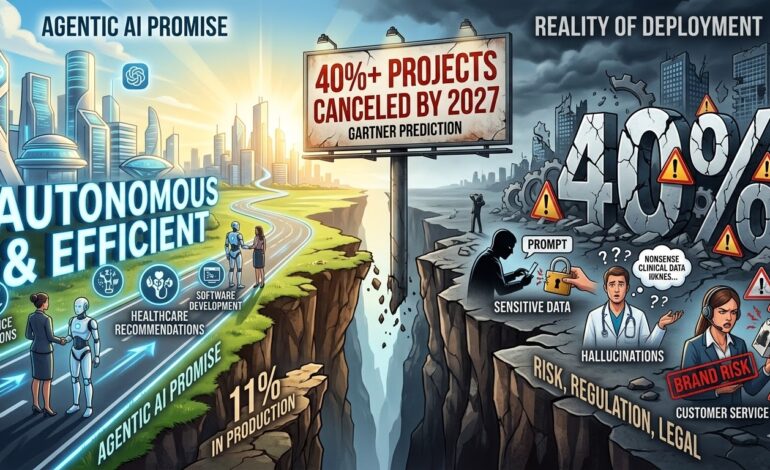
Gartner predicts that more than 40% of agentic AI projects will be canceled by 2027.

Gartner predicts that more than 40% of agentic AI projects will be canceled by 2027. Despite widespread investment, only 11% of organizations currently run AI agents in production. The gap between AI ambition and safe deployment is quickly becoming one of the defining technology challenges of this decade.
The promise of agentic AI is compelling: autonomous systems capable of reasoning, planning, and executing complex business workflows with minimal human oversight. Enterprises envision agents assisting with financial decision-making, healthcare recommendations, software development, and customer operations.
But as organizations rushed to deploy these systems, a different reality emerged. Financial services agents exposed sensitive data through prompt injection attacks. Healthcare assistants generated hallucinated clinical guidance. Customer-facing systems produced responses that created brand, regulatory, and legal risks.
The problem is not that AI lacks capability. The problem is that most organizations are attempting to scale AI systems without the guardrails required to make them trustworthy.
Trustworthy AI requires more than powerful models. It requires evaluation frameworks, bias controls, and governance architecture designed from the beginning to ensure that autonomous systems behave reliably, safely, and transparently.
Dr Swati Tyagi, an AI/ML industry leader and researcher whose contributions span patented innovations, peer-reviewed publications, and enterprise-scale deployments of trustworthy AI systems, argues that overcoming this challenge will require a structural shift in how organizations design, evaluate, and responsibly scale AI technologies. According to her, the next phase of AI innovation will not be defined solely by model capability, but by the ability of organizations to build trustworthy, well-governed AI systems that can operate safely and reliably in high-stakes, real-world environments.
Her blueprint for responsible agentic AI rests on three pillars: evaluation, fairness, and governance.
1. Holistic Evaluation
Most enterprises still evaluate AI systems using traditional benchmarks designed for narrow tasks. These evaluation methods were never intended to measure the reliability of autonomous agents operating in open-ended environments.
Research such as Stanford’s HELM study shows that model accuracy alone does not predict bias, toxicity, or hallucination risk. In regulated industries, relying solely on accuracy metrics can create a dangerous false sense of confidence.
To address this gap, Dr Tyagi developed an open-source LLM evaluation toolkit used by AI practitioners globally. The framework integrates multi-method hallucination detection, entity verification, numerical reasoning validation, and fairness metrics enabling organizations to evaluate AI systems across multiple dimensions before deploying them in production.
“The evaluation bottleneck is not a side problem, it is the central problem,” says Dr Tyagi. “If your evaluation framework only measures accuracy, you are blind to the failure modes that actually break AI systems in production.”
Holistic evaluation transforms AI systems from experimental prototypes into trustworthy enterprise infrastructure.
2. Bias Mitigation at the Architectural Level
Bias in AI systems is not an isolated issue; it is a systemic risk that scales with automation.
An AI agent may perform well on benchmarks while still perpetuating gender bias in hiring systems, racial bias in lending decisions, or disparities in healthcare recommendations.
Dr Tyagi’s research focuses on addressing this challenge at the technical root. Her work on debiasing deep generative models and representation learning introduces methods that mitigate bias at the embedding and model architecture level before biased patterns propagate into downstream decision systems.
“When an automated system processes thousands of decisions a day, small biases compound into large societal impacts,” she explains. “Guardrails must be built upstream in the model architecture, not added after deployment.”
By embedding fairness mechanisms early in the design process, organizations can build AI systems that are both powerful and socially responsible.
3. Governance by Design
Many organizations attempt to address AI governance only after systems are deployed. This reactive approach often leads to operational failures, compliance violations, and reputational damage.

Dr Tyagi advocates for governance-by-design, where evaluation pipelines, explainability mechanisms, monitoring systems, and oversight frameworks are integrated directly into the AI architecture.
“Governance is not the enemy of innovation,” she says. “It is the foundation that allows AI systems to scale safely.”
Without governance guardrails, autonomous systems can introduce unpredictable behavior into high-stakes environments. With governance integrated from the start, organizations can deploy AI systems that are auditable, reliable, and resilient.
The Path Forward
Industry analysts increasingly agree that the organizations capable of combining rigorous evaluation, fairness safeguards, and governance frameworks will be the ones that successfully scale agentic AI.Those that fail to address these issues risk becoming part of the growing list of abandoned AI initiatives. “The question is no longer whether enterprises will deploy AI agents,” Dr. Tyagi says. “The real question is whether they will deploy them responsibly.” The next generation of AI systems will not be defined solely by their intelligence. They will be defined by how trustworthy, transparent, and well-governed they are.
Organizations that build these guardrails today will be the ones that successfully scale AI tomorrow.