CBDC-based food subsidy transfers to begin in Chandigarh and Dadra & Nagar Haveli
The two Union Territories will become the first to provide food subsidies to all eligible PMGKAY beneficiaries through programmable digital rupee tokens, building on earlier pilots in Puducherry and Gujarat.
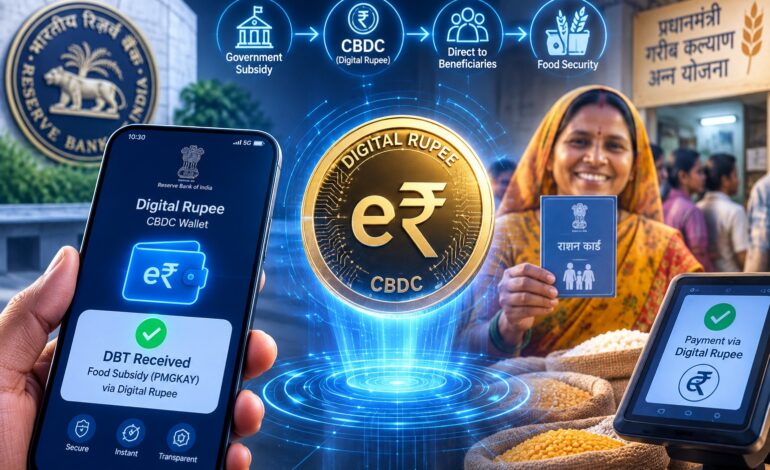
The two Union Territories will become the first in the country to operationalise food subsidy transfers to all eligible PMGKAY beneficiaries through programmable CBDC tokens deposited directly into their CBDC wallets.

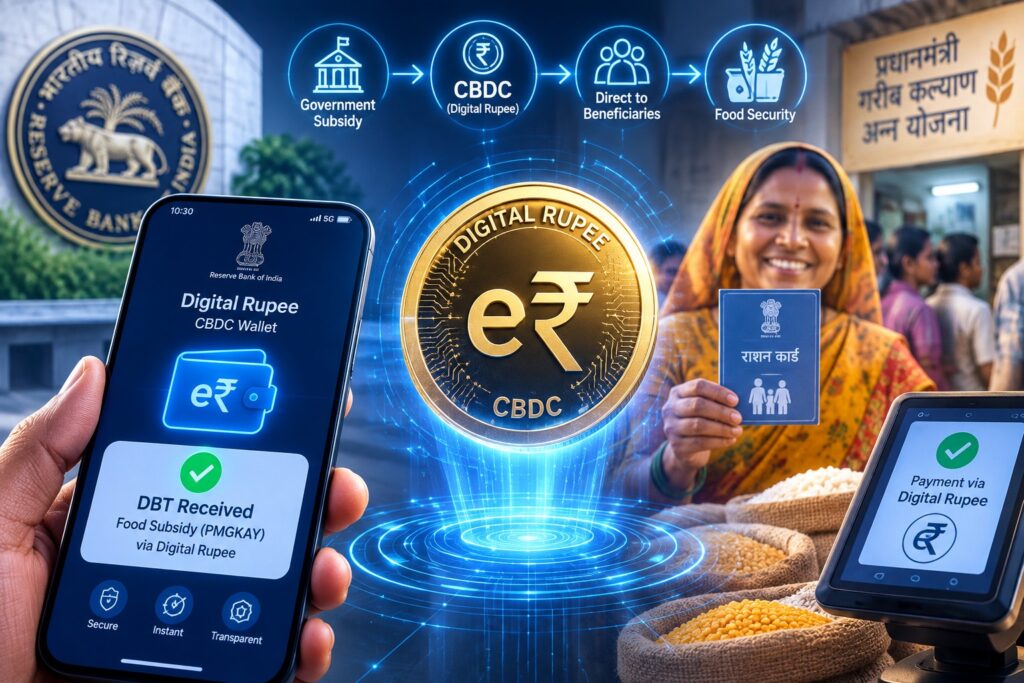
NEW DELHI: The Government of India is set to launch Central Bank Digital Currency (CBDC)-based Direct Benefit Transfer (DBT) under the Pradhan Mantri Garib Kalyan Anna Yojana (PMGKAY) in Chandigarh and Dadra & Nagar Haveli on August 14, marking a further expansion of the digital rupee into India’s welfare delivery system.
The two Union Territories will become the first in the country to operationalise food subsidy transfers to all eligible PMGKAY beneficiaries through programmable CBDC tokens deposited directly into their CBDC wallets.
The launch will be attended by Union Minister for Consumer Affairs, Food and Public Distribution Pralhad Joshi, Governor of Punjab and Administrator of Chandigarh Gulab Chand Kataria, Union Minister for Agriculture and Farmers Welfare Shivraj Singh Chouhan, Minister of State for Consumer Affairs, Food and Public Distribution Nimuben Jayantibhai Bambhaniya and other dignitaries.
Under the new model, eligible PMGKAY beneficiaries will receive their food subsidy directly in their CBDC wallets rather than through conventional bank-account transfers.
The digital subsidy can then be used to purchase foodgrains from empanelled merchants through a secure, traceable and real-time digital payment mechanism.
The government sees the rollout as a significant step towards a more technology-driven welfare-delivery system, with CBDC being used not merely as a digital form of money but as a programmable instrument linked to a specific welfare benefit.
The model is intended to provide end-to-end traceability of public funds and reduce the scope for leakages, diversion and cash handling associated with traditional subsidy-delivery mechanisms.
It is also expected to enable instant and secure transfer of benefits while promoting financial inclusion through wallet-based digital transactions.
The Chandigarh and Dadra & Nagar Haveli rollout builds on earlier pilot implementations in Puducherry and Gujarat.
The government said the latest expansion will achieve complete digital adoption and saturation among all eligible beneficiaries in the targeted Union Territories.
Real-time monitoring of subsidy utilisation is another intended benefit of the system.
Because transactions take place through the CBDC mechanism, the government expects greater visibility into the utilisation of food subsidies while maintaining a digital trail from the transfer of the benefit to its eventual use for purchasing foodgrains.
The initiative consequently links three elements of India’s digital policy architecture — the Digital Rupee, Direct Benefit Transfer and Digital Public Infrastructure.
Instead of transferring money into a conventional bank account and leaving its subsequent use outside the direct architecture of the welfare programme, the CBDC model allows the subsidy to be programmed for its intended purpose and spent through participating merchants.
The government is positioning the rollout as a proof of concept for the wider country.
The experience gained in Chandigarh and Dadra & Nagar Haveli is expected to provide operational insights into integrating CBDC with welfare schemes, including beneficiary onboarding, wallet-based transactions, merchant participation and monitoring of subsidy utilisation.
If the model proves scalable, similar CBDC-enabled welfare transfers could potentially be adopted by other states and union territories.
The initiative also reflects the broader evolution of India’s digital public infrastructure, with emerging digital-payment technologies being brought into public-service delivery rather than being confined to commercial transactions.
For beneficiaries, the immediate change will be the manner in which the food subsidy is received and used.
For the government, the larger objective is to create a welfare-delivery mechanism that is transparent, traceable and digitally monitored from the point at which public funds are transferred to the point at which the intended beneficiary uses them.
The August 14 launch will therefore serve as an important test of whether the Digital Rupee can move beyond payments and become an infrastructure layer for delivering targeted government benefits.