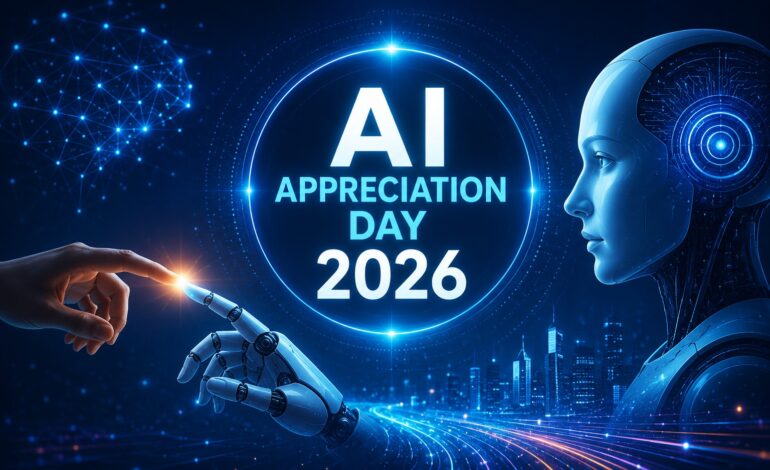
AI Appreciation day 2026: How India’s AI Ecosystem Thinks
From healthcare and manufacturing to finance, education and governance, AI is transforming how organisations operate, make decisions and deliver services.
For India's technology ecosystem, AI represents both an economic opportunity and a strategic imperative.

NEW DELHI: As the world marks AI Appreciation Day on July 16, artificial intelligence has moved far beyond being a futuristic concept to become a foundational technology shaping economies, businesses and public services. From healthcare and manufacturing to finance, education and governance, AI is transforming how organisations operate, make decisions and deliver services. At the same time, its rapid adoption is redefining the cybersecurity landscape, creating new opportunities for innovation while introducing increasingly sophisticated digital risks.
For India’s technology ecosystem, AI represents both an economic opportunity and a strategic imperative. With one of the world’s largest digital public infrastructures, a thriving startup ecosystem and a vast pool of engineering talent, the country is well-positioned to emerge as a global AI leader. However, sustaining that leadership will depend not only on developing cutting-edge AI solutions but also on ensuring they are secure, transparent and trustworthy.
To mark AI Appreciation Day 2026, Digital India Times presents perspectives from technology leaders on how AI is reshaping industries, the opportunities it will unlock over the next five years, and the challenges India must address to lead the next wave of responsible AI innovation.
Srinivas Shekar CEO & Co-Founder, Pantherun Technologies

How has AI changed your organisation or industry over the past year?
The biggest change hasn’t been AI itself; it’s the speed at which the cyber threat landscape has evolved because of it. AI has lowered the barrier for attackers to automate activities that once required significant expertise, from identifying vulnerabilities and generating highly convincing phishing campaigns to adapting attacks in real time based on the environment they are targeting.
For the cybersecurity industry, this has fundamentally changed the way we think about defence. It is no longer enough to rely on signatures or identify known threats. Security systems must recognise abnormal behaviour, respond in real time and continuously adapt as attacks evolve.
At the same time, AI is becoming embedded in connected devices and critical infrastructure, making the protection of data in transit just as important as protecting the endpoint itself. The conversation is gradually shifting from detecting attacks to building security into the foundation of digital systems.
What excites you most about AI in the next five years?
What interests me most is not AI replacing people, but AI helping organisations make better security decisions. Every connected system generates an enormous amount of information. The challenge has never been the lack of data but understanding what actually matters. AI has the ability to reduce that complexity by identifying patterns, providing context and allowing security teams to focus on risks that genuinely require attention.
At the same time, AI will become part of the infrastructure that supports transportation, manufacturing, energy and public services. As these systems become more intelligent, protecting the integrity of the data they exchange will become increasingly important. The opportunity lies in ensuring that innovation and security continue to evolve together rather than independently.
What is the one challenge India must solve to become a global AI leader?
India has the engineering talent, entrepreneurial ecosystem and digital public infrastructure to become a global AI leader. The bigger challenge is building trust at scale. AI systems are only as reliable as the data, infrastructure and security that support them.
As AI becomes part of financial services, healthcare, transportation and critical infrastructure, organisations need confidence that these systems are secure, resilient and protected against manipulation. That means cybersecurity cannot be viewed as a separate layer added after deployment. It needs to be part of the way AI systems are designed from the beginning.
India has an opportunity to differentiate itself by building AI that is not only innovative, but also trusted. If we can combine strong engineering with secure digital infrastructure and responsible implementation, we will be well positioned to lead the next phase of AI adoption.
Human Judgment Will Define AI’s True Value: Sandeep Kumar Jain, Managing Director, CDK India

Artificial intelligence is creating new possibilities for how organisations solve problems, make decisions and serve their customers. At CDK Global India, we see its greatest value emerging when technological capability is combined with human judgement, empathy and a deep understanding of context. In automotive retail, this partnership can help simplify complex processes, generate meaningful insights and create more responsive experiences for customers, dealers and employees.
As we observe AI Appreciation Day, it is also important to recognise that the future of AI will be shaped by the choices people make around its design and use. Responsible innovation, strong governance and continuous learning must evolve alongside technological advancement. AI should empower people to think more creatively and act with greater confidence, rather than distance them from the decisions that matter. Appreciating AI, therefore, also means investing in the human skills required to guide it well. The organisations that strike this balance will be best placed to turn AI’s potential into lasting and meaningful progress.
AI Creates Greater Value When It Amplifies Human Intelligence
Sameer Mathur, Managing Director, ROINET Solution

AI is transforming every industry, and its greatest strength lies in augmenting human potential rather than replacing it. At ROINET, we have embraced AI as a strategic driver of innovation, integrating it across multiple business functions to enhance productivity, improve customer engagement, and deliver more intelligent digital solutions.
Our teams are continuously exploring new AI-powered processes that enable faster execution, better insights, and scalable growth. As we move forward, our commitment is to adopt AI responsibly—with transparency, accountability, and a strong focus on security and trust.
We believe organizations that combine technological innovation with ethical implementation will be best positioned to create long-term value and drive inclusive digital progress.
Harsh Grover, Co- founder, LoansJagat

AI’s real value is not in replacing human intelligence, but in removing the complexity that prevents people from making better decisions. AI allows people to work more effectively and efficiently and achieve greater productivity. In financial services, AI is helping businesses scale faster, creating opportunities to understand customer needs more deeply, personalize financial journeys, and improve the speed and quality of customer support.
We believe responsible AI adoption must be built on transparency, data responsibility, and human oversight. For us, AI is not about following a technology trend, it is about using intelligence thoughtfully to simplify debt management and help customers regain greater control over their finances.
As the industry evolves, the organisations that create the most impact will not necessarily be those that adopt AI first. The actual impact will come from those who use AI responsibly to deliver value to both consumers and people while building trust along the way.
Sunil Kharbandha, COO and Co-founder of Trezix

In global trade, the process is the foundation, it doesn’t change because regulations, governance, and compliance cannot be compromised. What AI changes is how these processes are executed. By eliminating manual effort, reducing exceptions, accelerating decision-making, and continuously adapting to evolving regulations, AI makes trade operations significantly more intelligent, efficient, and resilient.
The real opportunity is not replacing established trade processes, but augmenting them with autonomous intelligence that improves accuracy, speed, and visibility across the entire trade lifecycle. At Trezix, we are building AI-native solutions that combine deep domain expertise with responsible AI principles.
Our approach is centered on transparency, explainability, human oversight, and regulatory compliance, ensuring that enterprises can confidently embrace AI while maintaining the trust, control, and governance that global trade demands.
Ritesh Kapadia, Field Chief Technology Officer at iLink Digital

The conversation around AI has matured significantly over the past two years. Enterprises are no longer asking whether they should adopt AI; they are asking how to deploy it securely, responsibly, and at scale. As AI moves from experimentation to execution, success will depend less on having the latest models and more on having the right data, cloud, and application foundations to operationalise it.
At iLink Digital, we believe AI creates value only when it solves real business problems, improves decision-making, and delivers measurable outcomes. As we mark AI Appreciation Day, it’s worth recognising that AI’s true potential lies not in the technology itself, but in the tangible impact it creates for businesses and the people they serve.