
SBI Research Sees RBI in Wait-and-Watch Mode Amid Inflation Risks, Weak Monsoon and Global Uncertainty
SBI Research says RBI is likely to maintain a cautious, data-driven policy stance as monsoon uncertainty, inflation risks, and global economic volatility persist, making discussions of an interest rate hike
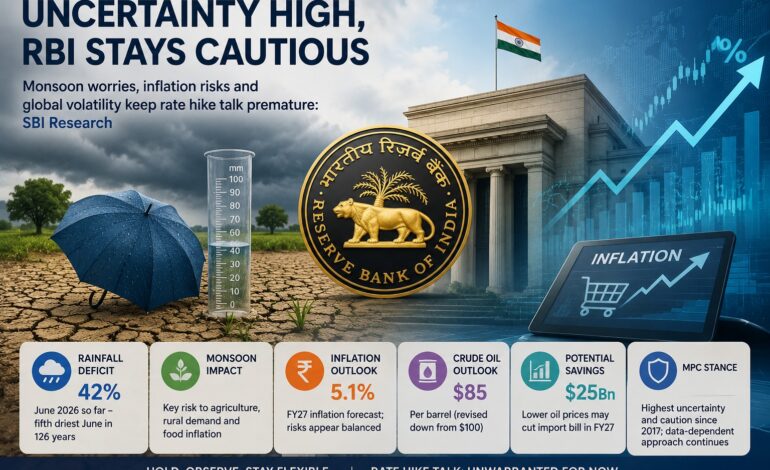
Analysing the minutes of the Reserve Bank of India's Monetary Policy Committee (MPC) meeting held between June 3 and June 5, 2026, SBI Research found that the language used by policymakers reflects the highest level of caution and uncertainty seen since 2017.

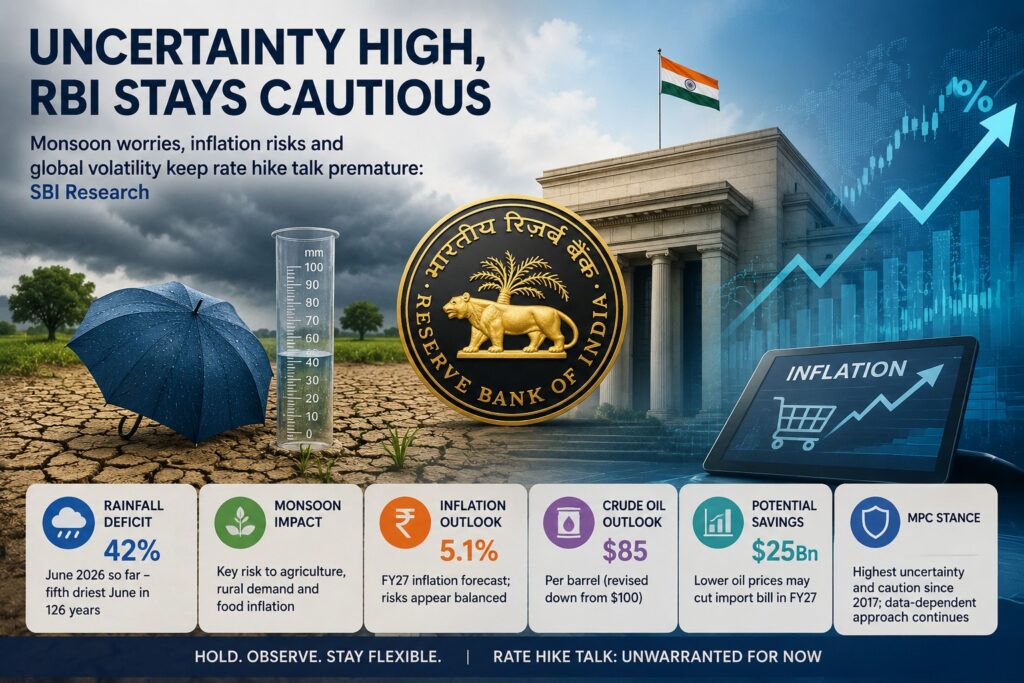
New Delhi: At a time when financial markets are debating the possibility of tighter monetary policy, a new research report from SBI has argued that discussions around an interest rate hike are premature, citing heightened uncertainty in both domestic and global economic conditions.
Analysing the minutes of the Reserve Bank of India’s Monetary Policy Committee (MPC) meeting held between June 3 and June 5, 2026, SBI Research found that the language used by policymakers reflects the highest level of caution and uncertainty seen since 2017. The report suggests that the RBI is likely to remain data-dependent and maintain policy flexibility rather than rush into further monetary tightening.
MPC Adopts a Cautious Tone
Using Natural Language Processing (NLP) techniques to assess the statements made by MPC members, SBI Research concluded that uncertainty and caution have become dominant themes in the committee’s deliberations.
According to the report, inflation risks have undoubtedly increased, but the degree of uncertainty surrounding key economic variables remains too high to justify immediate policy action. The overarching message emerging from the MPC minutes is clear: hold, observe, and preserve flexibility until greater clarity emerges.
The report notes that all MPC members expressed varying degrees of ambiguity regarding future policy actions, indicating that the central bank is reluctant to commit to a definitive rate path at this stage.
Monsoon Emerges as Biggest Risk Factor
One of the most significant concerns highlighted in the report is the performance of the southwest monsoon.
India has recorded a rainfall deficit of around 42 percent during June 2026 so far, making it potentially the fifth driest June in the last 126 years. Maharashtra, Gujarat, Madhya Pradesh, Bihar and Telangana are among the states facing the sharpest rainfall shortfalls. Such a weak monsoon could affect agricultural output, rural demand and food inflation in the months ahead.
📊 SBI Research: Key Economic Signals to Watch
India has recorded a rainfall deficit of around 42% in June 2026, making it potentially the fifth driest June in the last 126 years.
Current monsoon performance ranks among the weakest since 1900, raising concerns over agriculture and food inflation.
SBI Research expects inflation to remain manageable despite weather-related risks and global uncertainties.
Average crude oil price estimate revised down from $100 to $85 per barrel, easing inflationary pressures.
Lower crude prices could reduce India’s oil import bill by nearly $25 billion during FY27.
SBI’s NLP analysis suggests the RBI’s MPC is displaying its highest level of uncertainty and caution since 2017.
However, SBI Research also points to some encouraging developments. Forecasts from the Japan Meteorological Agency suggest the possibility of a positive Indian Ocean Dipole (IOD) emerging alongside El Niño conditions. A positive IOD typically supports rainfall over India and could help offset some of the adverse impacts of El Niño later in the season.
The report also expects strengthening of the Somali Jet stream over the Arabian Sea, which may improve moisture transport and support rainfall activity along India’s western coast in the coming weeks.
Inflation Risks Remain Balanced
Despite weather-related concerns, SBI Research believes inflation remains manageable for now.
The report projects FY27 consumer price inflation at around 5.1 percent, with risks appearing more balanced than previously anticipated. Earlier fears of sharply higher inflation have moderated due to a combination of softer global commodity prices and currency support.
A major relief factor is the decline in crude oil prices. SBI Research has revised its estimate for India’s average crude oil basket price to approximately $85 per barrel, down from an earlier expectation of $100 per barrel. This adjustment could reduce India’s oil import bill by nearly $25 billion during FY27, easing pressure on imported inflation and the current account balance.
Consumers Becoming More Cautious
The report also highlights an interesting divergence between actual inflation and household perceptions of inflation.
While inflation remains within the RBI’s target range, household inflation expectations have increased. Surveys indicate that consumers expect inflation to remain elevated over both the three-month and one-year horizons. This has led to softer consumer confidence and greater caution in discretionary spending decisions.
Economists warn that such expectations can influence spending patterns, potentially affecting overall demand conditions in the economy.
Lessons from Economic Theory
SBI Research draws upon the work of renowned economist William Brainard, whose influential 1967 theory argues that policymakers should move cautiously when the effects of their actions are uncertain.
According to the report, the current economic environment mirrors the conditions described in Brainard’s framework, where uncertainty regarding inflation, growth and external shocks warrants gradual and measured policy responses rather than aggressive interventions.
At the same time, the report cautions that excessive caution can also be risky if inflation expectations become unanchored. Therefore, the central bank must strike a balance between flexibility and credibility while communicating its policy intentions.
Global Developments Add Another Layer of Complexity
The international environment is also contributing to RBI’s cautious stance.
SBI Research notes that the US Federal Reserve has kept interest rates unchanged, although its commentary remains hawkish amid concerns about inflationary pressures linked to geopolitical developments. However, even the Fed appears uncertain about the future path of rates, reinforcing the broader theme of global policy ambiguity.
Rate Hike Unwarranted for Now
Taking into account weak monsoon conditions, improving crude oil outlook, balanced inflation risks, cautious household sentiment and global uncertainty, SBI Research concludes that calls for an immediate RBI rate hike are unwarranted.
Instead, the report argues that monetary policy should remain adaptive, data-driven and transparent, allowing policymakers to respond effectively as economic conditions evolve.
For now, the central message from both the RBI’s MPC minutes and SBI Research is unmistakable: uncertainty is high, risks are evolving, and patience may be the most appropriate policy response.