
Indian Scientists Trace Origin of Rare Cosmic X-Ray Flash Linked to Hidden Gamma-Ray Burst
Study of a rare Fast X-ray Transient sheds new light on powerful stellar explosions and hidden gamma-ray bursts
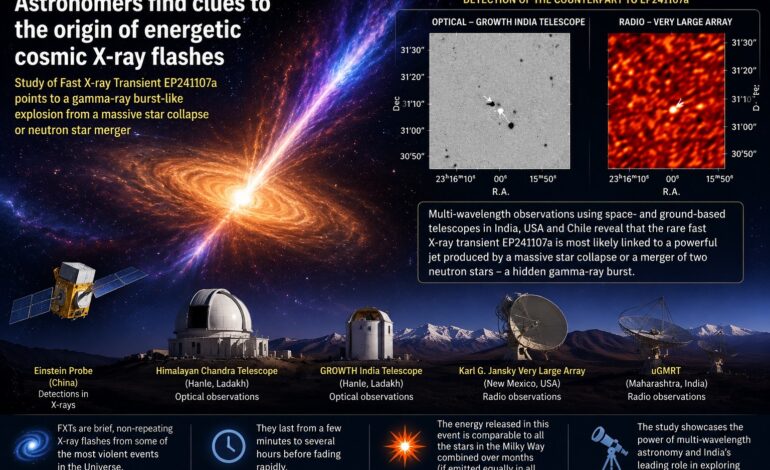
The breakthrough study, led by Deepak Eappachen and Arvind Balasubramanian of the Indian Institute of Astrophysics (IIA), has traced a rare FXT event, designated EP241107a, to a likely gamma-ray-burst-like explosion triggered either by the collapse of a massive star or the merger of two neutron stars.

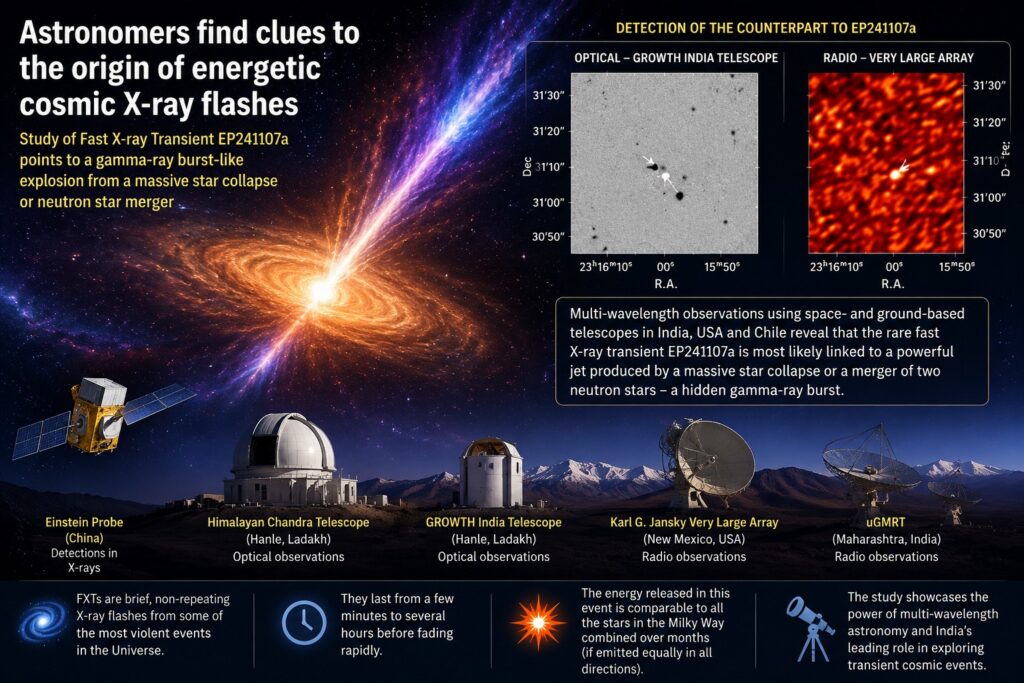
New Delhi: A team of astronomers led by Indian researchers has uncovered crucial clues about the origin of one of the universe’s most mysterious high-energy phenomena — Fast X-ray Transients (FXTs), brief but powerful flashes of X-rays that appear suddenly and vanish within hours.
The breakthrough study, led by Deepak Eappachen and Arvind Balasubramanian of the Indian Institute of Astrophysics (IIA), has traced a rare FXT event, designated EP241107a, to a likely gamma-ray-burst-like explosion triggered either by the collapse of a massive star or the merger of two neutron stars.
The findings provide valuable insights into some of the most violent and energetic events in the cosmos and help astronomers better understand the physics governing extreme stellar explosions.
Solving a Cosmic Mystery
Fast X-ray Transients are a relatively new class of astronomical phenomena discovered only about a decade ago. Unlike recurring cosmic signals, FXTs appear as sudden bursts of low-energy X-rays lasting from a few minutes to several hours before fading away.
Their fleeting nature has made them notoriously difficult to study, leaving astronomers uncertain about their origins.
Scientists have proposed several explanations over the years, ranging from supernova explosions and neutron-star mergers to tidal disruption events involving black holes. However, definitive evidence has remained elusive.
The latest study focused on EP241107a, a mysterious X-ray flash detected on November 7, 2024, by China’s Einstein Probe space mission, which continuously surveys the high-energy universe for transient events.
Multi-Wavelength Investigation
To unravel the mystery, researchers adopted a comprehensive multi-wavelength observational strategy.
The team successfully detected a radio counterpart to the X-ray flash using the Karl G. Jansky Very Large Array (VLA) in New Mexico, USA. Simultaneously, observations were conducted using some of India’s premier astronomical facilities, including the Himalayan Chandra Telescope (HCT) and the GROWTH India Telescope (GIT) at the Indian Astronomical Observatory in Hanle, Ladakh.
Additional observations were carried out using the Upgraded Giant Metrewave Radio Telescope (uGMRT), the Keck Observatory in Hawaii, and the Southern Astrophysical Research Telescope (SOAR) in Chile.
By combining optical, radio and X-ray data, researchers were able to reconstruct the nature of the explosion and its aftermath.
Evidence of a Hidden Gamma-Ray Burst
The analysis revealed that EP241107a was most likely associated with a gamma-ray-burst-like explosion, despite no gamma rays being directly detected.
Astronomers describe such events as “orphan afterglows” — remnants of gamma-ray bursts whose high-energy emissions are either too faint or directed away from Earth, making them invisible to conventional gamma-ray detectors.
Detailed modelling showed that the explosion generated an extremely energetic jet whose kinetic energy, if emitted equally in all directions, would rival the total energy produced by all the stars in the Milky Way over several months.
The researchers believe EP241107a may represent a lower-energy member of the known gamma-ray burst population, offering a rare glimpse into an otherwise hidden category of cosmic explosions.
India’s Growing Role in Global Astronomy
The study highlights the increasing contribution of Indian observatories and scientists to cutting-edge astrophysical research.
Researchers from the Indian Institute of Astrophysics and the Indian Institute of Technology Bombay collaborated with international experts from the California Institute of Technology, the University of North Carolina at Chapel Hill, and the Center for Astrophysics, Harvard & Smithsonian.
Published in the prestigious Monthly Notices of the Royal Astronomical Society, the research demonstrates how coordinated observations across multiple wavelengths and continents are helping scientists decode some of the universe’s most enigmatic phenomena.
As next-generation observatories continue to scan the skies, astronomers expect many more hidden cosmic explosions to be discovered, offering fresh insights into the life and death of stars and the extreme physics that shape the universe.