India-UK CETA to Take Effect from July 15, Opening Duty-Free Access for 99% of Indian Exports
Historic trade pact and social security agreement expected to boost exports, services, professional mobility and India's Viksit Bharat 2047 vision

The twin agreements, finalized after extensive negotiations and ratification processes in both countries, are being viewed as one of the most significant milestones in India's economic diplomacy and a major step towards achieving the vision of "Viksit Bharat 2047."

New Delhi: India and the United Kingdom have announced that the landmark Comprehensive Economic and Trade Agreement (CETA) and the Agreement on Social Security Contributions, also known as the Double Contribution Convention (DCC), will enter into force on July 15, 2026, ushering in a new era of bilateral economic cooperation and trade integration.
The twin agreements, finalized after extensive negotiations and ratification processes in both countries, are being viewed as one of the most significant milestones in India’s economic diplomacy and a major step towards achieving the vision of “Viksit Bharat 2047.”
The Comprehensive Economic and Trade Agreement will provide Indian exporters with immediate zero-duty access on nearly 99 percent of tariff lines, covering almost 100 percent of the value of India’s exports to the United Kingdom. Simultaneously, the Double Contribution Convention will exempt Indian professionals and employers from making dual social security contributions in the UK during temporary assignments, with the exemption period extended from three years to five years.
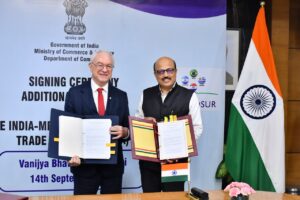
The foundation for the agreement was laid through the India-UK Enhanced Trade Partnership and the India-UK Roadmap 2030 launched in 2021. Following fourteen rounds of negotiations, CETA was concluded on May 6, 2025, and formally signed in London on July 24, 2025, by Union Commerce and Industry Minister Shri Piyush Goyal and UK Secretary of State for Business and Trade Jonathan Reynolds in the presence of Prime Minister Narendra Modi and UK Prime Minister Sir Keir Starmer.
The accompanying Double Contribution Convention was signed on February 10, 2026.
Describing the development as a major breakthrough, Commerce and Industry Minister Shri Piyush Goyal said the simultaneous implementation of CETA and DCC would unlock significant opportunities for Indian exporters and professionals.
According to the Ministry of Commerce and Industry, the agreement removes long-standing tariff barriers across several labour-intensive and export-oriented sectors. Tariffs of up to 70 percent on processed food products, 21.5 percent on marine products, 18 percent on engineering goods and auto components, 16 percent on leather and footwear products, 12 percent on textiles and apparel, and 8 percent on chemicals and pharmaceutical products will be reduced to zero.
The government expects the agreement to significantly enhance the competitiveness of Indian products in the UK market, benefiting farmers, fishermen, MSMEs, manufacturers and exporters while strengthening India’s integration into global value chains.
At the same time, India has protected sensitive sectors such as dairy products, cereals, millets, edible oils, oilseeds, apples and selected vegetable products through carefully negotiated exclusion lists.
A major feature of the agreement is its comprehensive services package. The UK has offered one of its most extensive commitments ever, covering all major services sectors and 137 sub-sectors of interest to India.
Indian companies and professionals in information technology, IT-enabled services, financial services, healthcare, education, engineering, telecommunications, consultancy and professional services are expected to gain enhanced market access and greater regulatory certainty.
The agreement also creates structured mobility pathways for business visitors, intra-corporate transferees, contractual service suppliers, independent professionals and investors.
In a unique provision, 1,800 Indian chefs, yoga instructors and classical musicians will receive dedicated mobility opportunities annually under the agreement, creating new avenues for cultural and professional exchanges.
The accompanying Double Contribution Convention is expected to benefit more than 75,000 Indian professionals and over 900 Indian companies operating in the United Kingdom. By eliminating dual social security payments and extending the exemption period to five years, the agreement is expected to reduce costs and improve the global competitiveness of Indian talent and businesses.
The two countries have also reached a consensus on safeguarding bilateral steel trade. While the UK introduces new steel measures from July 1, 2026, both sides have agreed on mechanisms that protect Indian commercial interests. According to the government, approximately 85 percent of India’s steel exports remain outside the scope of the new measures, while additional safeguards have been built into the framework through quotas and authorised-use arrangements.
Officials described the India-UK CETA as a people-centric trade agreement designed to create broad-based benefits across society. Farmers will gain access to premium export markets, fishermen will benefit from enhanced seafood exports, labour-intensive industries are expected to generate new employment opportunities, and women entrepreneurs, startups, youth and MSMEs will gain improved access to global markets.
Beyond tariff reductions, the agreement comprises 30 chapters covering digital trade, telecommunications, financial services, intellectual property, innovation, sustainability, SMEs, transparency and government procurement, making it one of India’s most comprehensive next-generation trade agreements.
With the implementation of CETA and DCC from July 15, India and the United Kingdom are expected to deepen their Comprehensive Strategic Partnership while creating a modern, rules-based economic architecture that supports growth, innovation, supply-chain resilience and long-term prosperity for both countries.
The agreement is widely regarded as a transformative step in India’s journey towards becoming a globally integrated, competitive and resilient economy under the Viksit Bharat 2047 vision.
India-UK CETA at a Glance
- Effective Date: July 15, 2026
- Zero-duty access on ~99% of India’s exports to the UK
- Covers nearly 100% of bilateral trade value
- 137 services sub-sectors opened for Indian providers
- DCC exemption period extended from 3 years to 5 years
- Over 75,000 Indian professionals expected to benefit
- More than 900 Indian companies covered
- Dedicated annual mobility opportunities for 1,800 Indian chefs, yoga instructors and classical musicians
- Tariffs up to 70% eliminated on several export categories
- Sensitive agricultural sectors protected through exclusion lists
- 30-chapter next-generation trade agreement covering goods, services, digital trade, innovation and sustainability