Wholesale Inflation Surges to 8.3%: Is India Entering a New Cost-Push Inflation Cycle?
Sharp rise in fuel, crude oil and industrial input prices raises concerns for manufacturing, infrastructure and household budgets
Unlike previous inflation episodes dominated by food prices, the current surge appears to be structurally broader and more deeply linked to global commodity volatility, energy costs and manufacturing input inflation.

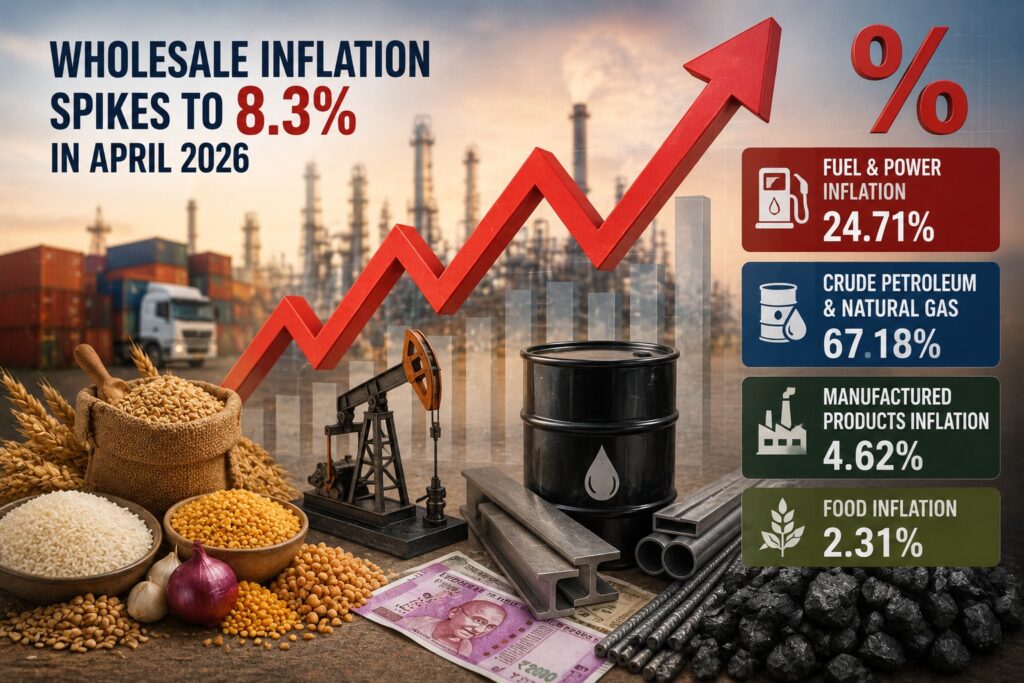
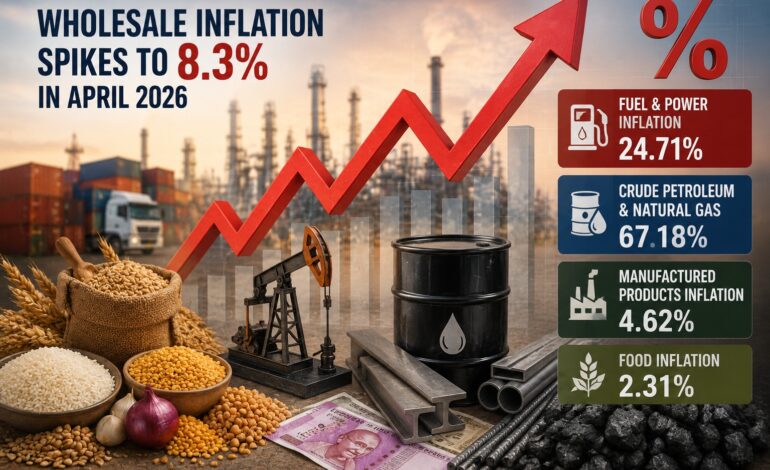
New Delhi: India’s wholesale inflation has staged a dramatic resurgence, climbing to 8.3 per cent in April 2026 — the highest level in recent years — raising fresh concerns that the country may be entering a prolonged phase of cost-push inflation driven by energy prices, industrial inputs and supply-side pressures.
The latest Wholesale Price Index (WPI) data released by the Ministry of Commerce and Industry on Thursday reveals a sharp acceleration from 3.88 per cent in March 2026 to 8.3 per cent in April 2026, marking a significant inflationary jump within a single month.
Unlike previous inflation episodes dominated by food prices, the current surge appears to be structurally broader and more deeply linked to global commodity volatility, energy costs and manufacturing input inflation.
The April data suggests that India’s inflation landscape is shifting from consumer-driven price increases to producer-level cost escalation — a development that could have far-reaching implications for manufacturing competitiveness, infrastructure projects, MSMEs and monetary policy.
Fuel and Energy Prices Are Driving the Inflation Shock
The most alarming trend in the April WPI data is the explosion in fuel and power inflation.
The “Fuel & Power” category recorded an inflation rate of 24.71 per cent in April 2026, compared to just 1.05 per cent in March.
Crude petroleum and natural gas prices witnessed an extraordinary inflation rate of 67.18 per cent, while crude petroleum alone surged by 88.06 per cent year-on-year.
Petrol inflation stood at 32.40 per cent and high-speed diesel (HSD) inflation rose to 25.19 per cent.
This energy-led inflation wave is particularly dangerous because fuel costs permeate almost every sector of the economy — transportation, logistics, agriculture, manufacturing, power generation and construction.
Unlike temporary food inflation, energy inflation tends to create second-order effects that gradually spread across supply chains and eventually reach retail consumers.
The month-on-month numbers are even more striking.
Fuel & Power prices rose 18.22 per cent in April over March alone, indicating a severe and rapid cost escalation across industrial and transport sectors.
Manufacturing Inflation Signals Industrial Cost Pressure
India’s manufacturing sector, which accounts for over 64 per cent weightage in WPI, also recorded sustained inflationary pressure.
Manufactured products inflation rose to 4.62 per cent in April 2026 from 3.39 per cent in March.
Several key industrial categories showed notable price escalation:
- textiles: 7.30%
- basic metals: 7.00%
- chemicals and chemical products: 5.09%
- tobacco products: 5.67%
- rubber and plastics: 2.15%
- cement, lime and plaster: 2.38%
These categories are core inputs for infrastructure, automobiles, housing, construction and consumer goods manufacturing.
The rising cost of industrial raw materials raises an uncomfortable possibility: Indian manufacturers may soon begin passing higher costs to consumers, triggering a delayed rise in retail inflation.
Food Inflation Is No Longer the Main Problem
Interestingly, food inflation — often the primary driver of inflation headlines in India — appears relatively contained compared to energy and industrial inflation.
The WPI Food Index stood at 2.31 per cent in April 2026, only marginally higher than 1.85 per cent in March.
Some food categories actually recorded substantial price declines:
- potato inflation: -30.04%
- onion inflation: -26.45%
- pulses inflation: -4.03%
Vegetable inflation moderated sharply to 0.53 per cent after elevated levels earlier in the year.
This suggests the current inflation spike is fundamentally different from earlier food-driven episodes that were often seasonal and temporary.
Instead, the present inflation cycle appears rooted in industrial commodities, energy markets and supply-chain costs — making it potentially more persistent and difficult to reverse quickly.
Global Geopolitics May Be Feeding India’s Inflation
The data strongly indicates that global commodity dynamics are influencing India’s inflation trajectory.
The sharp rise in crude oil and energy prices comes amid ongoing geopolitical uncertainty, disruptions in shipping routes, production adjustments by oil-exporting nations and volatility in global energy markets.
India remains heavily dependent on imported crude oil, making the domestic economy highly vulnerable to external price shocks.
Higher fuel prices not only increase transport and logistics costs but also widen the current account deficit, pressure the rupee and complicate fiscal management.
This creates a dangerous macroeconomic chain reaction:
- rising import costs
- higher industrial input prices
- increased logistics expenses
- pressure on government subsidies
- potential rise in retail inflation
- tighter monetary conditions
Infrastructure Boom Could Face Cost Escalation
India is currently undergoing one of its largest infrastructure expansion phases, with massive investments in:
- railways
- highways
- ports
- airports
- urban development
- renewable energy
- defence manufacturing
However, sustained wholesale inflation could significantly increase project costs.
Rising prices of steel, cement, fuel, chemicals and transport services may force revisions in EPC contracts, increase government expenditure and squeeze private sector margins.
MSMEs are likely to be especially vulnerable.
Large corporations may possess the pricing power and balance sheet resilience to absorb temporary cost increases. Smaller enterprises, however, often operate on thin margins and may struggle to manage rising energy and raw material expenses.
RBI Faces a Complex Policy Dilemma
The resurgence of wholesale inflation may also complicate the Reserve Bank of India’s policy outlook.
If producer inflation begins translating into sustained retail inflation, the RBI may face pressure to maintain tighter monetary conditions for longer than expected.
Yet the situation is delicate.
Aggressive rate hikes could slow investment and industrial growth at a time when India is positioning itself as a global manufacturing and supply-chain alternative.
On the other hand, failing to contain inflation risks eroding household purchasing power and weakening macroeconomic stability.
This creates a classic policy dilemma:
- support growth
or - control inflation
The answer may depend on whether the current inflation surge proves temporary or structurally embedded.
India’s Inflation Story Is Becoming More Complex
For years, India’s inflation debate largely revolved around food prices and monsoon performance.
That narrative is now changing.
The April 2026 WPI data indicates that India’s inflation architecture is becoming more globally interconnected and industrially driven. Energy markets, geopolitical tensions, logistics costs and commodity cycles are increasingly shaping domestic inflation outcomes.
The rise of manufacturing-linked inflation also reflects India’s deeper integration into global supply chains and industrial systems.
Ironically, the very transformation that is powering India’s economic rise — rapid industrialisation, infrastructure expansion and manufacturing growth — may also expose the economy to new inflation vulnerabilities.
The Bigger Question: Temporary Spike or Structural Shift?
The key question now confronting policymakers and industry is whether April’s 8.3 per cent wholesale inflation represents:
- a temporary commodity-driven spike
or - the beginning of a longer structural inflation cycle
If crude oil prices stabilise and supply chains normalise, inflationary pressures could moderate in the coming months.
But if geopolitical tensions persist and energy costs remain elevated, India could face a more prolonged phase of industrial inflation with implications for growth, investment and consumer spending.
For now, the April WPI numbers serve as a warning signal:
India’s inflation challenge may no longer be confined to kitchen economics. It may increasingly become an industrial, infrastructural and geopolitical problem.