What India’s Electoral Trends Reveal About Changing Voter Expectations
The evolving political trends across states such as West Bengal, Assam, Kerala, Tamil Nadu and Puducherry reflect more than routine shifts in electoral dynamics.
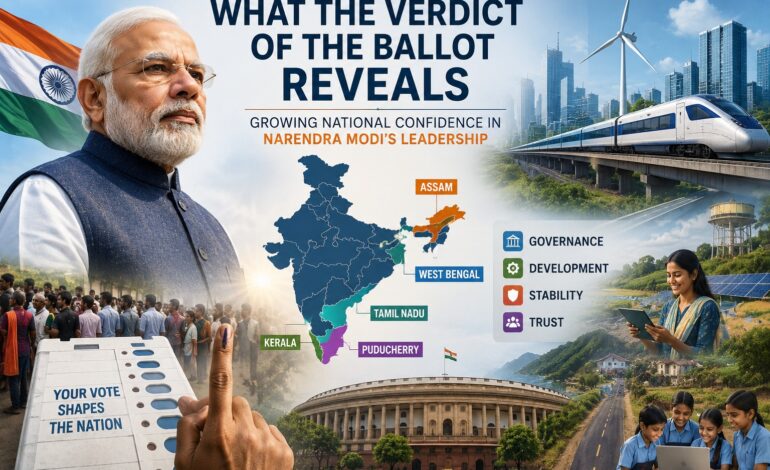
With over 160 million voters participating, the elections are expected to influence political strategies leading up to the next general elections, as parties recalibrate alliances, messaging and regional priorities.

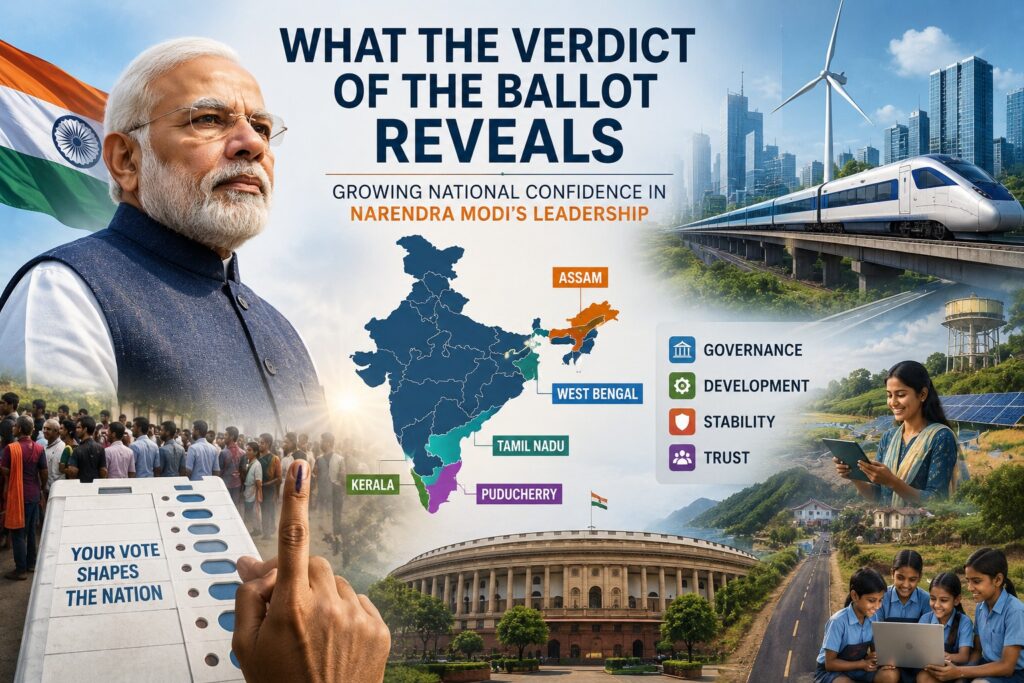
The evolving political trends across states such as West Bengal, Assam, Kerala, Tamil Nadu and Puducherry reflect more than routine shifts in electoral dynamics. They point towards a broader transformation in the political expectations of Indian voters – an increasing emphasis on governance, administrative delivery, stability and leadership credibility.
Across regions, the contemporary Indian electorate appears to be gradually moving beyond purely emotional appeals, identity-driven mobilisation and inherited political loyalties. Voters today are increasingly evaluating governments through measurable parameters such as welfare delivery, infrastructure development, corruption control, administrative efficiency and leadership effectiveness.
These changing political preferences also indicate the growing national visibility and acceptance of Prime Minister Narendra Modi’s governance-centric political approach.
West Bengal and the Search for Political Alternatives
West Bengal has historically witnessed long phases of political dominance – first under the Left Front and later under the Trinamool Congress. However, political discourse within the state is showing signs of gradual evolution.
Concerns relating to political violence, corruption allegations, administrative centralisation and institutional functioning have generated debate among sections of voters, particularly urban middle classes, youth and first-time voters. Simultaneously, issues such as employment generation, industrial growth and governance transparency are gaining greater political relevance.
Within this evolving landscape, the rise of the Bharatiya Janata Party in West Bengal represents more than an electoral expansion. It reflects the emergence of an alternative political narrative that seeks to challenge established regional political structures.
The BJP’s growth has been aided by sustained organisational expansion, welfare outreach linked to central schemes and the projection of Narendra Modi’s leadership as a governance-oriented national alternative.
The developments in Bengal therefore suggest not an immediate political realignment, but a gradual shift in voter expectations where governance and institutional credibility are becoming increasingly important factors.
Assam and the Consolidation of Governance Politics
Among the states where governance-based politics has found visible electoral resonance, Assam stands out prominently.
Under Chief Minister Himanta Biswa Sarma, the state has witnessed significant focus on infrastructure expansion, connectivity projects, healthcare systems, investment promotion and administrative responsiveness. The alignment between state governance and central developmental priorities has further reinforced perceptions of policy continuity and coordinated execution.
Infrastructure upgrades, road connectivity, digital governance initiatives and industrial outreach programmes have contributed to strengthening public confidence in governance delivery. Equally significant has been the emphasis on law-and-order management in a region historically sensitive to socio-political instability.
The political trajectory in Assam indicates that voters are increasingly rewarding administrative continuity and delivery-driven governance models.
Puducherry and the Enduring Appeal of Accessible Leadership
Political developments in Puducherry continue to highlight the importance of leadership style and public accessibility in democratic politics.
N. Rangaswamy’s enduring public acceptance reflects the continuing relevance of simplicity, administrative accessibility and personal credibility in political leadership. In an era often dominated by high-pitched rhetoric and polarised political communication, grounded leadership styles continue to retain electoral value.
The Puducherry experience illustrates that voters are influenced not only by ideological narratives, but also by perceptions of integrity, humility and administrative approachability.
Tamil Nadu and the Emergence of a More Competitive Political Space
Tamil Nadu’s political landscape has traditionally remained dominated by Dravidian parties rooted in strong linguistic and regional identity politics. However, recent years have witnessed the gradual expansion of the Bharatiya Janata Party’s organisational and political presence in the state.
Under K. Annamalai, the BJP has focused on cadre expansion, issue-based mobilisation and governance-centric political messaging. Themes such as corruption, transparency, national integration and administrative accountability are finding increasing resonance among sections of youth and urban voters.
While Tamil Nadu’s political transformation is likely to remain gradual, the BJP’s growing presence suggests the possibility of a more competitive and multi-dimensional political environment in the future.
Kerala’s Slowly Evolving Political Landscape
Kerala has long been characterised by bipolar competition between the Left Democratic Front (LDF) and the United Democratic Front (UDF). Yet subtle changes are becoming visible within this political structure.
Younger voters are increasingly engaging with national policy debates, digital political communication and welfare-driven governance narratives. Simultaneously, the BJP’s incremental expansion in local bodies and grassroots structures indicates a slow but sustained organisational presence.
Although Kerala’s broader political equations remain largely stable, the state’s political discourse is gradually becoming more nationally interconnected than before.
Modi’s Governance-Centric Political Model
One of the defining features of contemporary Indian politics has been the increasing centrality of governance in electoral discourse.
Under Narendra Modi’s leadership, policy emphasis on Direct Benefit Transfers, digital governance systems, infrastructure development, welfare targeting and anti-corruption measures has significantly altered the citizen-state interface.
For many voters, governance is now experienced through tangible outcomes – direct welfare access, reduced procedural leakages, faster infrastructure creation and improved administrative responsiveness. These experiences have contributed to strengthening perceptions of governance efficiency and institutional delivery.
At the same time, issues such as national security, administrative decisiveness and policy continuity have further reinforced Modi’s image as a stable national leader.
The Larger Democratic Shift
Taken together, these political trends suggest that Indian democracy is undergoing an important psychological transition.
Increasingly, voters appear to be prioritising governance over rhetoric, delivery over symbolism and accountability over political theatrics. Electoral legitimacy is becoming more closely tied to performance, administrative capability and public trust.
The expanding appeal of governance-oriented politics across diverse linguistic, cultural and regional contexts reflects not merely electoral strategy, but a deeper shift in democratic expectations.
India’s political diversity will continue to produce varied electoral outcomes across states. Yet a common theme is becoming increasingly visible: citizens are demanding governments that deliver measurable outcomes, maintain institutional stability and remain responsive to public aspirations.
This evolving electoral mindset may well define the next phase of Indian democracy.