Centre Launches Management Committee Guidelines 2026 to Strengthen Community-led School Governance
New framework aims to transform School Management Committees into active institutions for holistic child development and educational accountability
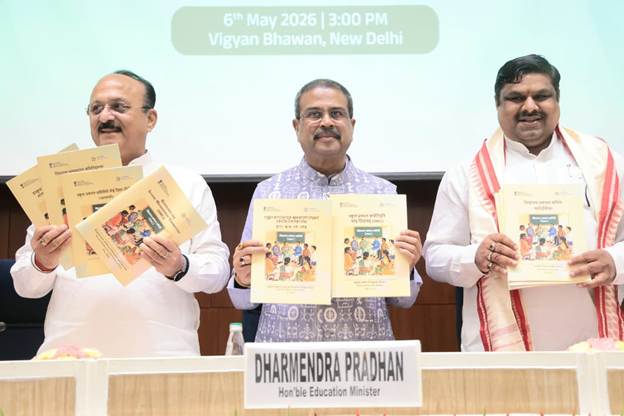
Union Minister for Education Dharmendra Pradhan (center) launched the School Management Committee (SMC) Guidelines 2026 in New Delhi on Wednesday.

New Delhi: Union Minister for Education Dharmendra Pradhan on Wednesday launched the School Management Committee (SMC) Guidelines 2026 here, positioning the initiative as a key step towards strengthening community participation and governance across India’s school ecosystem.
The event was attended by Ashish Sood, Gajender Yadav, Sanjay Kumar, Ashok Kumar Meena and Archana S. Awasthi, along with senior officials and representatives from various states.
Addressing the gathering, Pradhan said the SMC Guidelines 2026 would play a critical role in translating the vision of the National Education Policy 2020 into action across nearly 15 lakh schools in the country.
He said the guidelines envision School Management Committees as a bridge connecting students, teachers, parents and communities to ensure holistic child development through collective responsibility and stronger public participation.
Pradhan noted that while the government remains committed to ensuring education, health, well-being, mental health support and inclusion of Children With Special Needs (CWSN), the new framework also emphasises mentoring, handholding and community ownership of schools.
Calling for SMCs to evolve into a “people’s movement” for educational transformation, he said India’s education system historically flourished through community-led institutions and that the new guidelines seek to revive that tradition.
Highlighting initiatives such as Vidyanjali, the minister said greater public participation would strengthen accountability, learning outcomes and local engagement in schools.
Ashish Sood said the launch represented a deeper transformation in India’s education system rather than merely the introduction of administrative guidelines. He said achieving the vision of a developed India by 2047 would require strengthening classrooms and local school governance mechanisms.
According to Sood, the earlier SMC framework introduced under the Right to Education Act was largely focused on grants, infrastructure and monitoring functions. The new guidelines, however, expand the role of SMCs to include child safety, mental health, foundational literacy and numeracy (FLN), digital transparency, learning outcomes, inclusivity and student welfare.
He said the revised framework transforms SMCs from monitoring bodies into active “school community governing institutions”.
Gajender Yadav said active community involvement is essential for improving learning outcomes and bridging the gap between parents and schools through greater participation in school functioning and management.
The programme was also attended virtually by several state education ministers, including representatives from Haryana, Maharashtra, Mizoram, Tripura, Uttarakhand and Nagaland.
Click to access the School Management Committee (SMC) Guidelines