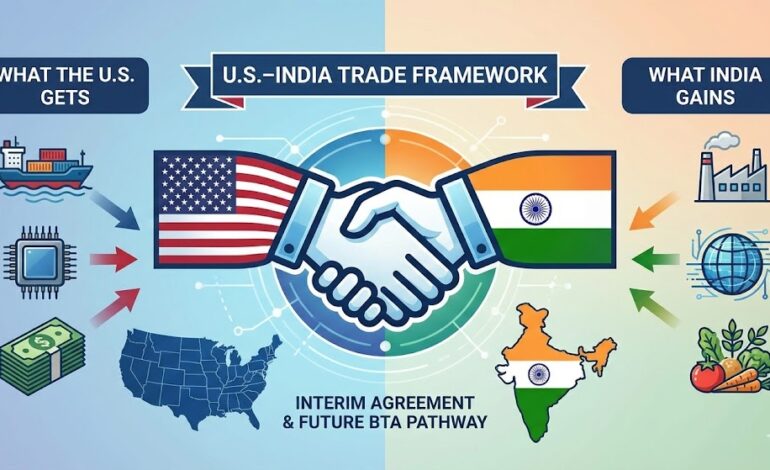
US–India Trade Framework: What India Gains, What the United States Gets
India secures enhanced access to a $30 trillion US economy, particularly for export-driven sectors such as textiles and apparel, leather and footwear, plastic and rubber goods, organic chemicals, home décor, artisanal products and select machinery.

New Delhi: The framework for an Interim Trade Agreement between India and the United States of America marks one of the most consequential shifts in bilateral economic relations in recent years. While the agreement paves the way for a comprehensive US–India Bilateral Trade Agreement (BTA), its immediate value lies in how it recalibrates market access, tariffs, supply chains and technology cooperation for both countries.
Below is a breakdown of who gains what under the agreed framework.
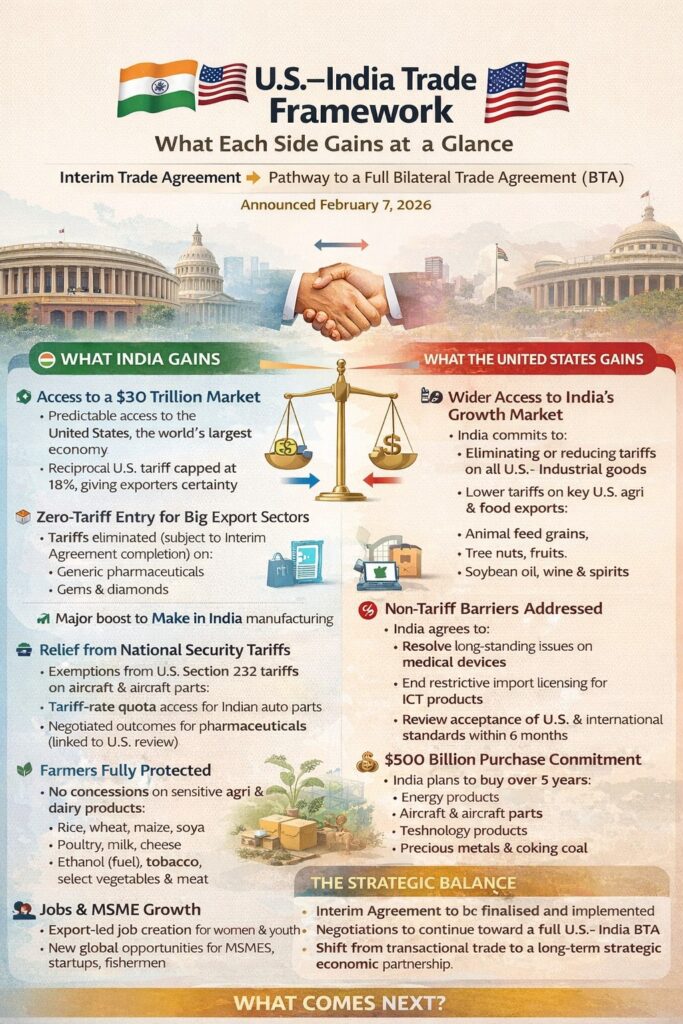
What India Gains
Expanded Access to the World’s Largest Market
India secures enhanced access to a $30 trillion US economy, particularly for export-driven sectors such as textiles and apparel, leather and footwear, plastic and rubber goods, organic chemicals, home décor, artisanal products and select machinery. The application of a reciprocal tariff rate capped at 18 percent provides greater predictability for Indian exporters compared to earlier, higher or uncertain tariff regimes.
Zero-Tariff Entry for Key Export Sectors
A major win for India is the U.S. commitment—subject to the successful conclusion of the Interim Agreement—to eliminate tariffs entirely on high-value Indian exports, including:
- Generic pharmaceuticals
- Gems and diamonds
- Aircraft parts
These sectors are central to India’s manufacturing and export competitiveness and align closely with Make in India objectives.
Relief from National Security Tariffs
India will receive exemptions from US Section 232 tariffs on aircraft and aircraft parts linked to steel, aluminium and copper import restrictions. In addition, India will receive preferential tariff-rate quotas for automotive parts, offering tangible gains for advanced manufacturing exports.
Technology, Energy and Supply Chain Integration
India stands to benefit from deeper integration into U.S.-led global supply chains, particularly in:
- Advanced technology products, including GPUs and data-centre equipment
- Energy security, with India planning purchases worth $500 billion over five years covering energy products, aircraft, technology and coking coal
This strengthens India’s industrial base while supporting its digital and infrastructure ambitions.
Protection of Farmers and Sensitive Agriculture
Crucially, India has fully protected sensitive agricultural and dairy sectors, including rice, wheat, maize, soya, poultry, milk, cheese, ethanol fuel, tobacco and select vegetables and meat products. This ensures that trade liberalisation does not come at the cost of farmers’ livelihoods or rural stability.
Job Creation and MSME Growth
With expanded exports and improved market access, the agreement is expected to generate large-scale employment, particularly for women and youth, while opening new growth avenues for MSMEs, start-ups and small producers.
What the United States Gains
Greater Access to India’s Growing Market
The US gains improved access to one of the world’s fastest-growing major economies, with India committing to eliminate or reduce tariffs on all US industrial goods and a broad range of agricultural and food products, including animal feed grains, tree nuts, fruits, soybean oil, wine and spirits.
Addressing Long-Standing Non-Tariff Barriers
India has agreed to tackle persistent non-tariff barriers affecting US exports, including:
- Medical devices pricing and market access issues
- Restrictive import licensing procedures for ICT goods
- Delays caused by testing and certification standards
India will also review the acceptability of US-developed or international standards in identified sectors within six months of the agreement’s entry into force.
Strengthened Digital Trade Rules
The framework commits both sides to address discriminatory or burdensome digital trade practices, setting the stage for robust and predictable digital trade rules under the BTA—an area of growing importance for US technology firms.
Strategic and Economic Security Alignment
The U.S. secures stronger alignment with India on:
- Supply chain resilience
- Investment screening and export controls
- Coordinated responses to non-market policies of third countries
This enhances Washington’s broader strategy of diversifying supply chains away from concentrated geographies.
Large-Scale Commercial Opportunities
India’s intention to purchase $500 billion worth of US goods over five years—spanning energy, aircraft, technology products and precious metals—represents a significant boost for US manufacturers, energy producers and high-tech industries.
The Strategic Balance
While the framework involves mutual concessions, it reflects a carefully balanced trade architecture: India gains export competitiveness, technology access and supply-chain integration without compromising agriculture, while the United States gains deeper entry into a high-growth market and a trusted economic partner in Asia.
As negotiations move towards a full US–India Bilateral Trade Agreement, the Interim framework signals a shift from transactional trade to a strategic economic partnership, aligned with long-term growth, innovation and geopolitical stability.