SHANTI Bill Will Go Down in History as One of Modi Government’s Biggest Science Reforms: Jitendra Singh
In a written reply in the Lok Sabha, Minister of State for Science and Technology Dr Jitendra Singh outlined how satellite data and indigenous space platforms are now operationally integrated into flagship programmes of central ministries and state governments.

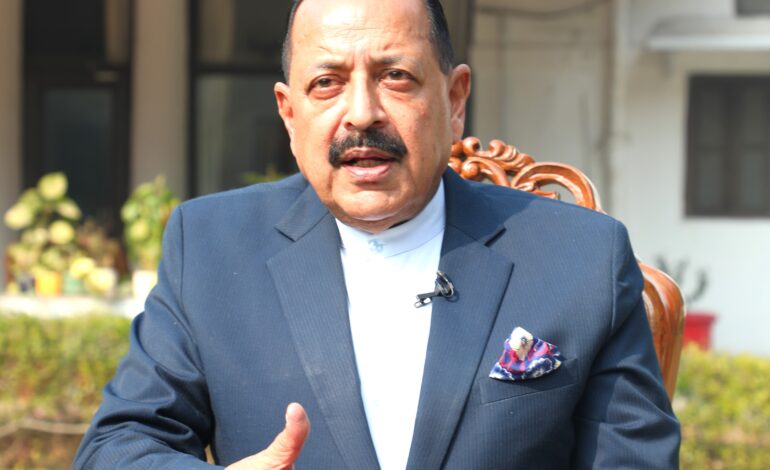
New Delhi, December 28: The SHANTI Bill will be remembered as one of the biggest science-led reforms of the Modi government, with the potential to reshape India’s long-term socio-economic trajectory, said Dr Jitendra Singh, Minister of Science and Technology, in a media interaction on Sunday.
Singh said the third term of Narendra Modi—widely referred to as Modi 3.0—is distinctly characterised by bold, structural reforms with a strong focus on science, innovation and entrepreneurship. Unlike earlier reform phases that centred largely on welfare and governance, he said the defining reforms of this phase would be those that determine India’s technological leadership and economic competitiveness.
Science-led reform at the core
The minister said the SHANTI Bill marks a decisive departure from convention by placing science-driven reform at the centre of national transformation. Despite the decisive role of science and technology in shaping future growth and industry, India had historically not framed scientific advancement within the reform narrative, he noted.
According to Singh, the SHANTI Bill links science, the economy, industry and business into a single policy framework that will shape India’s future socio-economic order.
Breaking a six-decade stalemate in nuclear energy
Singh said the Bill represents a historic reform in India’s nuclear sector, breaking a policy stalemate that persisted for more than six decades. The reform unlocks the sector’s potential for peaceful, clean and sustainable energy while maintaining uncompromising standards of safety, sovereignty and public interest.
He said such a reform became possible only because of the government’s willingness to dismantle legacy taboos and align India’s nuclear policies with global best practices, without diluting the country’s commitment to peaceful use.
Clean energy for a technology-driven economy
Highlighting the demands of an emerging AI-, quantum- and data-driven economy, Singh said nuclear energy is indispensable for providing reliable, round-the-clock power, unlike intermittent renewable sources. As India transitions away from fossil fuels and coal, nuclear energy will play a critical role in supporting advanced technologies, digital infrastructure and strategic sectors, he said.
India’s nuclear power capacity, he noted, has doubled from about 4.4 GW in 2014 to nearly 8.7 GW today. The government has set a roadmap to scale this up to around 100 GW by 2047, enabling nuclear energy to meet nearly 10 percent of India’s electricity demand and support the national Net Zero commitment.
Healthcare, SMRs and future readiness
Singh also highlighted the expanding role of nuclear science in healthcare, particularly in cancer diagnosis and treatment through nuclear medicine and isotopes, describing atomic science as a growing force for human welfare.
Looking ahead, he said India is moving towards Small Modular Reactors (SMRs) suited for dense urban clusters, industrial corridors and emerging economic zones, strengthening energy security while ensuring environmental responsibility.
Broad acceptance across stakeholders
The minister said the SHANTI Bill has been widely welcomed by the scientific community, industry, startups and the broader innovation ecosystem, reflecting a national consensus on the need to modernise India’s nuclear sector.
He added that the Bill exemplifies the reform-first approach of Modi 3.0, where science-led policy decisions are expected to play a defining role in India’s journey towards becoming a developed nation by 2047.