PSA Launches National Technology Readiness Assessment Framework; Public Feedback Invited Till Jan 31

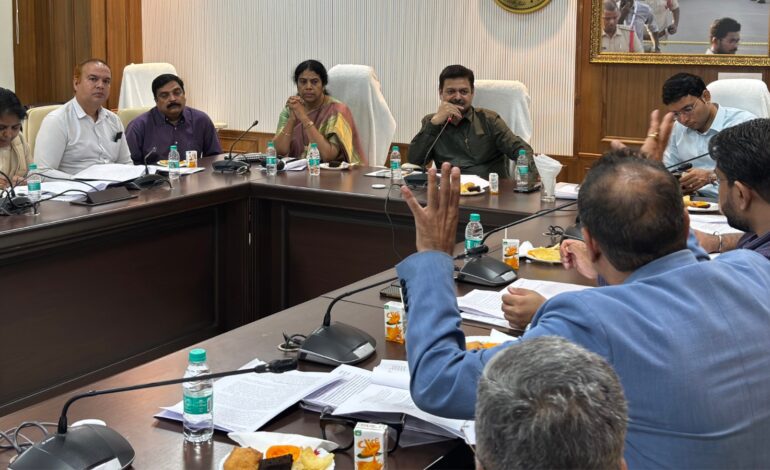
Principal scientific adviser to the government of India Ajay Kumar Sood on Monday unveiled the National Technology Readiness Assessment Framework (NTRAF), a first-of-its-kind national framework designed to standardise how technology maturity is assessed across India’s research, innovation and industry ecosystem.

New Delhi, December 31: Principal Scientific Adviser to the Government of India Ajay Kumar Sood on Monday unveiled the National Technology Readiness Assessment Framework (NTRAF), a first-of-its-kind national framework designed to standardise how technology maturity is assessed across India’s research, innovation and industry ecosystem.
Developed by the Office of the Principal Scientific Adviser (OPSA) in collaboration with the Confederation of Indian Industry (CII), the framework establishes a unified, objective yardstick to evaluate technologies from early laboratory research to full-scale commercial deployment. The NTRAF has been opened for public consultation until January 31, 2026.
Common language for researchers, funders and industry
Addressing the launch event, Sood said the absence of a shared understanding of technology maturity has long hampered India’s deeptech ecosystem.
“For too long, academia and industry have spoken different dialects on technology readiness. This creates a ‘valley of death’ between TRL 4 and TRL 7, where promising technologies struggle to attract funding. NTRAF moves us from subjective narratives to objective evidence, ensuring that we fund not just experiments, but scalable and market-ready solutions,” he said.
Structured assessment across nine TRLs
The framework operationalises the globally recognised nine Technology Readiness Levels (TRLs), covering:
- TRL 1–3: Proof of concept and fundamental research
- TRL 4–6: Prototype development and validation
- TRL 7–9: Operational deployment and commercial readiness
Officials said the framework will act as the backbone for multiple R&D funding programmes under national missions, enabling funding agencies to allocate resources with greater precision and reduce early-stage risk for private investors.
Bridging subjectivity with evidence
Scientific secretary, OPSA, Parvinder Maini, described NTRAF as a definitive guide for researchers and evaluators.
“By establishing a common language for technology maturity, we aim to bridge the gap between a researcher’s claim of readiness and an investor’s requirement for proof,” she said.
Industry and funding alignment
Chief executive officer of the Anusandhan National Research Foundation (ANRF), Shivkumar Kalyanaraman, stressed that technology readiness must be assessed alongside market validation, particularly beyond TRL 4. He proposed a pilot phase in which 20 selected technologies could be cross-validated by the National Research Development Corporation (NRDC) to calibrate and stress-test the framework before wider adoption.
Officials from the Department of Science and Technology (DST), including Praveen Roy and Jyoti Sharma, termed the framework a timely intervention that will strengthen implementation of the RDI Fund by bringing structural rigour to the evaluation of high-risk, high-reward projects.
Eliminating ambiguity in technology transfer
CII’s counsellor for technology, innovation and R&D, Rahul Katna, said the framework’s stringent standards would ensure that startups claiming deployment readiness meet genuine industrial benchmarks. OPSA chief technology officer Rohit Gupta added that NTRAF eliminates ambiguity in technology transfer by synchronising laboratories, industry and government around a validated definition of readiness.
Key features of NTRAF
According to the OPSA, the framework incorporates:
- Global best practices with Indian adaptation, drawing from international models such as NASA’s TRL system
- Evidence-based evaluation, replacing qualitative assessments with structured checklists
- Sector-specific annexures for areas such as healthcare, pharmaceuticals and software
- A self-assessment tool enabling researchers to identify gaps before seeking funding
Officials said the adoption of NTRAF is expected to improve funding efficiency, accelerate commercialisation and strengthen India’s deeptech and innovation pipeline, as the country seeks to scale research outcomes into globally competitive technologies.