Institutional Finance Emerges as Key Driver of India’s Fisheries Growth: Govt
Contributing 1.12% to India’s gross value added and supporting the livelihoods of nearly three crore people, the sector has transformed from a subsistence activity into a globally competitive industry.

New Delhi: The fisheries sector, recognised as India’s “sunrise sector”, has emerged as a major engine of economic growth, nutritional security, and employment, with institutional finance playing a central role in its rapid expansion, according to a statement released by the Ministry of Fisheries, Animal Husbandry & Dairying.
Contributing 1.12% to India’s gross value added and supporting the livelihoods of nearly three crore people, the sector has transformed from a subsistence activity into a globally competitive industry. India is currently the world’s second-largest fish producer and the largest aquaculture producer, accounting for about 8% of global fish production.
Over the past decade, fish production has nearly doubled—from 95.79 lakh tonnes in 2013–14 to an all-time high of 197 lakh tonnes in FY 2024–25—driven largely by inland fisheries, which now contribute more than 75% of total output. Exports reached ₹62,408 crore (USD 7.45 billion) in FY 2024–25, with frozen shrimp emerging as the dominant product and the United States and China as key markets.
According to the Department of Fisheries, sustained public investment and policy reforms have underpinned this growth. These include infrastructure development, cold-chain integration, processing facilities, deep-sea fishing, and climate-resilient aquaculture systems. The government has set a target of increasing national fish production to 220 lakh tonnes by FY 2025–26.
A major catalyst for improving access to finance has been the National Fisheries Digital Platform (NFDP), a single-window digital ecosystem that has registered around 30 lakh stakeholders. The platform enables access to credit, insurance, markets, and performance-linked incentives, addressing the sector’s fragmented structure.
To meet diverse financing needs, the government has worked with banks to design customised lending products. Credit requirements range from ₹50,000–₹30 lakh for small fishers and micro enterprises to ₹10 crore or more for large infrastructure and processing projects.
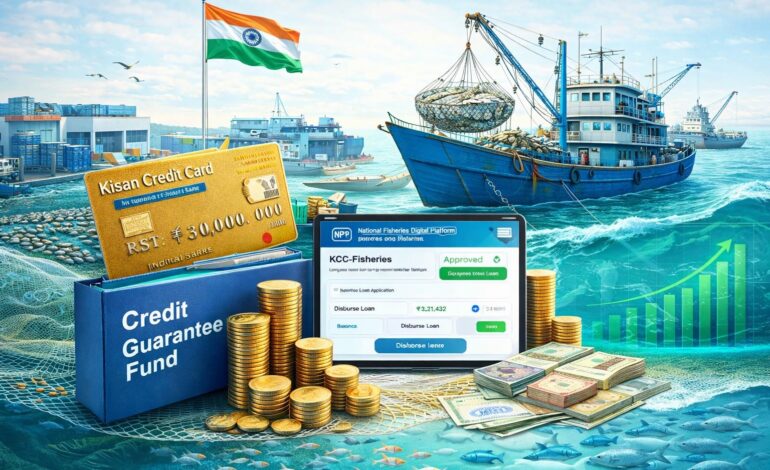
The Kisan Credit Card (KCC) for Fisheries, introduced in 2018–19, remains the most widely used short-term credit instrument. As of June 2025, 4.76 lakh KCCs had been issued, with ₹3,214.32 crore disbursed. Long-term financing is supported through the Fisheries and Aquaculture Infrastructure Development Fund, which offers interest subvention and has approved 178 projects worth over ₹6,369 crore.
To reduce lending risks, a ₹750 crore credit guarantee fund managed by NABSanrakshan provides collateral-free coverage for loans up to ₹12.5 crore. Loan applications are fully digitised through NFDP, with 12 nationalised banks onboarded.
More than 19,000 beneficiaries have submitted loan requests through the platform so far, with sanctioned amounts ranging from ₹15,000 to ₹5 crore. Banks are also conducting outreach programmes and capacity-building initiatives in collaboration with NABARD, BIRD, and MANAGE to strengthen fisheries-focused lending.
The government said this coordinated approach—combining digital platforms, credit guarantees, and interest-subvented loans—marks a decisive shift from subsidy-led support to credit-driven growth. Institutional finance, it added, will remain a critical lever in building a resilient, inclusive, and globally competitive blue economy for India.