“India’s Reform Express Is Being Driven by Technology”

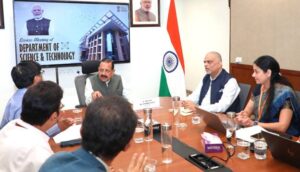
Union Minister Jitendra Singh addressing a press conference in Delhi on Thursday.

Deep Ocean Mission, Gaganyaan highlight dual push into space and deep-sea exploration
New Delhi, Jan 2: India’s reform momentum across governance, administration and the economy is being driven by science, technology and innovation, with technology acting as the central force of transformation, said Jitendra Singh on Thursday while presenting the year-end achievements of the Ministries of Science & Technology and Earth Sciences for 2025.
Addressing a press conference in Delhi, Singh said India’s growth trajectory over the next two decades will be led by innovation-driven sectors such as space, oceans, biotechnology, clean energy and advanced manufacturing. He said every major reform undertaken by the government today is technology-enabled, reflecting a sustained policy focus on science-led development since 2014.
Highlighting mission-mode programmes, Singh pointed to the Deep Ocean Mission and Gaganyaan as symbols of India’s parallel push into human spaceflight and deep-sea exploration. He said India is preparing for a landmark dual achievement in 2027, with an Indian astronaut travelling to space and a human-occupied submersible reaching depths of up to 6,000 metres in the ocean.
A major policy milestone in 2025, Singh said, was the launch of the ₹1 lakh crore Research Development and Innovation (RDI) Fund, through which the government is directly supporting private-sector R&D. He described it as an unprecedented global step. He also highlighted the establishment of the Anusandhan National Research Foundation (ANRF), aimed at democratising research funding, widening participation beyond elite institutions and mobilising 50–60% of resources from non-government sources such as industry and philanthropy.
Programmes such as the National Quantum Mission, NIDHI, PRERNA/PURSE and VAIBHAV were cited as key enablers for strengthening startups, research infrastructure and global scientific collaboration, including structured engagement with the Indian scientific diaspora.
Detailing contributions from CSIR, Singh highlighted innovations with direct societal and industrial impact, including steel-slag-based durable roads for difficult terrains, indigenous paracetamol production, India’s first home-grown antibiotic Nafithromycin, millet-based sustainable food products and the HANSA-NG two-seater trainer aircraft developed under a public-private partnership. He said these initiatives demonstrated growing global acceptance of Indian innovation. Public outreach efforts such as the ‘One Day as a Scientist’ programme were also highlighted for promoting scientific temper among students.
On Earth Sciences, Singh said India made significant advances in weather forecasting through IMD’s nowcasting capability, enabling accurate three-hour predictions. He also pointed to the desalination plant in Lakshadweep as a global model for sustainable freshwater generation using ocean resources, along with progress in ocean energy, marine observation systems and climate resilience.
Senior scientific leadership, including the principal scientific adviser to the government, secretaries of the science and biotechnology departments, the CSIR director general and the Earth Sciences secretary, attended the briefing.
Concluding the review, Singh said India has transitioned from being an importer to an exporter of high-end technologies, including vaccines and medical devices, with the bioeconomy emerging as a major growth engine. He said science-led reforms would accelerate India’s journey towards becoming a leading global economy well before 2047.