India’s Ease of Doing Business Push Gains Momentum ahead of World Bank’s B-READY Assessment
At the centre of India’s reform push is the Department for Promotion of Industry and Internal Trade (DPIIT), which has expanded and deepened its Business Reforms Action Plan (BRAP), a state-driven reform mechanism launched in 2014.

DPIIT rolls out sweeping compliance reforms, digitisation drive and BRAP 2024 rankings to strengthen investment climate
New Delhi: India’s business reform journey has entered a decisive new phase as the government aligns regulatory simplification, digital integration and state-level competitiveness with the World Bank’s upcoming Business Ready (B-READY) assessment scheduled for 2026.
The Ministry of Commerce & Industry in a statement said on Tuesday that India had improved by 79 ranks in the earlier Ease of Doing Business (EoDB) index, reaching 63rd position in 2019 before the World Bank discontinued the Doing Business Report in 2020. The new B-READY framework, launched in 2024, will evaluate more than 180 countries across 10 parameters, including business entry, utility services, labour, financial services, international trade, taxation, dispute resolution, market competition and insolvency. India will be assessed under the third B-READY report cycle in 2026.
At the centre of India’s reform push is the Department for Promotion of Industry and Internal Trade (DPIIT), which has expanded and deepened its Business Reforms Action Plan (BRAP), a state-driven reform mechanism launched in 2014. BRAP focuses on streamlining regulations, reducing compliance burdens and accelerating digitisation to make India more attractive for domestic and foreign investors.
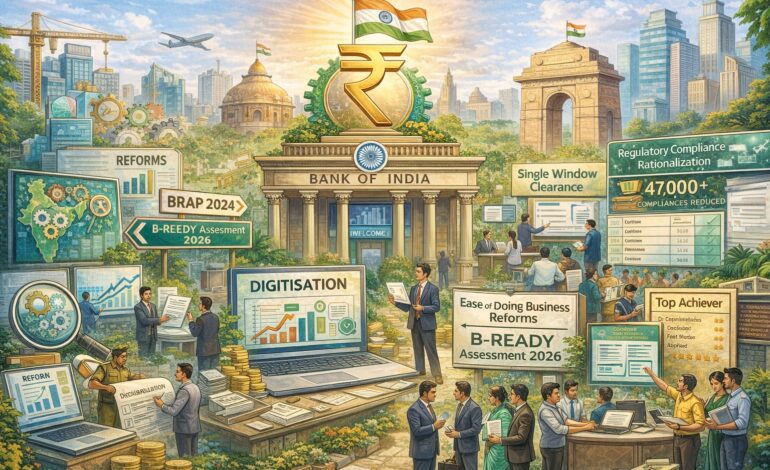
Regulatory Overhaul: 47,000+ Compliances Reduced
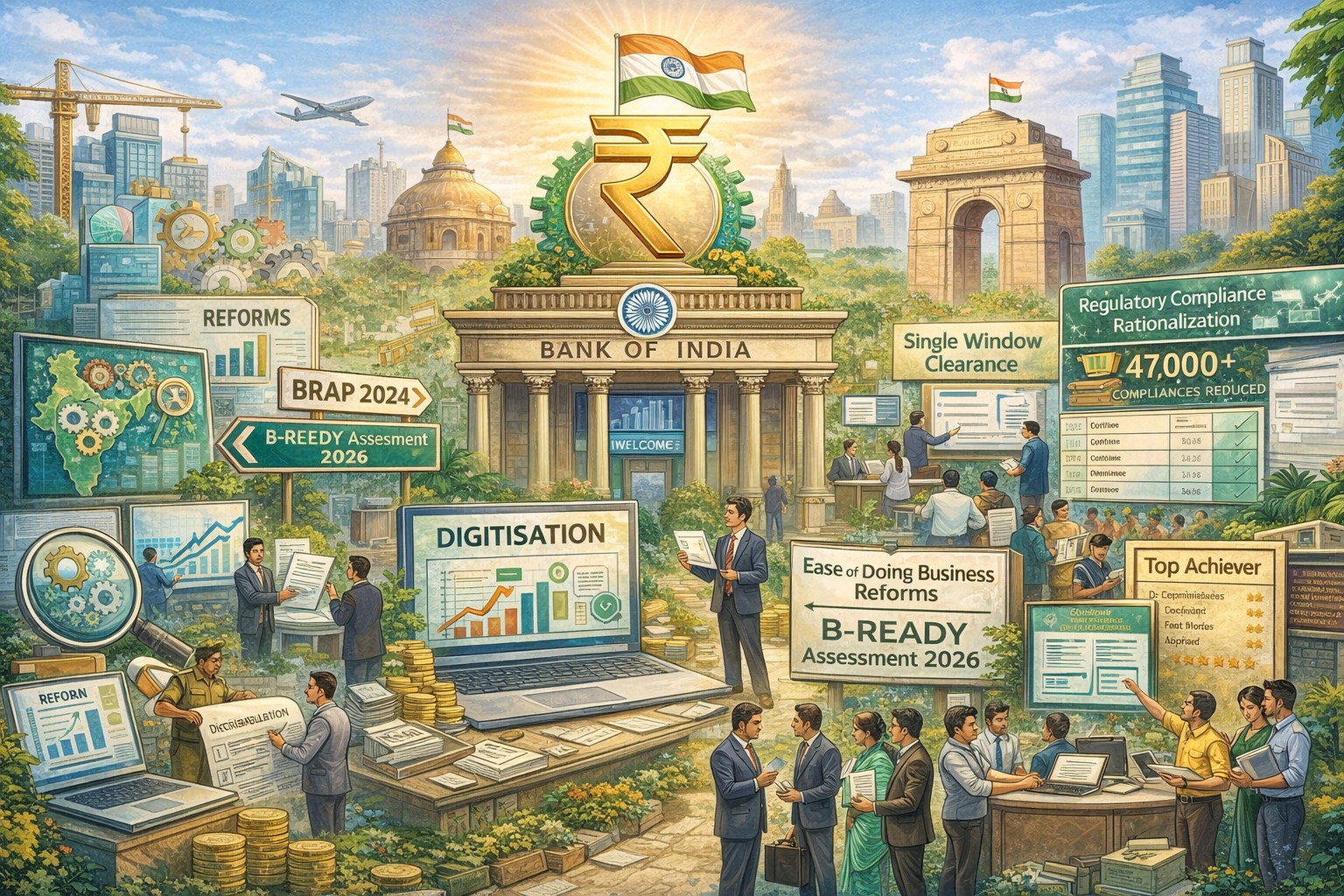
One of the most significant pillars of reform has been the Regulatory Compliance Burden (RCB) initiative, launched in 2020. Through a self-identification exercise undertaken by central ministries, departments and states/UTs, more than 47,000 compliances have been reduced over the past five years.
According to the release:
- 16,109 compliances were simplified
- 22,287 compliances were digitised
- 4,623 compliances were decriminalised
- 4,270 compliances were eliminated altogether
Under the RCB+ framework, 4,846 compliances have been reduced out of 6,262 identified across 23 Acts commonly implemented by states and UTs, helping address inter-state and intra-regulatory duplication .
The Jan Vishwas (Amendment of Provisions) Act, 2023 decriminalised 183 provisions across 42 Acts administered by 19 ministries and departments. A follow-up Bill in 2025 proposes further amendments to 355 provisions, including decriminalisation of 288 provisions, signalling the government’s intent to systematically remove minor criminal penalties from business laws.
Digitisation and Single-Window Clearances
BRAP reforms have expanded beyond compliance rationalisation to systemic digital transformation. Key measures include:
- Establishment of single-window systems
- Simplified building permissions
- Streamlined environmental clearances
- Digitised registrations and renewals
- Integration of land banks and GIS mapping with the India Industrial Land Bank portal
The National Single Window System (NSWS), operationalised by DPIIT, now integrates 32 central ministries/departments and 33 states/UTs. Businesses can access more than 300 central and 3,000 state-level G2B approvals via a unified digital interface. An investor dashboard enables real-time tracking of applications, while helpline and grievance redress mechanisms ensure time-bound resolution.
These measures aim to reduce turnaround time and costs associated with setting up and operating businesses in India, reinforcing transparency and accountability in regulatory processes.
State Rankings: Competitive Federalism in Action
The ministry in the statement detailed the evolution of BRAP rankings since 2015, highlighting how states have progressively improved reform implementation.
In BRAP 2019, Andhra Pradesh topped the rankings, followed by Uttar Pradesh and Telangana. By BRAP 2020, states including Andhra Pradesh, Gujarat, Haryana, Karnataka, Punjab, Tamil Nadu and Telangana were classified as “Top Achievers”.
The 2024 BRAP categorisation, based on compliance scores, reflects a more granular evaluation framework:
- Fast Movers (Category Y) include Odisha, Punjab, Andhra Pradesh, Rajasthan, Madhya Pradesh, Kerala, Assam, Uttarakhand, Jammu & Kashmir and Karnataka.
- Aspirers (Category Y) include West Bengal, Tamil Nadu, Maharashtra, Gujarat, Uttar Pradesh, Chhattisgarh, Haryana, Telangana, Jharkhand, Himachal Pradesh, Goa, Bihar and Delhi.
- Category X (covering northeastern states and select UTs) lists Tripura, Meghalaya, Chandigarh, Dadra & Nagar Haveli and Daman & Diu, Andaman & Nicobar Islands, Puducherry, Nagaland, Arunachal Pradesh, Mizoram, Sikkim, Lakshadweep and Manipur as Aspirers .
States are categorised as “Top Achievers” (above 95%), “Achievers” (90–95%), “Fast Movers” (80–90%) and “Aspirers” (below 80%), reflecting performance against reform action plans.
Aligning with B-READY
The transition from the World Bank’s Doing Business framework to the new B-READY assessment has prompted a recalibration of India’s reform agenda. The B-READY methodology evaluates not just regulatory design but also service delivery, implementation efficiency and real-world outcomes.
By combining compliance rationalisation, decriminalisation of minor offences, digitisation of services and inter-state competitive benchmarking, the government is attempting to build a more resilient, transparent and investor-friendly regulatory ecosystem.
The Ministry said these efforts are aimed at strengthening India’s position as an attractive investment destination while fostering ease of living and ease of doing business in tandem.
With B-READY 2026 on the horizon, India’s reform momentum suggests a strategic shift from rank-based competition to systemic institutional strengthening—an approach that may define the next phase of the country’s business environment transformation.