₹476 Crore Push, 80,590 Tonnes Output: India’s Makhana sector targets global superfood market
India’s makhana sector is expanding from a traditional Bihar crop into a fast-growing global food business, backed by rising demand, exports, value addition and a ₹476.03-crore government development scheme.
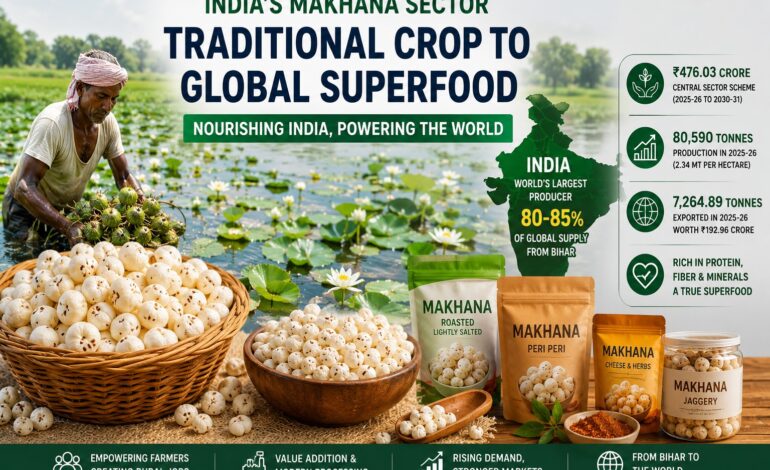
India is the world’s largest producer of makhana, with Bihar accounting for nearly three-fourths of the country’s production and around 80-85% of global supply.

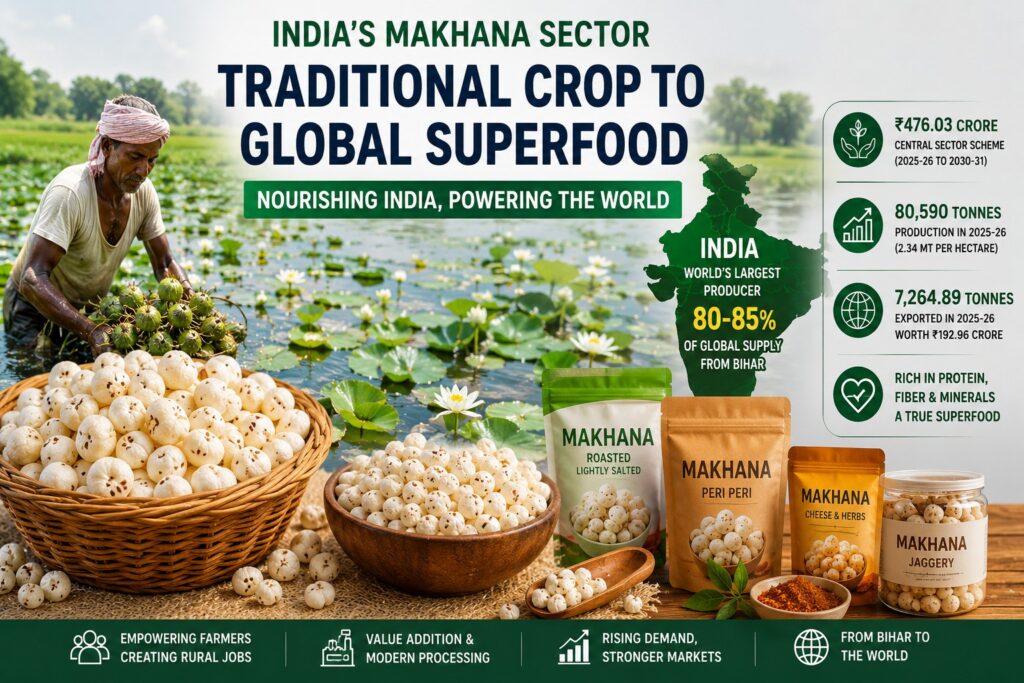
NEW DELHI: India’s makhana sector is rapidly evolving from a traditional crop concentrated in Bihar into a growing agri-food industry with rising domestic consumption, expanding exports and significant potential for value addition and farmer income.
A PIB backgrounder released on Wednesday said India is the world’s largest producer of makhana, with Bihar accounting for nearly three-fourths of the country’s production and around 80-85% of global supply. The crop is primarily cultivated in North Bihar, particularly across the Kosi basin and the Mithila and Seemanchal regions.
The sector is receiving institutional support following the establishment of the National Makhana Board and the approval of a Central Sector Scheme for Development of Makhana with an outlay of ₹476.03 crore for 2025-26 to 2030-31. The scheme covers research and innovation, quality seeds, farmer skills, harvesting and post-harvest practices, value addition, branding, marketing, exports and quality control.
Recent production data points to a sharp expansion in the crop. India produced 63,910 metric tonnes of makhana in 2024-25, while the Second Advance Estimates for 2025-26 put production at 80,590 metric tonnes, with average productivity rising from 2.03 tonnes per hectare to 2.34 tonnes per hectare. Bihar alone is estimated to have produced 60,000 tonnes in 2025-26.
The government has also been strengthening the sector through farmer training, improved cultivation technologies and infrastructure. According to the backgrounder, 8,159 farmers benefited under the Central Sector Scheme during 2025-26, while an additional 1,010 hectares were brought under makhana cultivation and 73 hectares were covered under a seed production programme.
Domestic demand is emerging as a major driver of the makhana boom. The domestic market recorded annual growth of 17-18% between 2021-22 and 2024-25, driven by health awareness, premiumisation and the expansion of branded snack companies. The market is projected to reach ₹11,000-12,000 crore by 2029-30.
Prices have also risen substantially. The average price of makhana increased from around ₹500 per kilogram during 2020-22 to nearly ₹1,250 per kilogram in 2025, according to the backgrounder. The rise has been attributed to stronger demand for health-focused snacks, premium branding and a relatively limited supply response.
India’s monthly domestic consumption of popped makhana is estimated at 3,000-3,500 tonnes, increasing to around 5,000 tonnes during festive periods. Organised and branded FMCG and snack companies account for about 1,800-2,000 tonnes of monthly consumption, while loose and unorganised retail continues to account for 1,200-1,400 tonnes.
Exports are becoming another important growth avenue. India exported 7,264.89 tonnes of makhana products in 2025-26, valued at ₹192.96 crore. The introduction of a dedicated HSN code for popped makhana and other makhana products in 2025 has also improved the availability of product-specific export data.
The export opportunity, however, is not evenly distributed across markets. The United States, Canada and the United Arab Emirates account for 77% of India’s makhana exports, but the backgrounder notes that smaller markets such as Germany, Nepal and Australia command higher unit prices. Germany records an average price of $26 per kilogram, compared with $19.5 per kilogram in the US and $13.3 per kilogram in the UAE.
This points to an opportunity for India to diversify its export destinations and focus more aggressively on premium markets rather than relying primarily on high-volume destinations.
Mithila Makhana has also received a Geographical Indication tag, giving the product legal protection and strengthening its potential for differentiation and branding in domestic and international markets.
The transformation is extending beyond raw agricultural production. Traditional makhana cultivation and processing remain labour-intensive, with seed collection often carried out manually underwater. But the value chain is increasingly incorporating improved varieties, field-system farming, mechanisation and modern processing technologies.
Secondary processing is creating additional opportunities through flavoured makhana, ready-to-eat snacks, makhana flour and other value-added products. The expansion of this segment could create new employment opportunities while enabling producers to capture a larger share of the consumer value chain.
The National Research Centre for Makhana is playing a role in this transition by developing improved varieties, water-efficient and integrated farming systems, and makhana-cum-fish farming. It has also developed machinery including seed washers, seed graders, roasting machines, popping machines and popped-makhana graders, with several technologies licensed for commercialisation.
The crop’s nutritional profile is another factor behind its growing popularity. Makhana contains protein, dietary fibre and essential micronutrients including magnesium, potassium, phosphorus and iron, while being low in fat and sodium and cholesterol-free. The backgrounder records fat content at 0.33 grams per 100 grams and protein digestibility at about 95%.
With India already dominating global production, the next phase of the makhana story is likely to be determined by how effectively the country converts that production advantage into higher productivity, stronger farmer incomes, modern processing, premium branding and greater access to international markets.
The government-backed institutional framework, combined with rising health-conscious consumption and growing demand for plant-based foods, is positioning makhana as more than a traditional snack from Bihar — it is emerging as a potential global Indian superfood and an expanding rural economic opportunity.