India Takes Traditional Medicine to Global Platforms Through WHO Partnerships, Ayush Cooperation Schemes
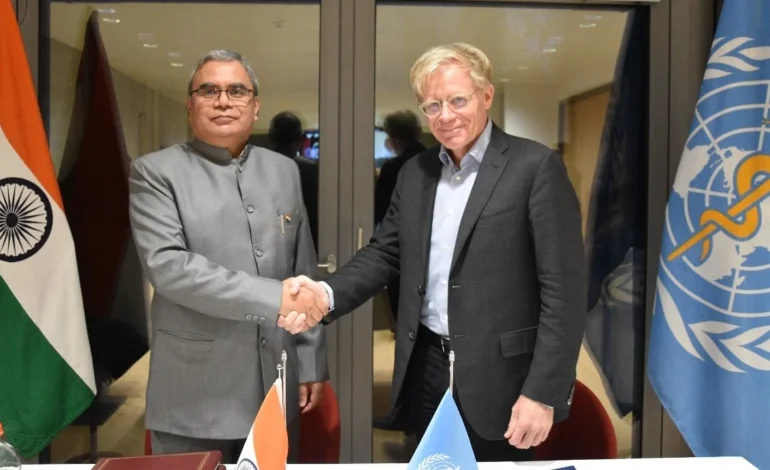
The World Health Organization (WHO) signed a new multi million five-year agreement with the Ministry of AYUSH, Government of India to boost the development of new TCI technical documents by WHO, in November 2023.

New Delhi, December 29: India is steadily positioning its traditional systems of medicine on global platforms through institutional partnerships, research collaboration, academic outreach and policy alignment with international health bodies, the government informed the Rajya Sabha.
The ministry of ayush has implemented a central sector scheme for the promotion of international cooperation in ayush (IC Scheme) to strengthen the global footprint of Ayurveda, Yoga, Naturopathy, Unani, Siddha and Homoeopathy. Under the scheme, financial and institutional support is provided to Indian ayush drug manufacturers and service providers to boost exports, facilitate international promotion, and expand market access for ayush products and services.
Global outreach through policy, research and academics
The IC Scheme supports international recognition of ayush systems by fostering stakeholder interaction, facilitating overseas training programmes, workshops and symposiums, and promoting academic and research collaboration. The ministry also sponsors ayush research, teaching programmes and institutional partnerships with reputed foreign universities, international agencies and UN bodies, including the World Health Organization.
A key pillar of India’s global ayush strategy is the establishment of the WHO Global Traditional Medicine Centre (GTMC) in Jamnagar, Gujarat, under an agreement signed with WHO. The centre serves as WHO’s global outposted office for traditional medicine and functions as an international knowledge hub for evidence-based Traditional, Complementary and Integrative Medicine (TCIM).
Objectives of WHO–GTMC
The GTMC aims to provide global leadership on traditional medicine, support countries in developing policies aligned with universal health coverage, and ensure quality, safety, efficacy, accessibility and rational use of traditional medicine systems. It is also tasked with developing global norms, standards and guidelines, strengthening data analytics, and assessing the impact of traditional medicine interventions.
The centre is envisaged as a WHO Traditional Medicine Informatics hub, creating a collaborative network of traditional medicine databanks, virtual libraries, academic institutions and research centres worldwide. Capacity-building and training programmes—on-campus, residential and digital—are also part of its mandate, in collaboration with the WHO Academy and strategic partners.
Standardisation and global classification
As part of WHO collaboration outcomes, benchmark documents for the training and practice of Ayurveda and Unani were published in 2022, following a project collaboration agreement signed in 2016. WHO has also published standardised terminology documents for Ayurveda, Unani and Siddha, supporting integration of traditional medicine into healthcare systems.
In a significant development, the ministry of ayush and WHO signed an agreement on May 24, 2025 to develop traditional medicine intervention categories and indices under the International Classification of Health Interventions (ICHI). The initiative focuses on Ayurveda, Siddha and Unani systems and marks the beginning of a dedicated traditional medicine module within ICHI, aligned with scientific classification and international standards.
Expanding global partnerships
The ministry has signed 25 country-to-country MoUs for cooperation in traditional medicine and homoeopathy, 15 MoUs with international institutions for establishing ayush academic chairs abroad, and 52 institute-to-institute MoUs for collaborative research and academic exchange. Additionally, 43 Ayush Information Cells have been set up across 39 countries to promote awareness and adoption of ayush systems globally.
Foreign nationals are also offered scholarships to pursue ayush courses in recognised institutions in India under the International Ayush Fellowship/Scholarship Programme, further strengthening India’s soft power in healthcare diplomacy.