Aravalli Green Wall Advances India’s Global Land Restoration Commitments, Says Union Minister Bhupender Yadav
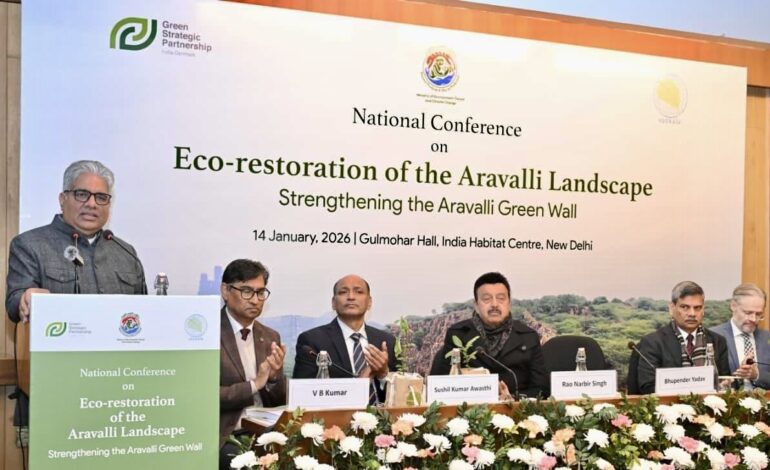
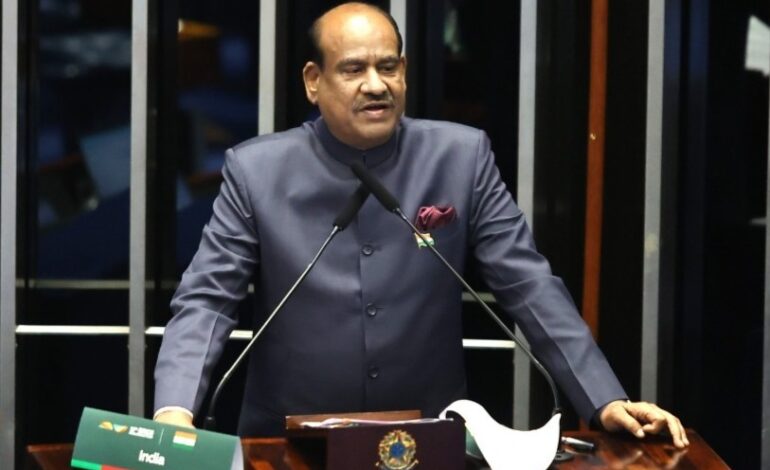
Union Minister for Environment, Forest and Climate Change Bhupender Yadav addresses the National Conference on Eco-restoration of the Aravalli Landscape: Strengthening the Aravalli Green Wall, in New Delhi on Wednesday.

New Delhi: Union Minister for Environment, Forest and Climate Change Bhupender Yadav on Wednesday inaugurated the National Conference on Eco-restoration of the Aravalli Landscape: Strengthening the Aravalli Green Wall in New Delhi, underlining the Centre’s push to restore the fragile Aravalli ecosystem through a landscape-scale approach.
At the inaugural session, Yadav also released a report titled Eco-restoration of the Aravalli Landscape, prepared by the Sankala Foundation. The report outlines a scientific, community-driven and scalable framework to strengthen the Aravalli Green Wall Project under the National Action Plan to Combat Desertification and Land Degradation.
Addressing the conference, the minister said the Aravalli Green Wall Project was launched as part of the vision of Prime Minister Narendra Modi and in line with India’s commitments under the United Nations Convention to Combat Desertification to restore 26 million hectares of degraded land. He said 6.45 million hectares of degraded land has been identified across the Aravalli region, with greening work already initiated over 2.7 million hectares in Gujarat, Delhi, Haryana and Rajasthan.
Yadav said divisional forest officers from 29 districts in the Aravalli landscape are implementing the project, with a focus on plantations of native species suited to arid and semi-arid conditions. He added that thousands of hectares in the region have been restored over the past two to three years, and the government remains committed to continuing the effort with ecology placed at the centre of development.
Recalling a key conservation intervention, the minister said around 97 square kilometres of heavily degraded Aravalli revenue land, stretching from Naurangpur to Nuh in Haryana, has been identified for afforestation and declared a protected forest by the Haryana government. He described the move as one of the most significant policy interventions for Aravalli protection since Independence, enabled through coordinated action between the Centre and the state.
Highlighting the ecological and historical importance of the Aravallis, Yadav said the mountain range is the oldest in the country and has supported human civilisation for thousands of years. He noted that the Aravalli ecosystem is currently protected by four tiger reserves and 18 protected areas, with additional green interventions being undertaken wherever required.
The minister also pointed to India’s growing global role in wildlife conservation, stating that the country is home to five of the world’s seven big cat species and nearly 70 per cent of the global tiger population, which continues to increase.
The inaugural session was also addressed by Rao Narbir Singh, environment minister of Haryana; Tanmay Kumar, Secretary, Ministry of Environment, Forest and Climate Change; Sushil Kumar Awasthi, Director General of Forests; Rasmus Abildgaard Kristensen, Ambassador of Denmark to India; and representatives of the Sankala Foundation.
The conference brought together policymakers, forest officials, experts, practitioners and civil society representatives to deliberate on the ecological significance of the Aravalli range and pathways for its long-term restoration. The report released at the event emphasises that restoration efforts must be landscape-scale, data-driven, community-anchored and multidisciplinary, noting that isolated interventions are no longer sufficient given the extent of degradation and mounting ecological pressures in the region.