Weather Forecast Accuracy Improves 30–40% Over a Decade as India Strengthens Climate Early Warning Systems
New Delhi: India’s weather forecasting capabilities have recorded a significant leap in accuracy over the last decade, with prediction skills for severe weather events improving by 30–40% for short- to
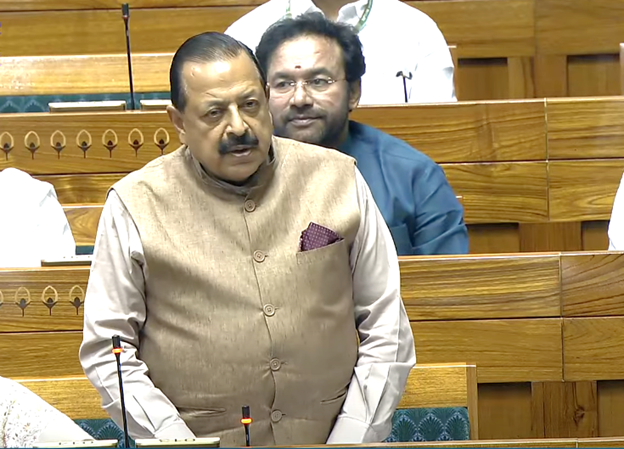
Union Minister of State (independent charge) for Atomic Energy and Space Dr Jitendra Singh

New Delhi: India’s weather forecasting capabilities have recorded a significant leap in accuracy over the last decade, with prediction skills for severe weather events improving by 30–40% for short- to medium-range forecasts, the government informed Lok Sabha on Wednesday.
In a written reply, Union Minister of State (independent charge) for Earth Sciences Dr Jitendra Singh said sustained investments in technology, modelling, radar infrastructure, and last-mile dissemination have transformed India’s early warning ecosystem, delivering tangible benefits for farmers, fisherfolk, disaster managers, and vulnerable communities.
Karnataka Sees Sharp Gains in Heavy Rainfall Forecasts
Citing Karnataka as a representative case, the minister highlighted marked improvements in the accuracy of heavy rainfall warnings—one of the most impactful severe weather events in the state.
In north interior Karnataka, the probability of detection (POD) for heavy rainfall events improved substantially between 2021 and 2025. At a one-day lead time, forecast skill rose from 52% to 88%, while five-day lead forecasts improved from 32% to 48%. Comparable gains were recorded across two-, three- and four-day lead periods.
South interior Karnataka also witnessed steady progress, with one-day lead accuracy rising from 58% to 70%, and five-day forecasts improving from 39% to 63% over the same period.
In coastal Karnataka, which is particularly vulnerable to monsoon extremes, forecast accuracy reached even higher levels. One-day lead detection improved from 80% to 92%, while five-day lead forecasts increased from 72% to 79%.
Overall, the government reported a 15–25% improvement in day-1 to day-5 heavy rainfall forecasts for Karnataka during 2020–2025.
Monsoon Prediction Accuracy Improves Nationwide
At the national level, the India Meteorological Department has strengthened climate services by adopting a multi-model ensemble (MME) forecasting strategy for monthly and seasonal outlooks from 2021 onwards.
As a result, the average absolute error in all-India southwest monsoon forecasts declined sharply to 2.28% of the long period average (LPA) during 2021–2024, compared to 7.5% during 2017–2020—reflecting a major improvement in seasonal climate predictability.
Digital Dissemination and Last-Mile Outreach
The government said forecasting gains are being matched by improvements in warning dissemination. IMD currently issues CAP-based alerts through the SACHET platform, with forecasts and warnings shared with state disaster management authorities and emergency operation centres for onward distribution.
Alerts are also disseminated through multiple channels including websites, social media, mobile apps, WhatsApp groups, APIs, and SMS-based systems, ensuring redundancy and wider reach.
In Karnataka alone, over 3.63 lakh farmers are directly connected through WhatsApp groups and receive real-time weather forecasts and advisories. For fisherfolk and vulnerable coastal communities, warnings are routed through district collector and SDM groups across coastal districts, including Dakshina Kannada.
Gram Panchayat-Level Forecasting Rolled Out Nationwide
A key institutional reform has been the launch of the Gram Panchayat Level Weather Forecasting (GPLWF) initiative. Rolled out nationally on 24 October 2024, the programme provides localised forecasts for nearly all gram panchayats in India.
These forecasts are accessible through platforms such as e-Gramswaraj, the Meri Panchayat app, e-Manchitra of the ministry of panchayati raj, and IMD’s Mausamgram portal—bringing weather intelligence closer to rural decision-making.
Radar Expansion, Heat Action Plans and Mission Mausam
India has also expanded its observation infrastructure. As of now, 47 Doppler Weather Radars (DWRs) are operational nationwide, covering about 87% of the country. This includes a C-Band Doppler Weather Radar commissioned at Shaktinagar, Mangalore, in November 2025, significantly strengthening coastal monitoring.
Heat action plans are being implemented in collaboration with the Karnataka State Natural Disaster Monitoring Centre, while the ministry of earth sciences has launched Mission Mausam—a national programme aimed at making India a weather-ready and climate-smart nation capable of mitigating climate change impacts and extreme weather risks.
Roadmap: Strengthening Farmer-Centric Advisory Systems
Looking ahead, the meteorological centre in Bengaluru is actively seeking feedback from user communities and state agencies to further strengthen last-mile delivery. An MoU has been signed with the GPS Institute of Agricultural Management to ensure timely dissemination of weather and climate advisories to farmers across Karnataka, supplementing agromet field units.
The government said the focus remains on integrating science, technology, governance, and community engagement to ensure that improved forecasts translate into real-world resilience and climate-smart decision-making.