Union Budget 2026–27: Growth, Inclusion and Global Integration Drive India’s Next Phase
New Delhi: Union Minister for Finance and Corporate Affairs Nirmala Sitharaman on Sunday presented the Union Budget 2026–27 in Parliament, outlining a Yuva Shakti–driven roadmap anchored in growth acceleration, capacity
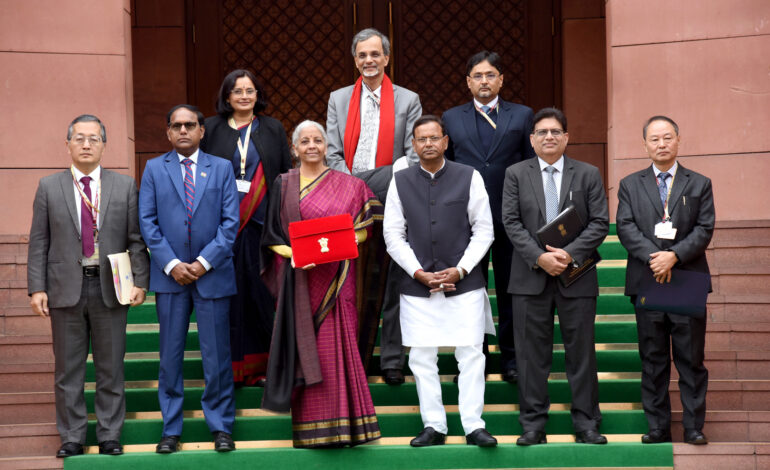
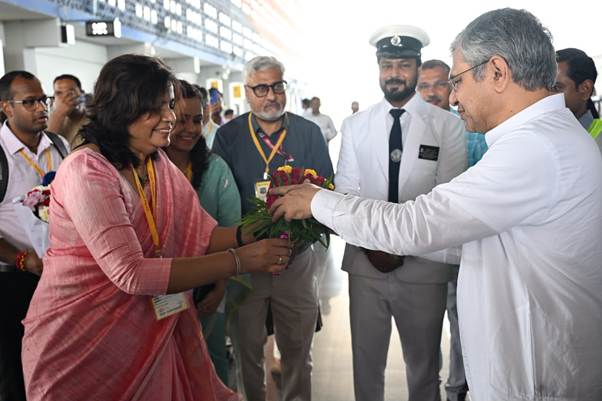
Union Minister for Finance and Corporate Affairs Nirmala Sitharaman along with Minister of State for Finance Pankaj Chaudhary and her budget team, senior officials of the ministry arrive for the presentation of the Union Budget-2026 at Parliament House, in New Delhi on Sunday, February 1, 2026.

New Delhi: Union Minister for Finance and Corporate Affairs Nirmala Sitharaman on Sunday presented the Union Budget 2026–27 in Parliament, outlining a Yuva Shakti–driven roadmap anchored in growth acceleration, capacity building, and inclusive development aligned with the vision of Sabka Sath, Sabka Vikas.
Prepared for the first time in Kartavya Bhawan, the Budget is guided by three kartavya: sustaining economic growth, fulfilling people’s aspirations by building capacity, and ensuring equitable access to opportunities across regions and communities.
Growth and investment push
Public capital expenditure has been increased from ₹11.2 lakh crore in 2025–26 to ₹12.2 lakh crore in 2026–27 to sustain infrastructure momentum. The Budget prioritises manufacturing across seven strategic sectors, MSME scale-up, legacy industry rejuvenation, energy security, and development of city economic regions.
A ₹10,000 crore SME Growth Fund has been proposed to nurture “Champion MSMEs”, while Biopharma SHAKTI, with an outlay of ₹10,000 crore, aims to position India as a global hub for biologics and biosimilars.
Seven high-speed rail corridors will be developed as “growth connectors” to promote environmentally sustainable passenger mobility.
Jobs, skills and human capital
To fulfil the second kartavya, the Budget focuses on education, skilling and employability. Key measures include:
- AVGC content creator labs in 15,000 schools and 500 colleges
- One girls’ hostel in every district for STEM institutions
- Upskilling 10,000 tourist guides through an IIM-led programme
- Launch of a Khelo India Mission to transform sports over the next decade
Medical tourism hubs, veterinary education expansion, and hospitality training reforms are also proposed to generate employment.
Agriculture, regions and social inclusion
Under the third kartavya, the Budget targets farmer income growth, regional development and social equity. Bharat-VISTAAR, a multilingual AI tool, will integrate AgriStack and ICAR systems to deliver customised farm advisory services.
Purvodaya states and the north-east will see focused investments, including tourism circuits, industrial corridors, e-buses, and Buddhist heritage development. Mental health infrastructure will be strengthened through NIMHANS-2 and upgrades to regional institutes.
Tax reforms and ease of doing business
A New Income Tax Act, 2025 will come into force from April 2026 with simplified rules and forms. The Budget proposes rationalisation of penalties and prosecution, reduced litigation, and extended timelines for return filing.
For the IT sector, a single category of IT services with a 15.5% safe harbour margin has been introduced, with the threshold raised to ₹2,000 crore. Foreign cloud service providers using Indian data centres will get a tax holiday till 2047.
Customs processes will be digitised through a single-window clearance system, risk-based audits, and AI-enabled scanning, while tariff rates on personal imports have been reduced to 10%.
Fiscal consolidation
The fiscal deficit for 2026–27 is estimated at 4.3% of GDP, with a declining debt-to-GDP ratio of 55.6%, reinforcing the government’s commitment to fiscal prudence while sustaining growth.
In essence, Union Budget 2026–27 positions India for the next phase of growth by combining infrastructure-led expansion, youth and skill development, global trade integration, and simplified taxation—aimed at steering the economy towards Viksit Bharat by 2047.