Ministry of Finance Year End Review 2025: DBT Scale, Fiscal Reforms and Capital Push Redefine Public Spending
New Delhi, January 9: The Ministry of Finance, through the Department of Expenditure, has closed 2025 with a strong emphasis on transparency, digital governance and growth-oriented public spending, driven by
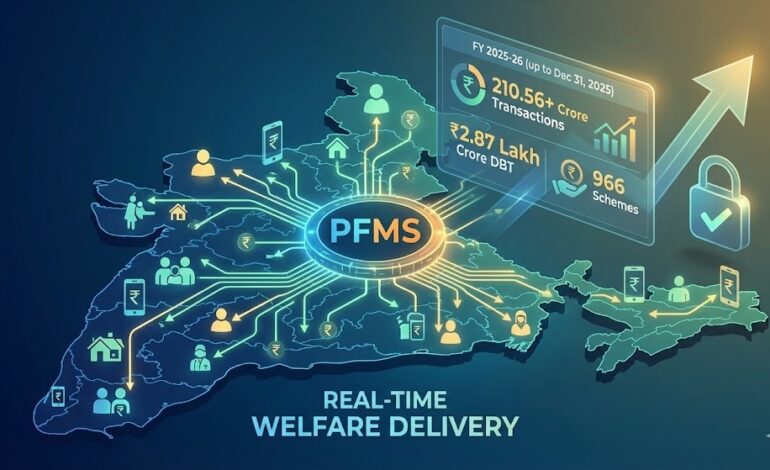
The Public Financial Management System (PFMS) has emerged as the backbone of India’s welfare delivery architecture. In FY 2025-26 (up to December 31, 2025), over 210.56 crore transactions amounting to ₹2.87 lakh crore were executed under 966 DBT-linked schemes, marking a decisive shift towards real-time, transparent fund transfers.

New Delhi, January 9: The Ministry of Finance, through the Department of Expenditure, has closed 2025 with a strong emphasis on transparency, digital governance and growth-oriented public spending, driven by large-scale adoption of Direct Benefit Transfer (DBT), reforms in public procurement, and an expanded capital expenditure framework for states, according to an official release on Thursday.
DBT via PFMS crosses ₹2.87 lakh crore in FY26 so far
The Public Financial Management System (PFMS) has emerged as the backbone of India’s welfare delivery architecture. In FY 2025-26 (up to December 31, 2025), over 210.56 crore transactions amounting to ₹2.87 lakh crore were executed under 966 DBT-linked schemes, marking a decisive shift towards real-time, transparent fund transfers.
PFMS now covers all centrally sponsored schemes, central sector schemes and major banks, enabling end-to-end digital tracking of public funds and sharply reducing delays and leakages.
Major DBT schemes dominate welfare spending
Among the largest DBT programmes in FY26 so far, MGNREGA recorded ₹48,021.62 crore in payments, followed by PM-KISAN with ₹39,532.37 crore. Other high-impact schemes included PAHAL (LPG subsidy), National Social Assistance Programme, PM Awas Yojana – Rural, and PM Surya Ghar Muft Bijli Yojana, reflecting the government’s continued focus on income support, energy access and rural housing.
Citizen-centric DBT governance strengthened
To enhance last-mile effectiveness, the Department of Expenditure conducted DBT regional conclaves and state workshops across 26 states and two union territories, bringing together senior officials for capacity building on PFMS and DBT modules.
The DBT Open House, operational since January 2024, enabled beneficiaries to directly raise grievances with PFMS officials. By December 2025, the platform recorded 476 sessions, over 1,300 institutional participations, and resolved all 1,358 issues raised, reinforcing citizen trust in digital governance.
CRM-based grievance redressal scales up
A unified Customer Redressal Management (CRM) system now handles more than 1.5 lakh grievances annually across PFMS, CGA and the Department of Expenditure. Resolution rates across helpdesk, DBT, banking, technology and reporting verticals remained above 99 percent, highlighting operational maturity of the platform.
Public procurement manuals comprehensively overhauled
In a major structural reform, the Department revised and reissued all public procurement manuals, including:
- Manual for Procurement of Goods (Second Edition, 2024)
- Manual for Procurement of Consultancy Services (Second Edition, 2025)
- Manual for Procurement of Works (Second Edition, 2025)
- A newly developed Manual for Procurement of Non-Consultancy Services
The revisions consolidate all CVC instructions and introduce clarity on conflict of interest, price variation caps, reverse auctions, outsourcing, and cartel mitigation, significantly easing compliance for suppliers and procurement professionals.
Capital expenditure push through special assistance to states
The Scheme for Special Assistance to States for Capital Expenditure (SASCI) continued to act as a growth multiplier. From its launch in 2020-21 to FY 2025-26 (till January 4, 2026), total releases under the scheme touched ₹4.49 lakh crore.
For FY 2025-26 alone, ₹83,595 crore has already been disbursed. The scheme supports reforms in mining, urban planning, land governance, agricultural digital infrastructure, road safety enforcement, and financial management efficiency.
Borrowing flexibility linked to reforms
Following the Fifteenth Finance Commission recommendations, states were permitted net borrowing of 3 percent of GSDP, amounting to ₹10.29 lakh crore in FY 2025-26.
Additionally, states undertaking power sector reforms became eligible for an extra 0.5 percent of GSDP borrowing, incentivising improvements in metering, subsidy DBT, AT&C loss reduction, tariff rationalisation, and payment discipline. Between 2021-22 and 2024-25, permissions worth ₹1.48 lakh crore were granted under this reform-linked window.
Finance Commission grants reinforce fiscal federalism
The Department of Expenditure released substantial Finance Commission grants during FY 2025-26, including allocations for revenue deficit states, urban and rural local bodies, health sector strengthening, disaster response and mitigation funds. Additional assistance was extended for disaster recovery, fire services modernisation, urban flood management, landslide risk mitigation and wetland restoration across multiple states.
Looking ahead
The year-end review underscores how digital public finance systems, rule-based procurement, and reform-linked fiscal incentives are reshaping India’s public expenditure landscape. By combining scale with accountability, the Department of Expenditure has positioned fiscal governance as a key enabler of inclusive growth and cooperative federalism.