India, Russia Sign Wide-Ranging Agreements to Deepen Strategic, Economic and People-Centric Cooperation
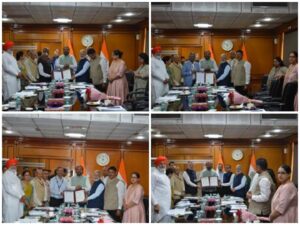
New Delhi, December 6: India and Russia concluded a comprehensive set of agreements spanning migration, mobility, health, maritime cooperation, academic partnerships, media collaboration and trade facilitation during the State Visit
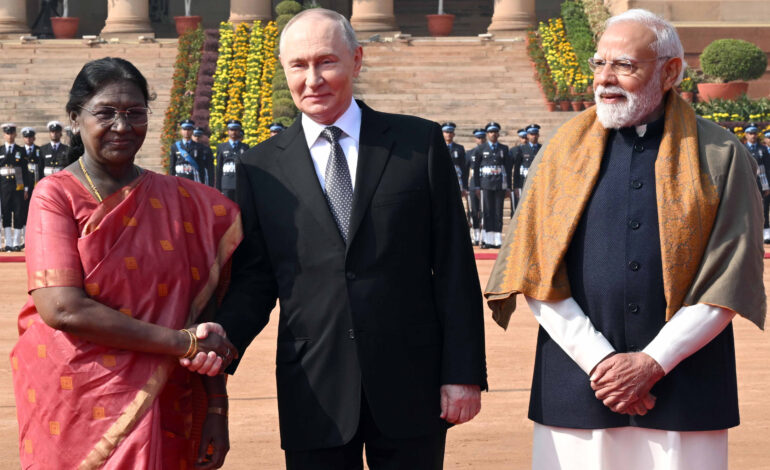
President Droupadi Murmu accords a ceremonial welcome to Vladimir Putin, President of the Russian Federation at Rashtrapati Bhavan, along with Prime Minister Narendra Modi, in New Delhi on Friday, December 5, 2025.

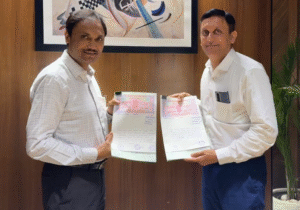
New Delhi, December 6: India and Russia concluded a comprehensive set of agreements spanning migration, mobility, health, maritime cooperation, academic partnerships, media collaboration and trade facilitation during the State Visit of Vladimir Putin, the President of the Russian Federation, to India, on December 4-5. The outcomes signal a renewed push toward long-term strategic alignment and enhanced economic engagement between the two countries.
The two sides signed landmark agreements on migration and mobility, including a framework allowing temporary labour activity by citizens in each other’s territories and a cooperation pact to combat irregular migration. Officials said the agreements are expected to streamline legal movement of workers, improve regulatory safeguards and strengthen coordination between the two governments.
Health and food safety formed another pillar of the outcomes. India and Russia signed an agreement to expand cooperation in healthcare, medical education and scientific exchange. A parallel pact between the Food Safety and Standards Authority of India and Russia’s federal surveillance service aims to strengthen joint work on food safety standards — an area critical to expanding agri-trade and ensuring consumer protection.
Maritime ties received a boost with two MoUs focused on specialist training for ships operating in polar waters and broader cooperation between the Ministry of Ports, Shipping and Waterways and Russia’s maritime authorities. With growing interest in Arctic routes and polar logistics, the agreements are expected to enhance skill development and enable closer operational coordination.
In the fertilizers sector, a multilateral MoU involving UralChem and three major Indian entities — Rashtriya Chemicals and Fertilizers Limited, National Fertilizers Limited and Indian Potash Limited — was signed to secure supply chains and deepen industrial partnerships.
Customs cooperation was strengthened through a protocol enabling exchange of pre-arrival information on goods and vehicles moving between the two nations, aiming to simplify procedures and reduce transit delays. India Post and Russian Post also signed a bilateral agreement to enhance postal and parcel logistics connectivity.
Academic and research collaboration featured prominently in the outcomes. New partnerships were formalised between the Defence Institute of Advanced Technology, Pune, and Tomsk State University, as well as between the University of Mumbai, Lomonosov Moscow State University and Russia’s sovereign investment fund. These initiatives are expected to expand joint research, faculty exchange and advanced study programmes.
The two countries also broadened media cooperation. Prasar Bharati signed multiple MoUs with leading Russian broadcasters and media groups — including Gazprom-Media Holding, National Media Group, BIG ASIA, TV-Novosti and TV BRICS — to deepen content exchange, co-production opportunities and collaborative broadcasting.
Several announcements accompanied the signed agreements. India and Russia finalised the Programme for the Development of Strategic Areas of Economic Cooperation till 2030, outlining long-term priorities for trade, technology and investment. The Russian Federation announced its decision to join the International Big Cat Alliance, supporting India’s global conservation initiative. Cultural cooperation received a boost with a pact for an upcoming exhibition titled “India. Fabric of Time” in Moscow.
In a significant move to revive tourism flows, India announced 30-day e-Tourist Visas on a gratis basis for Russian nationals on a reciprocal basis, along with free Group Tourist Visas.
Officials described the outcomes as wide-ranging and forward-looking, reflecting continuity in the India–Russia strategic partnership across economic development, people-to-people exchanges, technology, education and media cooperation. The agreements are expected to shape the trajectory of bilateral engagement through the remainder of the decade.