Indian scientists develop breakthrough cathode material for next-generation zinc-ion batteries
Bengaluru, November 22: Bengaluru-based researchers have reported a major advance in zinc-ion battery (ZIB) technology, unveiling a new cathode activation method that significantly boosts energy density, stability and lifespan—offering a
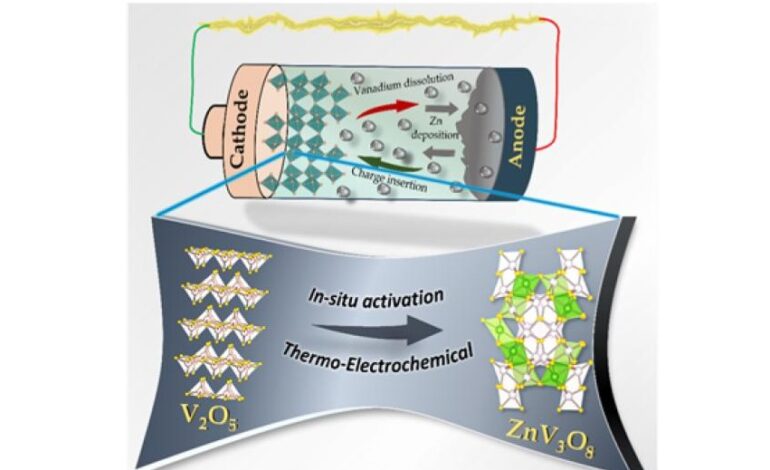
The research team, led by Ashutosh Kumar Singh from the Centre for Nano and Soft Matter Sciences (CeNS), an autonomous institute under the department of science and technology, has developed a thermo-electrochemical treatment technique that transforms conventional vanadium oxide (V₂O₅) into a structurally enhanced zinc-vanadium oxide (Zn-V₂O₅) material.

Bengaluru, November 22: Bengaluru-based researchers have reported a major advance in zinc-ion battery (ZIB) technology, unveiling a new cathode activation method that significantly boosts energy density, stability and lifespan—offering a potential eco-friendly alternative to lithium-ion batteries.
The research team, led by Ashutosh Kumar Singh from the Centre for Nano and Soft Matter Sciences (CeNS), an autonomous institute under the department of science and technology, has developed a thermo-electrochemical treatment technique that transforms conventional vanadium oxide (V₂O₅) into a structurally enhanced zinc-vanadium oxide (Zn-V₂O₅) material. By deliberately introducing nanoscale defects and channels into the material, the modified structure allows faster ion movement, improved hydrogen-ion interaction and greater structural stability during repeated charge–discharge cycles.
According to the researchers, the activated cathode enables zinc-ion batteries to store far more energy and sustain thousands of recharge cycles with minimal degradation—a breakthrough that addresses longstanding performance limitations of oxide-based cathodes in aqueous ZIB systems. The study, published in Advanced Energy Materials, demonstrates that the technique is simple, scalable and potentially applicable to other cathode materials.
Co-author Rahuldeb Roy said the team adopted a “novel yet oversimplified strategy” to stabilise and enhance traditional cathode materials. He added that the method could accelerate the development of safer, more affordable and environmentally sustainable battery technologies.
With concerns rising over lithium supply, environmental impact and safety risks, zinc-ion batteries—known for their water-based electrolytes, inherent safety and abundant raw materials—are gaining global research attention. The new cathode activation strategy could help push ZIBs closer to real-world deployment in grid storage, consumer electronics and renewable energy systems.