India’s space economy targets USD 40–45 billion as private-sector participation expands
India’s space economy, valued at nearly USD 9 billion, could reach USD 40–45 billion in less than a decade, driven by private investment, startups and wider adoption of space technology.
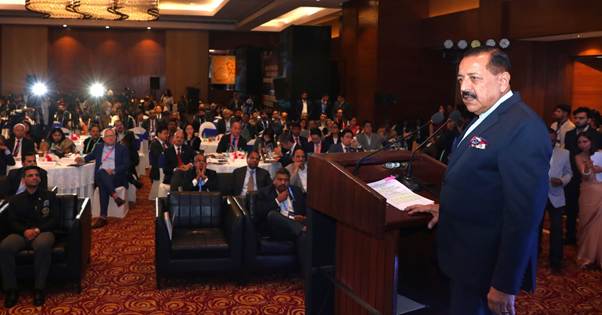
Union Minister of State for Science and Technology Dr Jitendra Singh addresses the fifth India International Space Conclave 2026 in New Delhi on Monday, November 23.

NEW DELHI: India’s space economy is projected to grow from nearly USD 9 billion to USD 40–45 billion in less than a decade, with expanding private-sector participation expected to play a central role in the next phase of growth, Union Minister of State for Science and Technology Dr Jitendra Singh said.
Addressing the fifth India International Space Conclave 2026 in New Delhi, the minister said the country’s space ecosystem had expanded from a handful of startups to an estimated 400–500 companies in just a few years. He attributed the growth to policy reforms that opened the sector to private investment, entrepreneurship and technology development.
The two-day conclave, organised by the Indian Space Association (ISpA) on November 23 and 24, brought together space companies, startups, researchers and international stakeholders. Its theme was ‘Shaping the Future of Space through Innovation, Governance, Human Potential and Global Collaborations’.
The event also saw the launch of the report ‘Space Economy 2036: The India Blueprint’.
Private companies expand across the space value chain
Dr Singh cited the progress of Indian space startups, including Skyroot Aerospace and Agnikul Cosmos, as evidence of the changing industry landscape. He referred to Skyroot’s maiden launch vehicle flight on July 18, 2026, its multi-mission launch agreement and unicorn status as significant milestones.
He also highlighted developments in advanced propulsion systems, privately developed rocket engines, Earth-observation technologies and satellite imaging capabilities.
The Minister said the establishment of NewSpace India Limited (NSIL), followed by the creation of the Indian National Space Promotion and Authorisation Centre (IN-SPACe), had helped transform a sector traditionally dominated by government institutions into one that increasingly accommodates private enterprises.
Space technology moves beyond satellite launches
The minister argued that the economic contribution of the space sector should not be measured only through rocket launches, satellite manufacturing and direct commercial revenues. Its wider contribution to productivity, cost savings and public-service delivery also needs to be considered.
He cited the PM Gati Shakti National Master Plan as an example of how space-based applications can support infrastructure planning, project monitoring, timely execution and reduction of wastage.
Applications of space technology now extend across infrastructure, construction, communications, education, healthcare, railways and defence, he said.
Responding to questions on generating greater demand for the industry, Dr. Singh said awareness of practical applications remained important. Wider adoption across government departments and other sectors, he indicated, could create new opportunities for space companies.
Investment, research and global partnerships
The minister urged domestic companies to increase investments and encouraged industry leaders to attract overseas capital into India’s space ecosystem. He referred to the Anusandhan National Research Foundation and the Research, Development and Innovation Fund as mechanisms intended to strengthen research and innovation.
He also called on industry to direct greater corporate social responsibility support towards scientific research and development, arguing that investment in research should be viewed as a contribution to society.
On international cooperation, Dr Singh said strengthening indigenous capabilities and working with global partners were not contradictory objectives. He emphasised the importance of indigenous sources, technologies and projects while remaining open to mutually beneficial partnerships.
Suggestions raised at the conclave included an international space innovation alliance, a global accelerator programme for startups and international innovation challenges.
Turning projections into a sustainable industry
The projected expansion to USD 40–45 billion would require more than an increase in the number of startups. Sustained private investment, access to capital, reliable demand, technology commercialisation and the ability to compete in global markets will be critical to achieving that scale.
Equally important will be the development of downstream applications that translate satellite data and space-based services into measurable value for agriculture, urban planning, transport, disaster management and public administration.
India’s policy reforms have widened private-sector participation, but the next test will be whether the growing ecosystem can build commercially viable products, secure long-term customers and establish a larger presence in international markets.