Grievance Portals, Unresolved Realities: Is India’s Digital Governance Closing Complaints or Solving Problems?
India's digital grievance platforms have simplified complaint registration and disposal, but administrative closure does not always mean citizen relief, raising questions about accountability and effective governance.
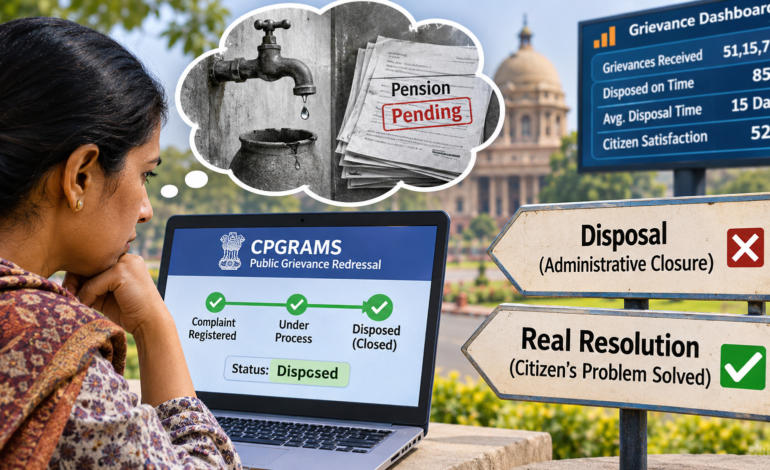
India's digital grievance redressal systems can record complaints as disposed of, but has the citizen's underlying problem actually been resolved?

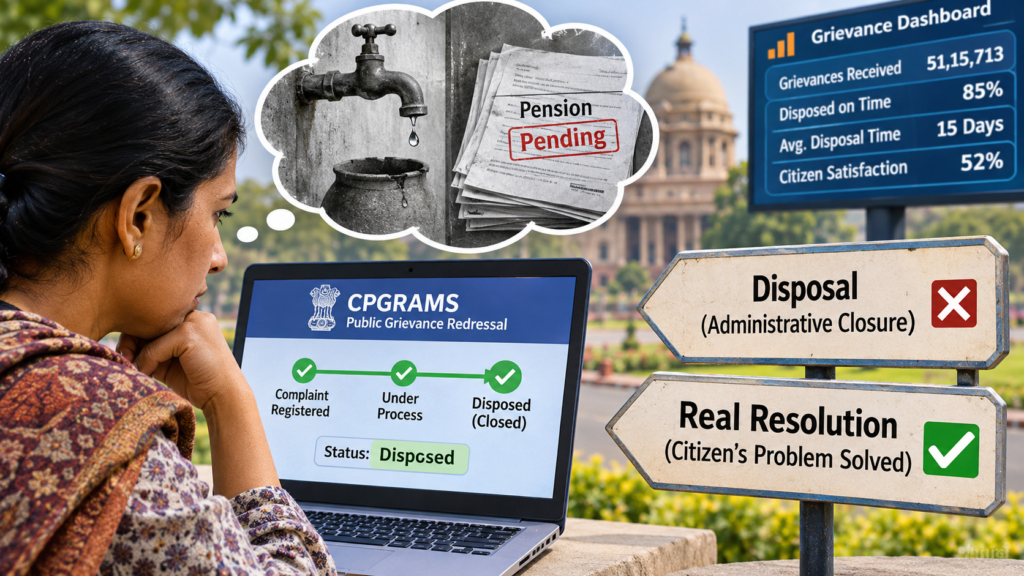
NEW DELHI: India’s digital transformation has significantly changed the way citizens interact with government institutions. From accessing public services and submitting applications to tracking entitlements and registering complaints, digital platforms have reduced several traditional barriers between citizens and public administration.
Among these initiatives, the Centralised Public Grievance Redress and Monitoring System (CPGRAMS) has emerged as an important component of India’s digital governance architecture. Available round the clock, the platform provides citizens with an online mechanism to register grievances relating to public service delivery and monitor their progress.
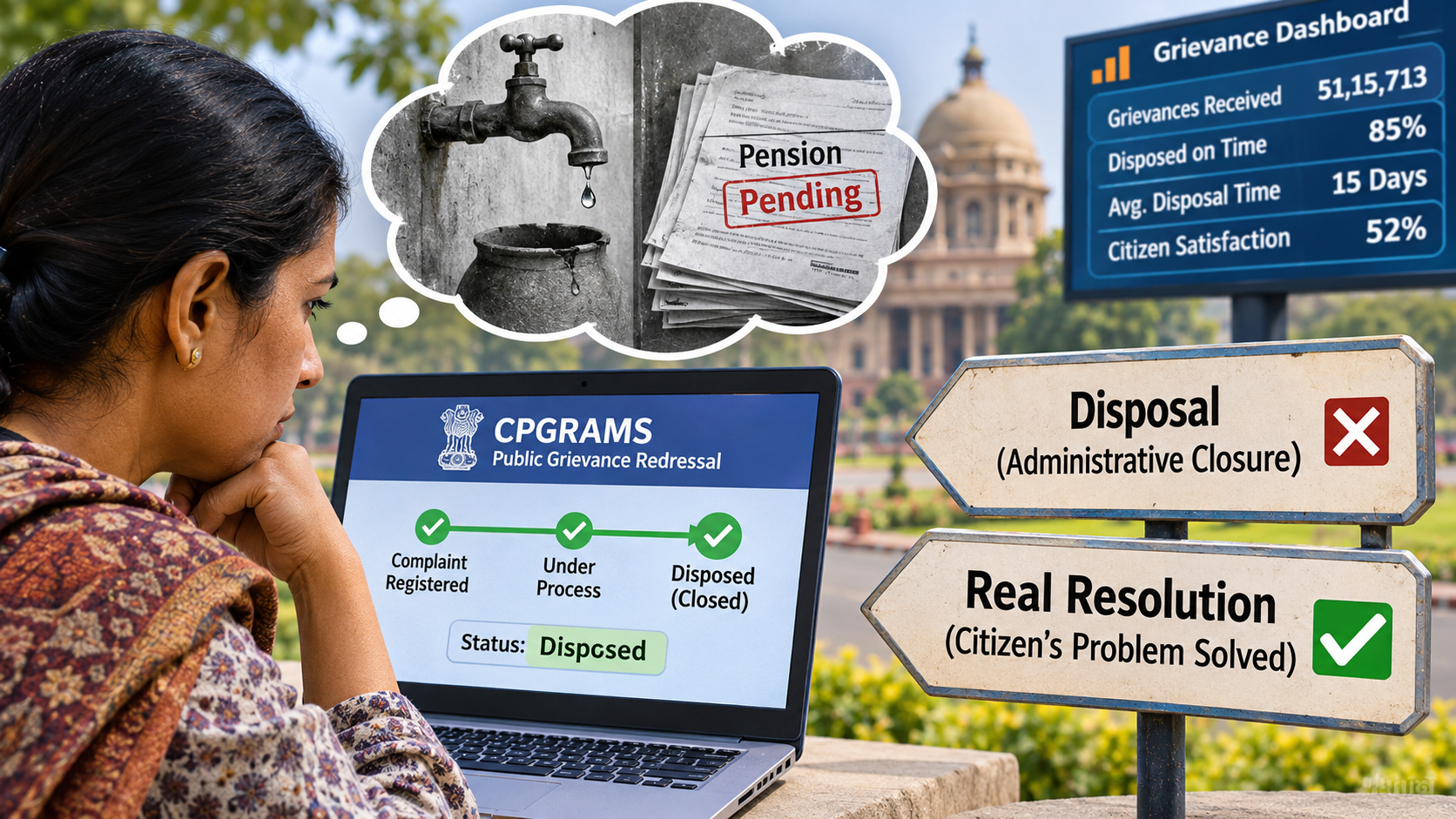
The scale of its operations is substantial. According to a government disclosure in Parliament in February 2026, Central Government Ministries and Departments received 51,15,713 grievances through CPGRAMS between 2023 and 2025. Of these, 43,56,331, approximately 85 per cent, were disposed of within the prescribed timeframe.
These figures demonstrate the growing capacity of the government to process public grievances through a centralised digital infrastructure. They also reflect the administrative effort invested in reducing pendency, improving monitoring and bringing greater efficiency to grievance management.
However, an important question remains largely unanswered: Does the disposal of a complaint necessarily mean that the citizen’s grievance has been resolved?
The distinction is more than a matter of terminology. It goes to the heart of what digital governance is expected to achieve. A government may become increasingly efficient at registering, routing, processing and closing complaints without necessarily becoming equally effective at addressing the problems that citizens bring to its attention.
This is where India’s digital grievance redressal framework faces a critical test. The next phase of digital governance must move beyond measuring how many complaints are closed and establish how many citizens actually receive the remedy they seek.
The numbers tell a story, but not the entire story
The government has made measurable progress in strengthening CPGRAMS and reducing the time taken to process grievances.
In a parliamentary reply in March 2026, the government stated that the average disposal time for grievances handled by Central Government Ministries and Departments was 15 days in 2025. It also reported that 82.1 per cent of grievances were disposed of within the prescribed 21-day timeline.
The August 2024 Comprehensive Guidelines for Effective Redressal of Public Grievances reduced the prescribed timeframe from 30 days to 21 days and introduced measures intended to strengthen institutional responsibility.
The government has also introduced dedicated grievance cells, designated grievance redressal officers, escalation mechanisms, senior-level reviews and feedback systems. Its 10-step CPGRAMS reform programme seeks to make grievance redressal more timely, effective and accessible.
These are meaningful administrative improvements. Faster processing can reduce uncertainty for citizens, while centralised monitoring can help senior officials identify departments with excessive pendency.
Yet, the number of complaints disposed of and the time taken to dispose of them are primarily measures of administrative activity. They do not, by themselves, establish whether the citizen’s underlying problem has been addressed.
A grievance relating to a delayed pension, an incorrect electricity bill, a failed government benefit transfer, a defective public service or an unresolved land record issue may be marked as disposed of after a departmental response. But unless the pension is released, the bill corrected, the benefit transferred or the record rectified, the citizen may continue to face the same problem.
The distinction between an administrative response and a substantive remedy is therefore central to evaluating the effectiveness of grievance redressal.
A disposal rate measures the government’s ability to process complaints. A resolution rate should measure its ability to solve them.
These are related, but they are not interchangeable.
When administrative closure becomes the performance indicator
One of the structural challenges in grievance management is the tendency to equate measurable administrative output with public service outcomes.
Government departments operate within systems that require files to be processed, cases to be assigned, replies to be submitted and pending matters to be cleared. Digital platforms have made these activities easier to monitor and quantify.
Dashboards can show how many complaints a department has received, how many remain pending, how quickly cases are being processed and how individual officers are performing against prescribed timelines.
Such information is essential for administrative supervision. However, when disposal rates become the dominant measure of performance, there is a risk that the system may reward procedural closure rather than substantive resolution.
An officer may respond to a complaint by explaining the existing rules, referring the citizen to another department, stating that the matter has been examined or communicating that necessary action has been initiated. Depending on the nature of the case, such a response may be administratively valid.
But has the citizen obtained relief?
Consider a pensioner whose monthly pension has been withheld because of a discrepancy in official records. The department may examine the complaint, communicate the applicable procedure and close the grievance after issuing a response. If the pension remains unpaid, the citizen’s problem has not been resolved.
Similarly, a consumer who complains about an incorrect electricity bill may receive a reply explaining the billing procedure without receiving a corrected bill. A beneficiary denied an eligible welfare entitlement may be informed that the matter has been forwarded to the concerned authority, but forwarding the complaint is not the same as restoring the entitlement.
These examples illustrate why a grievance redressal system must distinguish between the submission of a response, the completion of an administrative process and the delivery of the remedy sought.
Without such differentiation, digital efficiency can create an incomplete picture of institutional performance.
The citizen satisfaction question
The government has itself recognised the importance of measuring citizen satisfaction rather than relying exclusively on disposal statistics.
According to the Department of Personnel and Training’s Annual Report 2024–25, citizen satisfaction with grievance redressal, as indicated by feedback calls, increased from 40.74 per cent in 2023 to 52 per cent in 2024.
This improvement is encouraging. It suggests that the government’s reform measures may be contributing to a better citizen experience.
At the same time, the reported satisfaction level raises an important question about the experience of citizens whose grievances have been disposed of but who remain dissatisfied with the outcome.
The two sets of figures must be interpreted carefully. The disposal statistics and feedback-based satisfaction figures have different measurement bases and cannot be directly compared as if they represented the same group of complaints. Nor does dissatisfaction automatically establish that a grievance was improperly handled. Some requests may fall outside the jurisdiction of the receiving authority or may not be legally admissible.
Nevertheless, citizen feedback is an important indicator of the quality of grievance redressal.
A system that closes a large proportion of complaints within the prescribed timeframe but receives substantial dissatisfaction among respondents needs to examine why the gap exists.
Are citizens dissatisfied because their requests were rejected on legitimate grounds? Are departments providing inadequate explanations? Are complaints being transferred without effective coordination? Are citizens being asked to approach multiple authorities for a single problem? Or are grievances being closed before the promised corrective action is completed?
These questions cannot be answered by disposal dashboards alone.
They require a deeper examination of grievance outcomes, the quality of departmental responses and the actual experience of citizens after their complaints are closed.
The accountability gap: Who owns the citizen’s problem?
A grievance redressal platform can provide a centralised entry point, but the responsibility for resolving a problem often lies with a specific department, local authority or field-level administrative unit.
This creates an institutional challenge.
A complaint may involve several departments. A citizen seeking correction of a land record, for example, may encounter issues involving revenue officials, municipal authorities and registration departments. A public infrastructure complaint may require coordination between a local body, a utility provider and a state department.
The digital platform can route the complaint to the designated authority. It cannot automatically ensure that all the institutions involved cooperate to deliver a solution.
When a grievance moves between departments, responsibility can become fragmented. Each authority may respond within its own jurisdiction, while the citizen continues to face the original problem.
This raises a fundamental question of administrative ownership: who is accountable for the final outcome?
The grievance redressal officer should not necessarily be expected to personally implement every corrective measure. However, the institutional framework should ensure that someone remains responsible for tracking the complaint until the required action is completed or a reasoned, legally valid decision is communicated to the citizen.
The distinction between forwarding a complaint and taking ownership of its resolution must become an important element of administrative accountability.
The government has already taken steps in this direction. Its August 2024 comprehensive guidelines provide for dedicated grievance cells, designated nodal and appellate officers, root-cause analysis, action on citizen feedback and stronger escalation mechanisms.
The challenge now is implementation. The effectiveness of these provisions will depend on whether departments treat them as enforceable management responsibilities rather than procedural requirements.
The limitations of a technology-first approach
India’s digital governance agenda increasingly relies on data analytics, artificial intelligence and integrated platforms to improve public service delivery.
In grievance management, these technologies offer considerable potential. AI-assisted systems can classify complaints, identify recurring issues, route cases to appropriate departments, translate submissions, detect patterns in public grievances and flag cases that remain unresolved beyond prescribed timelines.
Data analytics can also help identify administrative bottlenecks and recurring failures in service delivery.
The Department of Personnel and Training’s Annual Report 2024–25 notes the use of AI-powered dashboards within the Department of Administrative Reforms and Public Grievances for data visualisation, identification of clusters and root-cause analysis.
These developments indicate that the government is moving towards a more data-driven grievance management framework.
However, technology cannot substitute for institutional responsibility.
An AI system can identify that hundreds of citizens have complained about the same malfunctioning public utility. It cannot independently repair the utility. It can identify repeated pension delays, but it cannot release the pending pension without an authorised administrative decision. It can detect that a particular department has an unusually high volume of complaints, but it cannot, by itself, correct the underlying shortage of staff or deficiencies in implementation.
There is also a risk that automated systems may make the grievance process more efficient without making it more responsive.
If complaints are automatically classified and closed based on predefined departmental responses, technology could reinforce existing administrative practices rather than challenge them.
AI-assisted grievance management must therefore be designed around verifiable outcomes, human oversight, transparency and an effective appeal mechanism.
The objective should not be to automate complaint disposal. It should be to improve the government’s capacity to resolve citizens’ problems.
The digital divide must not become a grievance divide
Another important dimension of citizen-centric governance is accessibility.
The availability of an online grievance platform does not mean that every citizen can use it effectively.
Digital literacy, language barriers, internet connectivity, disability access and familiarity with government procedures continue to influence the ability of citizens to navigate online systems.
For elderly citizens, persons with disabilities, rural households and economically disadvantaged communities, registering a complaint may itself require assistance.
The government has taken steps to expand access through Common Service Centres and other assisted digital channels. These are important interventions because grievance redressal must not become an exclusive facility available only to digitally confident citizens.
Accessibility, however, must extend beyond complaint registration.
Citizens must be able to understand departmental responses, receive meaningful updates, submit additional evidence, challenge unsatisfactory decisions and access an appeal mechanism without navigating an unnecessarily complicated digital process.
A grievance portal that is easy to enter but difficult to use for follow-up and escalation does not fully address the citizen’s needs.
Nor should citizens be expected to possess sophisticated digital skills to secure a service or benefit to which they are legally entitled.
The success of digital governance must ultimately be judged by how effectively it serves those who face the greatest barriers in accessing public institutions.
Repeated complaints should trigger institutional scrutiny
One of the most valuable but underutilised possibilities of a centralised grievance system is its potential to identify systemic failures.
When several citizens complain about the same issue, the complaints should not be treated merely as separate administrative cases.
A recurring pattern may reveal a deeper problem: defective service-delivery procedures, inadequate infrastructure, outdated records, corruption risks, poor coordination, insufficient staffing or a failure to implement existing government policies.
For example, repeated complaints about delayed welfare payments may indicate a systemic problem in beneficiary verification or fund disbursement. Multiple complaints about the same road may point to inadequate maintenance or defective project execution. A continuing pattern of complaints about electricity connections may indicate weaknesses in local service delivery.
The purpose of a grievance database should therefore extend beyond monitoring individual cases.
It should help government institutions identify the reasons citizens repeatedly approach them for relief.
The government’s emphasis on root-cause analysis in its comprehensive grievance redressal guidelines is a welcome step. However, the real test is whether recurring grievances lead to corrective administrative action.
If hundreds of complaints about the same problem are disposed of individually without addressing the underlying cause, the system may be clearing its queue while allowing the problem to persist.
A mature grievance redressal framework should identify recurring issues, assign responsibility for corrective measures, establish deadlines and monitor whether the number of similar complaints declines.
This would transform grievance data from a case-management resource into an instrument of governance reform.
From disposal metrics to outcome-based accountability
India does not necessarily need another digital grievance portal. It needs a stronger accountability framework that connects the existing digital infrastructure to measurable improvements in public service delivery.
The next generation of grievance redressal should consider a more comprehensive set of performance indicators.
First, distinguish between disposal and resolution. Government dashboards should separately report complaints that have received a departmental response, cases in which corrective action has been completed, and matters that remain unresolved or have been rejected with reasons.
Second, introduce outcome verification. Citizens should be given a meaningful opportunity to confirm whether the stated remedy has actually been delivered. This should not become a mechanism for shifting the burden of proof onto citizens. Departments must retain responsibility for producing evidence of corrective action.
Third, strengthen the appeal mechanism. An appeal should trigger a substantive review of the original decision, including whether the department addressed the actual grievance rather than merely issuing a response. Appellate authorities should have access to the complete complaint history and relevant supporting evidence.
Fourth, publish department-wise outcome data. Public dashboards should go beyond the number of complaints received and disposed of. They should include verified resolution rates, appeal outcomes, recurring grievances, reasons for rejection and the proportion of complaints reopened after unsatisfactory disposal.
Fifth, link recurring grievances to administrative reform. Departments should identify patterns in complaints and publish periodic accounts of the corrective measures undertaken to address systemic deficiencies.
Sixth, establish clearer responsibility for inter-departmental cases. A citizen should not be made responsible for coordinating between government departments. An identified nodal authority should remain accountable for ensuring that the complaint reaches a substantive conclusion.
Seventh, independently assess citizen experience. Feedback systems should disclose their methodology, response rates and satisfaction levels. Independent audits and periodic citizen experience assessments can help establish whether reported improvements reflect actual service-delivery outcomes.
These measures would not require abandoning the existing digital infrastructure. Rather, they would build on it and shift the emphasis from administrative throughput to public value.
The larger governance question
The evolution of CPGRAMS reflects an important aspect of India’s digital transformation. The government has built an extensive mechanism through which citizens can approach public authorities, monitor complaints and seek administrative intervention.
The reduction in disposal timelines, expansion of grievance officer networks and introduction of centralised monitoring are significant developments.
But the ultimate purpose of grievance redressal is not to produce impressive administrative statistics. It is to ensure that public institutions respond effectively when citizens encounter failures in service delivery.
A citizen does not approach a grievance portal merely to obtain a registration number or a closure notification. The citizen expects a problem to be examined, a decision to be communicated and, where the grievance is justified, an appropriate remedy to be delivered.
This expectation must remain central to the design and evaluation of digital governance.
India’s digital public infrastructure has demonstrated that technology can expand access, improve administrative coordination and make government processes more measurable. The next challenge is to ensure that the same infrastructure strengthens accountability for outcomes.
A complaint that is closed without resolving the underlying problem is not necessarily evidence of administrative failure in every instance; some grievances may be unfounded, inadmissible or outside the authority’s jurisdiction. But a system that cannot distinguish between justified rejection, procedural closure and actual corrective action cannot provide a complete account of its own effectiveness.
The real measure of digital governance is not how quickly a government can close a complaint, but how effectively it can address the citizen’s problem.
India has made considerable progress in digitising grievance redressal. It must now make the transition from digital disposal to demonstrable resolution.
The next milestone in citizen-centric governance should not be another record in the number of complaints disposed of. It should be a measurable reduction in the number of citizens who need to complain repeatedly to obtain what they are already entitled to.