2025 at a Glance: Driving Digital Justice, Consumer Trust and Quality in India’s Marketplace
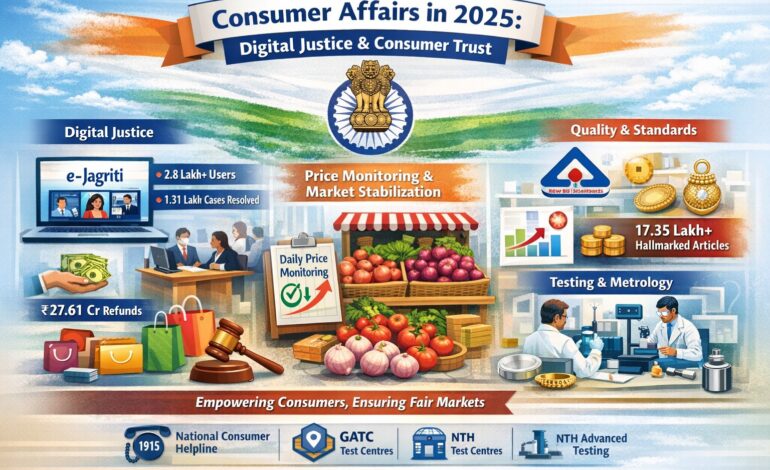
The year 2025 marked a defining phase for the Department of Consumer Affairs, as consumer protection in India shifted decisively towards speed, accessibility, transparency, and trust, according to the Ministry of Consumer Affairs, Food & Public Distribution.

New Delhi: The year 2025 marked a defining phase for the Department of Consumer Affairs, as consumer protection in India shifted decisively towards speed, accessibility, transparency, and trust, according to the Ministry of Consumer Affairs, Food & Public Distribution.
Through large-scale digital transformation, market stabilisation measures, modernised standards, and strengthened institutions, the department ensured that consumer welfare remained central to India’s rapidly evolving marketplace. The year reflected a transition from reactive regulation to responsive, technology-driven governance, the ministry said in a statement on Friday.
2025 at a glance
- Over 2.8 lakh users onboarded on the e-Jagriti platform
- 1.31 lakh+ consumer cases disposed digitally
- ₹27.61 crore refunds facilitated through the National Consumer Helpline
- Daily price monitoring across 575 centres nationwide
- 12 Government Approved Test Centre (GATC) certificates issued
- New BIS standards released to enhance product safety and quality
Digital transformation of consumer justice
e-Jagriti: Speed, simplicity and access
A landmark reform in 2025 was the nationwide rollout of e-Jagriti on January 1, integrating legacy systems such as CONFONET, e-Daakhil, OCMS, and NCDRC-CMS into a single end-to-end digital platform.
Designed around citizen convenience, the platform offers multilingual access, OTP-based registration, encrypted document exchange, virtual hearings, voice-to-text support, and real-time case tracking. It has significantly reduced physical visits, litigation costs, and procedural delays.
By mid-November 2025, over 2.81 lakh users, including more than 1,400 NRIs, had registered on e-Jagriti. Complaints were filed from countries including the US, UK, UAE, Canada, and Australia. More than 1.35 lakh cases were instituted and 1.31 lakh cases disposed, reflecting faster resolution and reduced pendency.
Strengthening the consumer protection framework
Alongside digital reforms, institutional capacity was strengthened under the Consumer Protection Act, 2019. Recruitment rules for Group ‘A’ posts in the National Consumer Disputes Redressal Commission were amended to improve administrative efficiency.
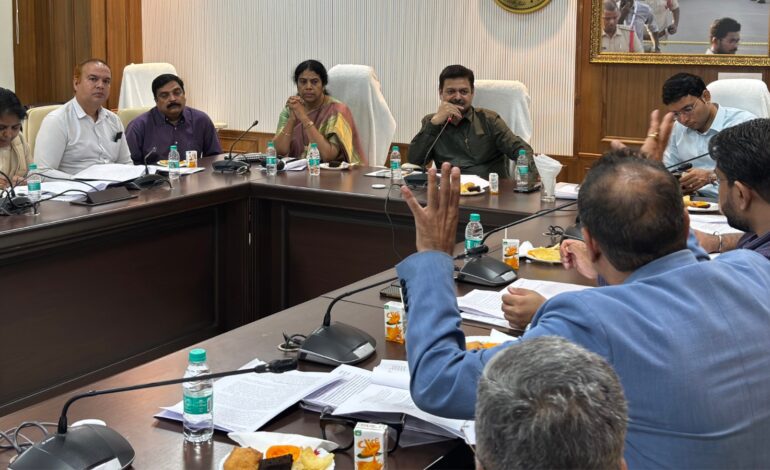
The department also conducted extensive stakeholder consultations with consumer commissions, industry bodies, e-commerce platforms, voluntary organisations, and academia on issues such as misleading advertisements, unfair online trade practices, and technology-enabled justice delivery.
Under the Strengthening Consumer Commissions scheme, ₹7.31 crore was released to states during the year to upgrade infrastructure and service delivery.
Consumer awareness and outreach
Consumer awareness initiatives focused on scale and last-mile inclusion. The Jago Grahak Jago campaign continued across digital, print, and outdoor platforms. IVRS voice calls and SMS outreach in 11 languages helped reach citizens without smartphones or reliable internet access.
Awareness activities were extended to mass gatherings such as the Maha Kumbh Mela 2025, which saw an estimated footfall of over 66 crore. Innovative tools, including Amar Chitra Katha comic books on consumer rights, were used to sensitise young consumers, alongside weekly virtual interactions with Panchayats.
National Consumer Helpline: Quick resolution
The National Consumer Helpline continued to serve as the first point of grievance redressal, operating in 17 languages through phone (1915), WhatsApp, SMS, web portal, UMANG, and email.
The number of convergence partners rose to 1,169 companies, enabling faster pre-litigation resolution. Between April and October 2025, the helpline facilitated refunds worth ₹27.61 crore across 49,333 cases, offering a fast, non-adversarial alternative to litigation.
Price monitoring and market stabilisation
Daily monitoring of essential commodity prices continued across 575 centres under the Price Monitoring System. Targeted interventions through the Price Stabilisation Fund helped manage volatility in pulses, onion, potato, and tomato.
Onion prices remained largely stable during 2025–26 due to higher production and timely buffer stock operations, including discounted retail sales and efficient rail transport. The Tomato Grand Challenge continued to promote innovation in the tomato value chain.
Legal metrology reforms
Legal Metrology reforms focused on accuracy in trade and ease of compliance. New rules were notified for instruments such as gas meters, moisture meters, radar speed devices, and breath analysers.
A major step was the issuance of 12 GATC certificates to private entities, significantly expanding verification capacity and reducing turnaround time. The e-Maap portal, under implementation, aims to integrate state legal metrology systems into a unified national digital platform.
Bureau of Indian Standards: Quality assurance
The Bureau of Indian Standards strengthened India’s quality ecosystem through standardisation, certification, hallmarking, and laboratory modernisation.
A key highlight was the release of a new Indian Standard for incense sticks (agarbatti), aimed at improving safety and product quality. Mandatory hallmarking was expanded, with HUID marking introduced for silver jewellery, enabling full digital traceability. Over 17.35 lakh articles have already been hallmarked under the HUID system.
National Test House: Expanding capabilities
The National Test House advanced its modernisation agenda, including a memorandum of understanding with the Defence Research and Development Organisation and DMSRDE to strengthen advanced testing and research collaboration.
Capabilities were expanded in emerging sectors such as electric vehicles, renewable energy, drones, defence equipment, and food testing, improving efficiency and turnaround times.
Looking ahead
National Consumer Day 2025 was observed with the theme “Efficient and Speedy Disposal through Digital Justice”, underscoring the role of technology in accessible consumer justice.
Building on the momentum of 2025, the department is focused on deepening digital justice delivery, strengthening legal metrology, expanding standardisation outreach, and enhancing testing capacity. Together, these initiatives reaffirm the government’s commitment to consumer-centric governance, fair markets, and trust-based growth in India’s marketplace.