PMKVY adds 600+ new-age courses as India steps up future-ready skilling
Under PMKVY 4.0, ₹2,392.37 crore has been released since FY2022-23, while special projects target women, SCs, STs, PwDs and underserved districts.
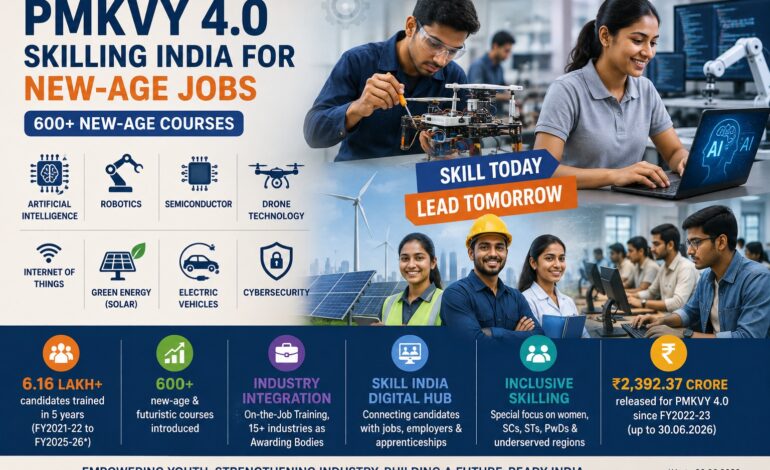
Under PMKVY 4.0, more than 600 new-age and futuristic courses have been introduced to respond to changing technology requirements and market demand.

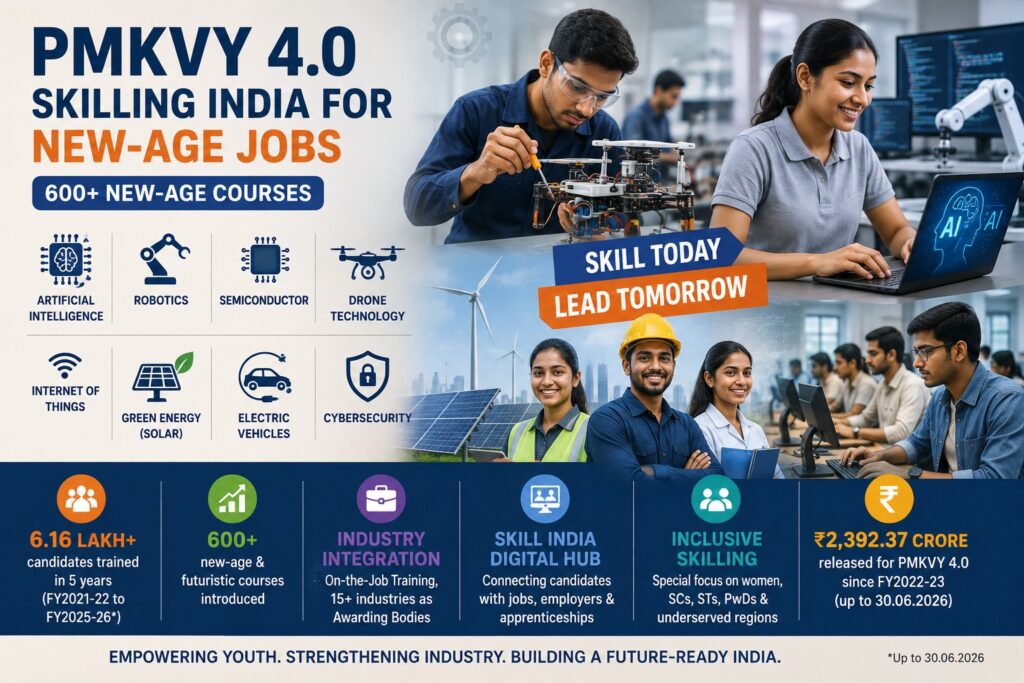
NEW DELHI: India’s skilling strategy is moving beyond conventional vocational training, with the Pradhan Mantri Kaushal Vikas Yojana (PMKVY) increasingly focused on preparing workers for emerging technologies such as artificial intelligence, robotics, semiconductors, drones and the Internet of Things.
Under PMKVY 4.0, more than 600 new-age and futuristic courses have been introduced to respond to changing technology requirements and market demand. Around 5.44 lakh candidates had been trained or oriented in these new-age job roles across the country as of June 30, 2026.
This information was given by the Minister of State (Independent Charge), Ministry of Skill Development and Entrepreneurship (MSDE), Jayant Chaudhary in a written reply in the Lok Sabha on Monday.
The expansion of future-oriented training is being accompanied by a broader restructuring of the skilling ecosystem, with courses being aligned to the National Skills Qualification Framework (NSQF), industry requirements and national priorities.
The government has released ₹2,392.37 crore for implementation of PMKVY 4.0 during the last three years and the current financial year, with the scheme operating as a demand-driven programme rather than through fixed state-wise allocations.
From AI to drones and semiconductors
The nature of jobs emerging from India’s technology-driven economy is forcing a change in the skills being offered to young workers.
PMKVY 4.0 has aligned training with job roles in artificial intelligence, robotics, Internet of Things, semiconductor technology, drone technology, solar energy and 3D printing, among other areas. The government says the new courses have been introduced in response to changing requirements in technology and the labour market.
The sector-wise data illustrates the breadth of the programme.
Training under PMKVY has covered sectors ranging from aerospace and aviation, agriculture and automotive to electronics and hardware, healthcare, IT and IT-enabled services, green jobs, logistics, telecommunications, tourism and hospitality.
The programme has also expanded into emerging and specialised areas such as life sciences, instrumentation and automation, power, infrastructure equipment and renewable-energy-related skills.
Industry gets a bigger role
The government’s approach is not limited to adding new courses.
Industries and Sector Skill Councils are being given a larger role in identifying skill gaps, developing curricula, defining competency standards and overseeing training, assessment and certification in alignment with NSQF.
A major reform under PMKVY 4.0 is the integration of On-the-Job Training through industries.
The objective is to give trainees exposure to actual workplace environments rather than confining skill development to classroom or training-centre settings.
More than 15 industries have also been designated as Awarding Bodies to develop job roles aligned with industry requirements. The government release cites HCL Technologies, IBM, Bajaj Finserv and Microsoft among the companies involved in this ecosystem.
Kaushal Mahotsavs are being organised in collaboration with industries to create employment opportunities for skilled candidates, while additional industries have been onboarded to deliver skill training across sectors.
The strategy effectively seeks to connect three elements that have often operated separately — what industry needs, what training institutions teach and what jobs actually require.
Skill India Digital Hub connects training to jobs
The government has also added a digital layer to the skilling ecosystem through the Skill India Digital Hub (SIDH).
The platform integrates skilling, education, employment and entrepreneurship services, creating a unified digital interface for candidates.
Trained candidates can make their details available on the platform, allowing potential employers to identify and connect with suitably skilled workers. SIDH also facilitates access to employment and apprenticeship opportunities by connecting candidates with prospective employers and establishments.
This creates a potential pathway extending from training to certification and finally to employment or apprenticeship.
The emphasis is therefore shifting from simply counting how many candidates complete training to creating a more connected skills-to-employment ecosystem.
Training reaches millions across India
The scale of PMKVY remains substantial even beyond its new-age skills component.
The latest five-year state-wise data shows that 6,16,040 candidates were trained in FY2021-22, followed by 2,11,170 in FY2022-23, 5,39,992 in FY2023-24, 20,38,319 in FY2024-25 and 1,53,388 in FY2025-26. In the current financial year, 85,754 candidates had been trained up to June 30, 2026.
The figures show considerable variation across states.
Uttar Pradesh recorded 4,63,503 trainees in FY2024-25, the highest annual figure in the state-wise table, while Rajasthan recorded 2,80,156 and Madhya Pradesh 2,59,871 during the same year.
The sector-wise data also shows the scale of training in areas directly connected with India’s digital and technology economy.
In FY2024-25, electronics and hardware accounted for 4,85,201 trainees, IT and IT-enabled services for 1,80,082, handicrafts and carpet for 2,22,628, apparel for 1,37,240 and beauty and wellness for 1,23,668.
IT and IT-enabled services alone recorded 93,672 certifications in FY2024-25, while electronics and hardware recorded 3,05,070 certifications.
Inclusion built into the skilling model
The future-skills push is being combined with an explicit inclusion agenda.
PMKVY 4.0 is described as a demand-driven scheme accessible to different sections of society, including women, Scheduled Castes, Scheduled Tribes and other marginalised communities.
Special Projects are targeted at under-represented groups and geographical areas such as Aspirational Districts and tribal districts. The government has also said special attention is being given to women, tribal communities and other marginalised groups in rural areas.
The program provides additional support intended to make participation easier for disadvantaged candidates.
For women and persons with disabilities undergoing non-residential training, conveyance and transportation costs are covered. Candidates with disabilities are also eligible for ₹5,000 towards assistive devices, aids and appliances.
All candidates are covered by one-year accidental insurance, providing an additional layer of social protection.
Funding follows demand rather than state quotas
Unlike conventional centrally funded programmes where allocations may be predetermined for individual states, PMKVY 4.0 is structured as a demand-driven scheme with no provision for state-wise fund allocation.
The funding data shows a Budget Estimate of ₹1,558 crore for FY2023-24, ₹1,938.30 crore for FY2024-25, ₹1,915 crore for FY2025-26 and ₹1,400 crore for FY2026-27.
Against these estimates, funds released were ₹510.52 crore in FY2023-24, ₹1,538 crore in FY2024-25, ₹265.57 crore in FY2025-26 and ₹78.28 crore in FY2026-27 up to June 30, 2026. The cumulative amount released was ₹2,392.37 crore.
The model reflects the government’s attempt to make the skilling system responsive to demand rather than treating every state or sector identically.
The bigger challenge is jobs
The expansion of new-age courses is significant because India’s employment landscape is changing at the same time as its technology ecosystem.
Training someone in AI, robotics, drones or semiconductor-related roles is only the first step. The larger test is whether the training translates into recognised skills, industry exposure, apprenticeships, employment or entrepreneurship.
That is where the industry’s role, On-the-Job Training and the Skill India Digital Hub become particularly important.
The government’s architecture is increasingly designed around that entire chain — identify the skill gap, develop the course, train the candidate, certify the skill, provide workplace exposure and connect the candidate with an employer.
If that chain works effectively, PMKVY can evolve from a large-scale training programme into an employment-oriented skills infrastructure for India’s next generation of workers.
For a country preparing for a technology-intensive economy, the shift is crucial.
The question is no longer simply how many young Indians can be trained.
It is whether they are being trained for the jobs India will actually need tomorrow.