NIELIT launches CYBER KUSHTI 2026 to test cybersecurity judgement, not detection speed
NIELIT has launched CYBER KUSHTI 2026, a national cybersecurity and AI hackathon that tests human judgement in evaluating, prioritising and challenging machine-generated security findings.
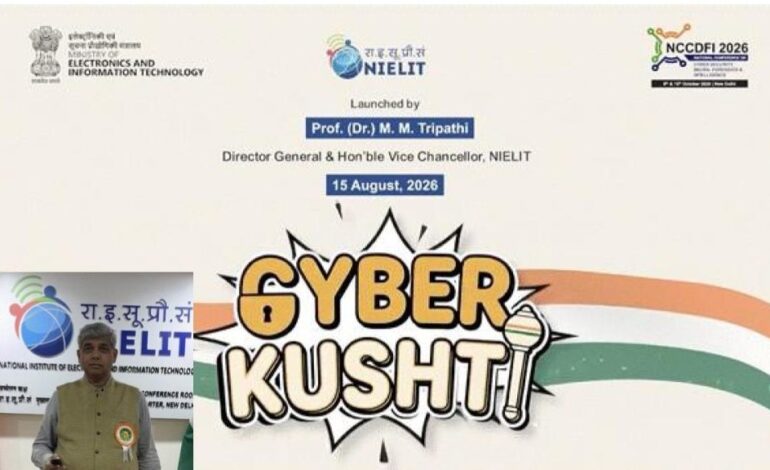
Prof. (Dr) MM Tripathi, Director General, NIELIT and Vice Chancellor, NIELIT Deemed to be University, formally launched the competition on Saturday.

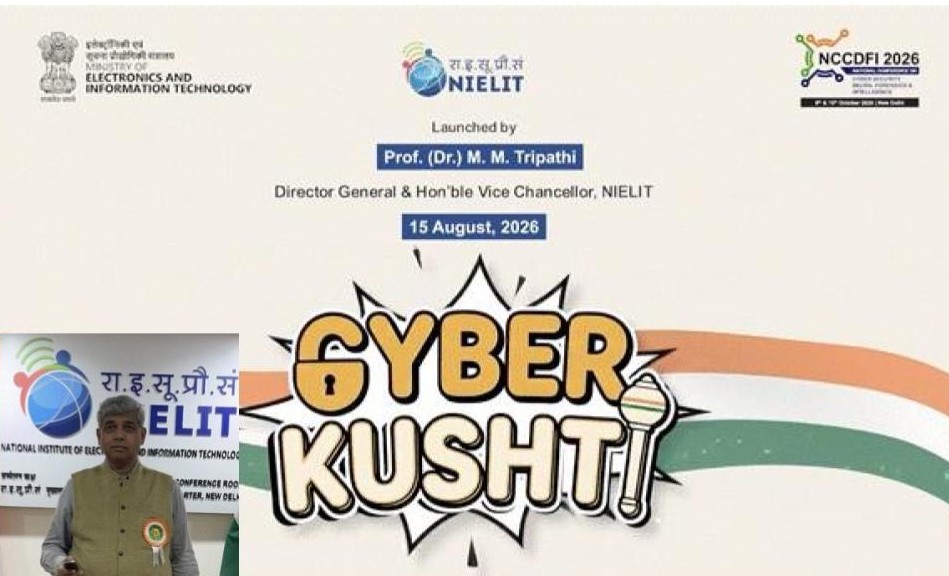
NEW DELHI: The National Institute of Electronics and Information Technology (NIELIT) has launched CYBER KUSHTI 2026, a national cybersecurity and artificial intelligence (AI) hackathon that shifts the focus from simply finding vulnerabilities to judging which security findings are genuine, important and actionable.
The hackathon was launched on August 15 and will serve as the official parallel technical track of the 3rd National Conference on Cyber Security, Digital Forensics and Intelligence (NCCDFI 2026). Prof. (Dr) MM Tripathi, Director General, NIELIT and Vice Chancellor, NIELIT Deemed to be University, formally launched the competition.
The event is being conducted by NIELIT in collaboration with the Information Sharing and Analysis Center (ISAC) Foundation under the National Security Database (NSD), with CERT-In as the Knowledge Partner.
Testing the ability to question machine-generated findings
Unlike conventional cybersecurity competitions that often centre on vulnerability discovery and Capture The Flag (CTF) challenges, CYBER KUSHTI 2026 is designed around a different proposition: Can cybersecurity professionals distinguish between what a machine finds and what actually matters?
Each participating team will receive an identical security assessment package containing deliberately imperfect material, including AI-generated findings, static analysis outputs, dependency and secrets scans, architecture documentation, source code and application logs.
The material will contain a mixture of genuine, false and duplicated findings. Some actual vulnerabilities will also be deliberately omitted.
Teams will therefore have to produce a corrected and prioritised security assessment and defend the reasoning behind their decisions. The scoring will recognise not only the ability to identify genuine vulnerabilities but also the ability to correctly reject false positives.
Prof. (Dr) MM Tripathi said the nature of cybersecurity work has changed as machines increasingly generate security findings at a pace that human teams cannot easily process.
“What they cannot yet do reliably is tell us which findings are real, which matter most, and what must be fixed first.”
According to NIELIT, the hackathon is intended to measure precisely this human judgement.
Equal footing for students and professionals
A key feature of CYBER KUSHTI 2026 is that every team will receive the same tool-generated assessment material simultaneously. This is intended to reduce the advantage that teams with access to expensive commercial security tools might otherwise have.
Participants will also be free to use AI tools of their choice while analysing the assessment package.
The format is consequently designed to place students, independent researchers and corporate teams on broadly equal footing.
“A student from a college in any part of the country can compete on entirely equal terms with a corporate team,” Prof. Tripathi said.
Registration opened on August 15, 2026, and will remain open until September 10. Participation is free and is open to students and independent researchers in teams of three.
Three rounds leading to the Cyber Kesari title
CYBER KUSHTI 2026 will be conducted through three progressively competitive rounds:
- Round 1 – The Akhada: An online round on September 15, from which 50 teams will advance.
- Round 2 – The Dangal: An online round on September 24, from which 10 finalist teams will be selected.
- Final Round – The Kesari: An in-person final on October 9 at the Dr Ambedkar International Centre, New Delhi.
The 10 finalist teams will work under supervision during the final and subsequently present and defend their assessments on the main stage of NCCDFI 2026.
The final will also introduce a direct comparison between machine analysis and human assessment. An automated analysis of the same security assessment material will be displayed alongside the teams’ presentations, allowing delegates to see where automated findings agree with expert judgement and where they diverge.
Cybersecurity awards go beyond the winner
The winning team will receive the title “Cyber Kesari 2026” and the traditional Gada. The runners-up will be recognised with the titles “Rustam” and “Pahalwan”.
The finalists will be evaluated by an eminent jury jointly constituted by NIELIT and ISAC, comprising senior cybersecurity practitioners and experts from government, industry and academia, including National Cyber Security Scholars recognised under the National Security Database.
The organisers are also introducing recognition for reasoning and learning. Round 1 participants will receive a Certificate of Participation and an individual scorecard, while those advancing beyond Round 1 will receive NSD recognition credits.
A special award will recognise the “most instructive incorrect submission”, rewarding an unsuccessful assessment where the reasoning is sufficiently clear and useful to have instructional value.
No testing on live systems
CYBER KUSHTI 2026 will operate entirely within controlled environments provided by the organisers.
Participants will neither be directed towards nor permitted to interact with live systems, third-party infrastructure or public infrastructure at any stage of the competition.
Final round at NCCDFI 2026
The final of CYBER KUSHTI 2026 will form part of the 3rd National Conference on Cyber Security, Digital Forensics and Intelligence, scheduled for October 9–10 at the Dr Ambedkar International Centre in New Delhi.
NCCDFI brings together stakeholders from government, law enforcement, the judiciary, industry, academia and the research community, along with cybersecurity professionals and students.
The hackathon adds a practical competition track to the conference while placing a broader question before the cybersecurity community: as AI and automated security tools become increasingly capable of producing findings, who decides which findings deserve attention?
CYBER KUSHTI 2026 is built around the proposition that the answer still depends on human judgement.